 Quran

Learning to read the Quran by yourself is possible with the right approach, even if you are starting from the basics.
If you are wondering how to learn to read Quran by yourself in Australia, you can begin by learning the Arabic alphabet, understanding Harakat, practicing with Noorani Qaida, and gradually developing your pronunciation and Tajweed.
The key is to learn step by step rather than rushing into full Quranic verses. With consistent daily practice, audio guidance, and regular correction of difficult words, you can steadily build your reading skills and confidence.
1- Start by Learning the Arabic Alphabet
The first step in learning to read the Quran by yourself is becoming familiar with the Arabic alphabet. You do not need to speak Arabic fluently to begin reading the Quran, but you do need to recognize each letter and learn how it is pronounced.
Start by learning the 28 Arabic letters individually, paying close attention to letters that have similar shapes or sounds. For effective self-study, follow this simple routine:
- Learn a small group of letters at a time rather than trying to memorize all of them in one session.
- Say each letter aloud while looking at its written form.
- Practice distinguishing between similar letters.
- Review previously learned letters before introducing new ones.
- Use reliable audio resources to hear the correct pronunciation.
- Don’t move on until you can recognize and pronounce the letters confidently.
Once you are comfortable with the alphabet, you can move to Harakat and basic vowel sounds, which will allow you to combine letters and begin reading Arabic words.
2- Learn Harakat and Basic Vowel Sounds
After learning the Arabic letters, the next step is to understand Harakat, the vowel marks that indicate how each letter should be pronounced. Begin with the three basic short vowels:
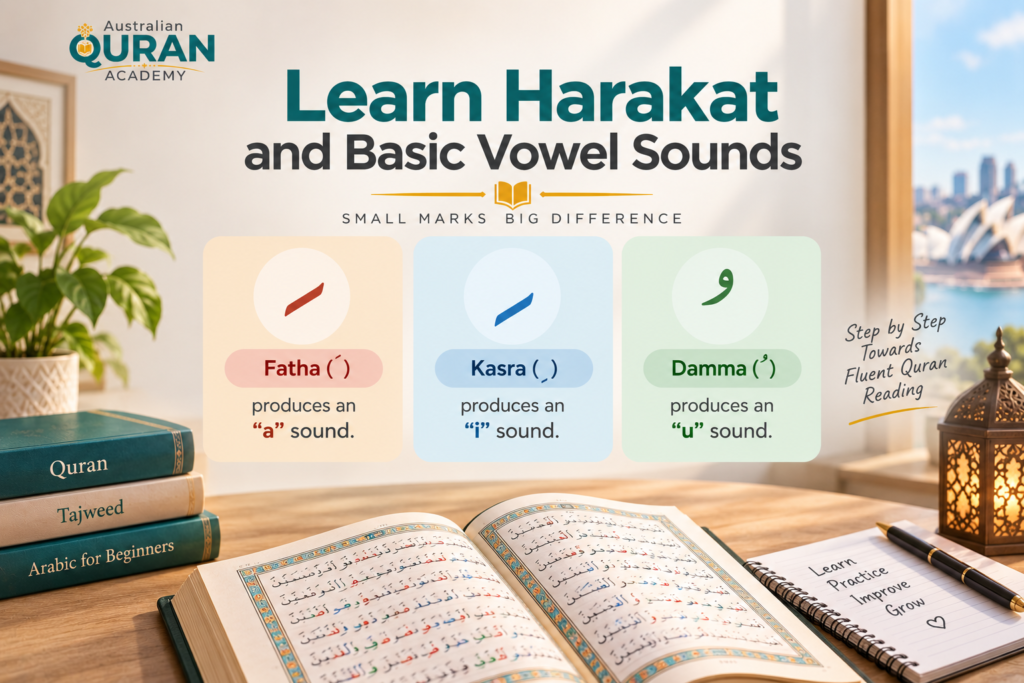
- Fatha (َ) produces an “a” sound.
- Kasra (ِ) produces an “i” sound.
- Damma (ُ) produces an “u” sound.
You should also become familiar with Sukoon (ْ), which indicates that a letter has no short vowel, and Shaddah (ّ), which indicates a doubled or emphasized consonant sound.
Read Also: How To Get Better At Reading Quran In Australia?
3- Use Noorani Qaida or a Structured Beginner Resource
Once you understand Arabic letters and Harakat, Noorani Qaida can help you connect these basics and gradually develop Quran reading skills. It introduces letters, vowel marks, combinations, and words in a progressive order, making it particularly useful for beginners learning to read the Quran independently.
A practical approach is:
- Review the Arabic letters and their sounds.
- Practice letters with Harakat until you can read them naturally.
- Move to connected letters and combinations.
- Practice reading complete words.
- Apply what you have learned to short Quranic verses.
Try to spend a few minutes each day working through your Qaida instead of completing many lessons in one sitting.
Read also: What We Learn From the Quran? – 12 Main Lessons
4- Learn the Basic Rules of Tajweed
After building a foundation with Arabic letters, Harakat, and Noorani Qaida, the next step is to learn the basic rules of Tajweed. Tajweed refers to the principles for pronouncing the letters and words of the Quran correctly during recitation.
Learning Tajweed can help you improve your Quran pronunciation, avoid common reading errors, and develop more accurate Quran recitation.
As you begin learning Tajweed, focus on:
- Correct letter pronunciation: Learn how each Arabic letter should sound and practice letters that are easily confused.
- Makhraj: Understand where different letters are articulated in the mouth and throat.
- Sukoon and Shaddah: Practice how these marks affect the way letters are pronounced.
- Madd: Learn when certain sounds are extended during Quran recitation.
- Clear pronunciation: Avoid dropping, adding, or changing sounds when reading Quranic words.
- Listening and repetition: Compare your recitation with a reliable reciter and repeat difficult words several times.
You do not need to memorize every Tajweed rule before opening the Quran. Start with the rules that directly affect your pronunciation and gradually add more as your reading improves.
5- Listen to Skilled Quran Reciters and Read Along
Listening to skilled Quran reciters can make a significant difference when you are learning how to read the Quran by yourself.
Hearing the correct pronunciation gives you a clear audio model to follow, especially when you are still developing your Arabic pronunciation and Tajweed skills.
Try this simple practice method:
- Listen to one verse carefully without reading aloud.
- Read the same verse yourself, paying attention to each letter and vowel mark.
- Listen again and compare your pronunciation with the reciter.
- Repeat difficult words or phrases several times.
- Move to the next verse once you feel comfortable with the previous one.
You can also slow down the audio when a word or verse feels difficult. This gives you more time to notice individual sounds, pauses, and vowel movements before returning to the normal pace.
Read Also: How To Improve Recitation Of The Quran In Australia?
6- Start with Short Surahs
Once you are comfortable with Arabic letters, Harakat, basic Tajweed, and following audio recitation, begin applying your skills to short Surahs.
Starting with shorter passages makes it easier to concentrate on pronunciation, recognize familiar patterns, and build confidence without feeling overwhelmed.
Use the following approach:
- Read the Surah slowly while identifying each letter and vowel mark.
- Listen to the same verses from a reliable Quran reciter.
- Repeat each verse aloud and compare your pronunciation with the audio.
- Mark difficult words so you can return to them during your next practice session.
- Review the same Surah regularly instead of constantly moving to new material.
- Gradually increase the length of the passages you read as your confidence develops.
Do not worry about how quickly you can finish a Surah. At this stage, the goal is to build accurate Quran reading habits, not simply to complete as many verses as possible.
7- Read the Quran Slowly Before Trying to Increase Your Speed
When you first begin reading the Quran, it is better to focus on accuracy rather than speed. Trying to read quickly before you are comfortable with Arabic letters, Harakat, and basic Tajweed can make it easier to overlook pronunciation mistakes.
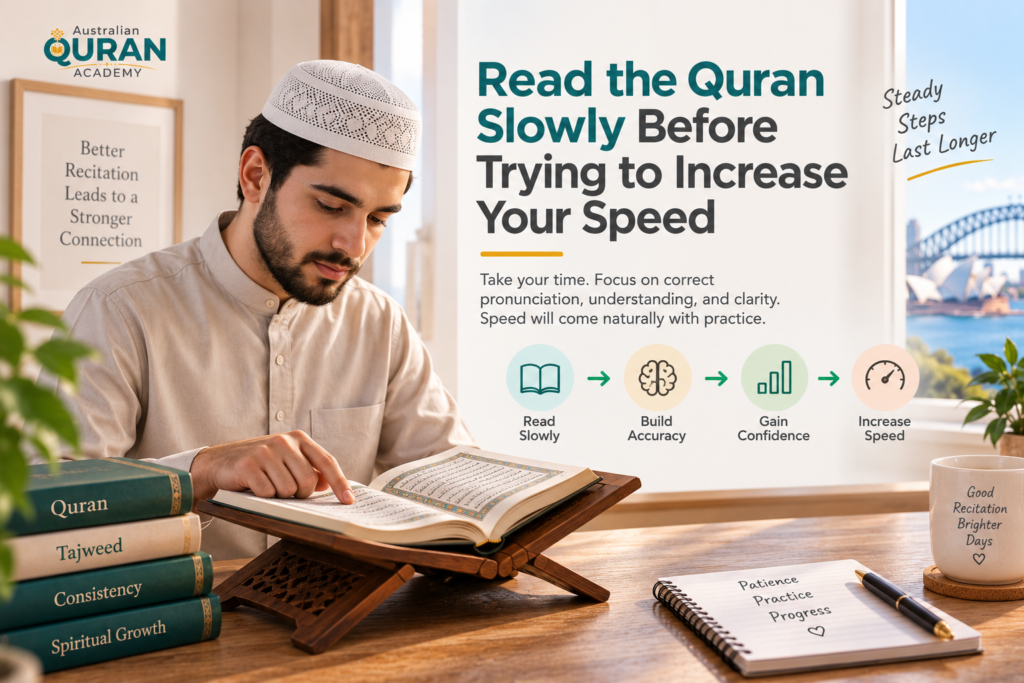
To make slow reading part of your self-study routine:
- Read one word at a time when you encounter a difficult passage.
- Pronounce each letter and vowel clearly before combining them.
- Pause when you are unsure about a word rather than guessing.
- Listen to the verse from a reliable reciter and repeat it.
- Read the same verse several times until it becomes more comfortable.
- Increase your reading speed gradually only after your accuracy improves.
There is no benefit in finishing a large portion of the Quran quickly if you are repeatedly making pronunciation errors. Your early practice should instead help you develop clear and confident Quran reading.
See Us in Action!
Curious about what our online classrooms look like? Watch the short clips below to see how our interactive, one-on-one sessions bring learning to life with real-time feedback and engaging teaching methods.
Start Your Quranic Journey in Australia
Join our leading online academy and learn with expert tutors through a structured, personalized curriculum.
Book Your Free Trial8- Repeat Difficult Verses Instead of Simply Moving Forward
When learning to read the Quran by yourself, it is normal to encounter words or verses that feel more difficult than others.
Instead of moving forward every time you make a mistake, take a moment to repeat difficult verses until you become more comfortable with their pronunciation. When you struggle with a verse, try this process:
- Break the verse into smaller phrases rather than reading the entire verse at once.
- Identify the letters, Harakat, and pronunciation points that are causing difficulty.
- Listen to the same phrase from a reliable Quran reciter.
- Repeat the phrase slowly several times.
- Read the complete verse again once the difficult section becomes easier.
- Return to the verse during your next practice session to make sure the improvement lasts.
You can keep a small list of words or verses that repeatedly cause problems. Reviewing this list regularly can help you focus your practice instead of spending equal time on material you already read comfortably.
Read also: Can You Learn the Quran During Periods? A Complete Guide for Muslim Students
9- Practice Reading Quran Every Day
You do not need to spend hours reading every day. A short, focused practice session can be more effective than studying for a long time once or twice a week.
Try to set a regular time for Quran reading practice that fits naturally into your daily routine. Even 10-20 minutes a day can give you regular exposure to Arabic letters, Harakat, Quranic vocabulary, and Tajweed.
A simple daily routine could include:
- 5 minutes: Review Arabic letters, Harakat, or a Tajweed rule.
- 5 minutes: Listen to and repeat difficult words or verses.
- 10 minutes: Read a short Surah or Quranic passage aloud.
- A few minutes: Review mistakes from previous sessions.
Keep track of the words, verses, or pronunciation points that you find difficult.
Read Also: How To Make Reading Quran More Interesting In Australia?
Common Mistakes When Learning Quran by Yourself
Learning to read the Quran independently can be effective, but beginners may develop habits that make progress more difficult.
Recognizing these mistakes early can help you build a stronger foundation and improve your Quran reading more consistently.
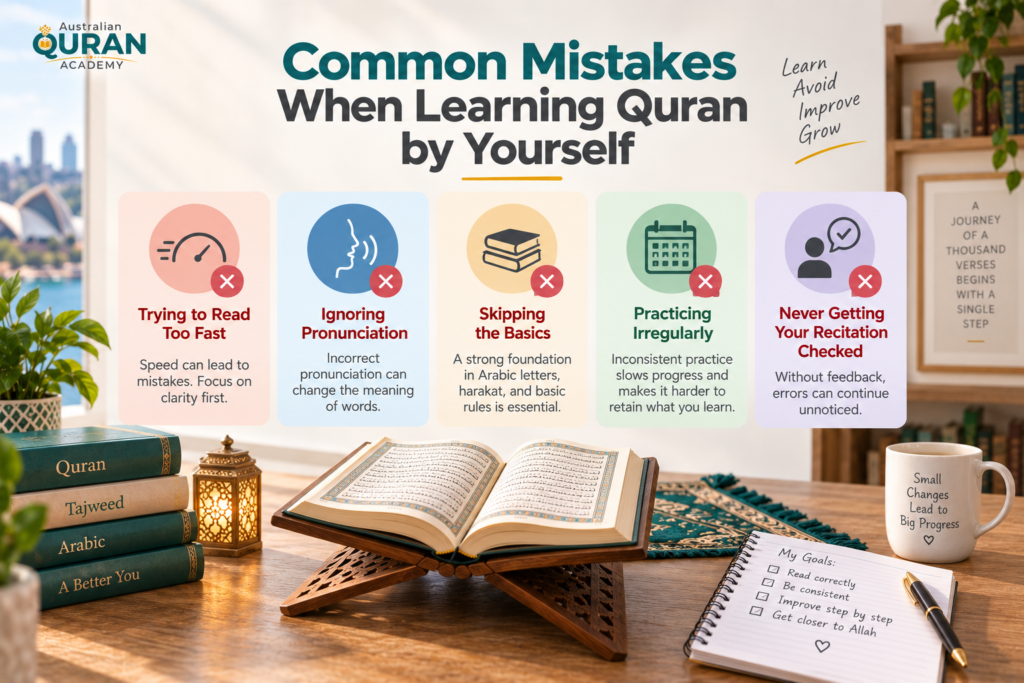
a. Trying to Read Too Fast
Speed should not be the main goal when you are still learning Arabic pronunciation and Tajweed.
Reading too quickly can cause you to skip vowel marks, mispronounce letters, or overlook mistakes. Focus on accuracy first and allow your reading speed to develop naturally.
b. Ignoring Pronunciation
Recognizing Arabic letters is only one part of learning Quran reading. Some letters have sounds that may be unfamiliar to English speakers.
Pay attention to Makhraj and practice difficult sounds carefully rather than assuming your pronunciation is correct.
c. Skipping the Basics
Moving directly to full Surahs without becoming comfortable with the Arabic alphabet, Harakat, and basic word combinations can create unnecessary difficulties. Build your skills progressively before moving to more advanced material.
d. Practicing Irregularly
Studying for a long session once a week is usually less useful than practicing consistently.
A short daily session can help reinforce what you have already learned and keep Quran reading familiar.
e. Never Getting Your Recitation Checked
Self-study can help you develop many reading skills, but some pronunciation mistakes are difficult to recognize on your own. Having a qualified Quran teacher listen to your recitation from time to time can help identify errors and show you how to correct them.
The key is to learn gradually, practice consistently, prioritize accurate pronunciation, and seek guidance when you reach areas that are difficult to correct independently.
Read Also: Free Online Quran Classes for Beginners in Australia
How Long Does It Take to Learn to Read the Quran by Yourself?
The time needed to learn to read the Quran by yourself varies from person to person.
There is no fixed number of days or weeks because progress depends on your starting level, how regularly you practice, and how quickly you become comfortable with Arabic letters, Harakat, pronunciation, and basic Tajweed.
Your progress may depend on factors such as:
- Your familiarity with the Arabic alphabet.
- Whether you have studied Arabic before.
- How many days per week you practice.
- The amount of time you dedicate to each session.
- Whether you receive feedback on your pronunciation.
- How consistently you review difficult letters, words, and verses.
Instead of setting a goal such as “I want to learn Quran reading in 30 days,” focus on measurable improvements.
For example, aim to recognize all Arabic letters, read basic Harakat confidently, complete Noorani Qaida lessons, or read a short Surah with fewer pronunciation mistakes.
Read Also: How To Learn To Read Quran Word By Word In Australia?
Can You Learn Quran Reading Online in Australia?
Yes, you can learn Quran reading online in Australia, whether you are a complete beginner or already have some experience with Arabic letters and Quranic reading. Online Quran reading lessons may include:
- Arabic alphabet and Harakat for complete beginners.
- Noorani Qaida to develop foundational reading skills.
- Quran reading practice using short Surahs and selected passages.
- Tajweed lessons to improve pronunciation and recitation.
- Makhraj practice for difficult Arabic letters and sounds.
- One-to-one guidance based on your individual learning needs.
Inside Our Virtual Classrooms
We believe in full transparency and proven quality. Take a look at these actual snippets from our live classes to experience our modern learning platform, patient instructors, and interactive student participation.
Start Your Quranic Journey in Australia
Join our leading online academy and learn with expert tutors through a structured, personalized curriculum.
Book Your Free TrialLearn Quran Reading With Australian Quran Academy
If you have started learning Quran reading by yourself but feel that you need help with pronunciation, Tajweed, or maintaining a consistent learning routine, structured online lessons can provide the guidance you need.
Australian Quran Academy offers online Quran learning designed to support students at different stages, from beginners learning the Arabic alphabet to learners who want to improve their Quran reading and Tajweed.
Personalized Quran Reading Lessons
Instead of following the same approach for every learner, lessons can focus on your current reading level and the areas where you need the most improvement. This can be particularly useful if you struggle with specific Arabic letters, words, or pronunciation points.
Learning Quran reading takes time, and students do not always progress at the same speed.
A flexible learning approach allows you to review difficult material, repeat lessons when necessary, and gradually move toward more confident Quran reading.
Flexible Online Learning in Australia
For students living in different parts of Australia, online Quran classes provide a convenient way to learn without needing to travel to a physical learning center.
Lessons can fit more easily around school, work, family commitments, and daily routines.
If you have been searching for how to learn to read Quran by yourself in Australia, you can begin with self-study and daily practice.
For those beginning from zero, the Learn Quran for Beginners in Australia program at Australian Quran Academy provides a structured, interactive entry point, with no prior knowledge required.
Our Quran Courses
- Quran Online Academy
- Quran Recitation Classes
- Quran Reading Classes
- Online Quran Classes for Kids
- Quran Classes for Adults
- Quran Classes for Female/Sisters
- Learn Quran Course for Beginners
- Quran Memorization (Hifz) Course
- Hifz Classes for Adults
- Quran Memorization and Hifz Course for Kids
- Quran Hifz Course for Ladies
- Quran Ijazah Program
- Quran Qirat Learning Course
- Quran Tafsir Course
- Noorani Qaida Course
- Noorani Qaida Course for Kids
- Weekend Quran Classes
- Intensive Quran Course
- Al-Azhar Quran Course
- Online Tajweed Classes
- Tajweed Course for Kids
- Tajweed Course for Adults
- Tajweed Course for Ladies

Conclusion
Learning how to learn to read Quran by yourself in Australia is possible when you follow a clear, gradual approach. You don’t have to learn alone.
Australian Quran Academy provides flexible online Quran lessons to help beginners and learners improve their Quran reading, pronunciation, and Tajweed with personalized guidance.
Enroll today and take the first step toward reading the Quran with greater confidence and accuracy. Join Australian Quran Academy and start your personalized Quran learning journey from the comfort of your home.
FAQs
How can I learn Quran reading at home?
Start by learning the Arabic alphabet and Harakat, then use Noorani Qaida to practice combining letters and reading words. Listen to skilled Quran reciters, read along, repeat difficult verses, and practice for a short period every day.
Can I learn Tajweed by myself?
You can learn basic Tajweed concepts through books, courses, and audio resources. However, applying Tajweed correctly requires accurate pronunciation, and some mistakes are difficult to detect without feedback.
What is the best way to start learning Quran reading?
Begin with the Arabic alphabet, learn Harakat, and practice with Noorani Qaida. Once you are comfortable with the basics, introduce Tajweed and start reading short Surahs.
Can I learn Quran online in Australia?
Yes. Online Quran classes are available for students in Australia and can provide structured lessons, live guidance, pronunciation correction, and Tajweed practice.
Is Noorani Qaida suitable for beginners?
Yes. Noorani Qaida is commonly used as a structured starting resource for beginners because it introduces Arabic letters, vowel marks, combinations, and reading patterns progressively.
Should I learn Arabic before learning to read the Quran?
You do not need to become fluent in Arabic before learning to read the Quran. You can begin by learning the Arabic alphabet, pronunciation, and Harakat specifically for Quran reading.




Leave a Reply