 Quran

Improving your Quran reading takes consistent practice, correct pronunciation, and a gradual understanding of Tajweed.
If you are wondering how to get better at reading Quran in Australia, the key is to build a strong foundation, practice regularly, listen to accurate recitation, and receive guidance from a qualified Quran teacher.
With the right approach and a manageable routine, you can steadily improve your fluency, pronunciation, and confidence in reading the Quran.
1- Start by Mastering Arabic Letters and Pronunciation
Before focusing on reading speed or advanced Tajweed, make sure you can recognize the Arabic letters and pronounce them correctly. T
he Quran contains sounds that may be unfamiliar to English speakers, so learning each letter accurately is an essential first step.
Start with the 28 Arabic letters, paying attention to how and where each sound is produced. A structured resource such as the Noorani Qaida can help beginners build this foundation gradually.
Do not worry about reading quickly at this stage. Instead, practise connecting letters, recognizing vowel marks, and reading simple combinations until they become familiar.
Correct pronunciation is more important than speed because small changes in Arabic sounds can affect how a Quranic word is read.
If you are unsure about a particular letter or sound, practising with a qualified Quran teacher is especially helpful. A teacher can identify pronunciation mistakes early and show you how to correct them before they become habits.
Read Also: How To Learn To Read Quran By Yourself In Australia?
2- Improve Your Makhraj Before Trying to Read Faster
Makhraj refers to the correct point of articulation from which an Arabic letter is produced. Improving your Makhraj can make your Quran reading clearer and help you distinguish between letters that may sound similar to non-Arabic speakers.
Instead of trying to increase your reading speed, practise difficult letters slowly and focus on producing each sound correctly. Pay particular attention to letters that require unfamiliar movements of the tongue, throat, or lips, such as ع, ح, خ, ص, ض, ط, ظ, and ق.
A useful practice method is to:
- Listen carefully to a qualified Quran reciter.
- Repeat individual letters and short words slowly.
- Compare similar sounds and notice how their articulation differs.
- Ask a Quran teacher to correct your pronunciation.
- Apply the correct pronunciation while reading short Quranic verses.
Developing accurate Makhraj takes repetition, so avoid becoming frustrated if some sounds feel difficult at first. Accuracy should come before speed; once your pronunciation becomes more consistent, your reading fluency can improve naturally.
For those beginning from zero, the Learn Quran for Beginners in Australia program at Australian Quran Academy provides a structured, interactive entry point – no prior knowledge required.
3- Learn Tajweed Gradually, Not All at Once
You do not need to learn every Tajweed rule before you can start improving your Quran reading. A better approach is to learn the essential rules step by step and practise each one until it becomes part of your natural recitation.
Begin with the rules that have the greatest impact on everyday reading, such as Madd (elongation), Qalqalah, Noon Sakinah and Tanween, Meem Sakinah, and rules of stopping and starting.
Once you understand a rule, practise it directly while reading Quranic verses rather than studying it only in theory.
A simple learning routine can help:
- Learn one Tajweed rule at a time.
- Listen to examples from a skilled Quran reciter.
- Repeat the examples slowly.
- Find the same rule in the verses you are reading.
- Ask a qualified teacher to correct your application.
- Move to the next rule once you are comfortable with the previous one.
The goal is not to memorize a long list of rules. It is to apply Tajweed correctly while reading the Quran. With consistent practice, these rules gradually become easier to recognize and use.
4- Read the Quran Slowly Before Trying to Increase Your Speed
When improving your Quran reading, accuracy should come before speed. Reading too quickly can make it easier to miss letters, vowel marks, or Tajweed rules, especially while you are still developing your pronunciation.
Start by reading each verse at a comfortable pace. Give yourself enough time to recognize the words, pronounce the letters clearly, and apply the Tajweed rules you have learned. If you make a mistake, stop and repeat the word or phrase correctly before continuing.
Try reading the same passage several times rather than rushing through a new page every day. This helps you become familiar with the words and sentence patterns while reinforcing correct pronunciation.
Remember, the goal is not simply to finish more pages. The goal is to read the Quran correctly, clearly, and with confidence.
Read Also: How To Improve Recitation Of The Quran In Australia?
5- Listen to Skilled Quran Reciters and Read Along
Listening to skilled Quran reciters can help you improve your pronunciation, rhythm, fluency, and Tajweed. Instead of listening passively, make the Quran text part of the exercise by reading along as the reciter reads.
Choose a clear, measured recitation and follow the same verses in your Mushaf. Pay attention to how the reciter pronounces individual letters, stretches certain sounds, applies Tajweed rules, and pauses between verses.
For effective practice:
- Choose a short passage rather than listening to an entire Surah at once.
- Listen to one verse carefully.
- Read the same verse while following the reciter.
- Repeat it independently at a slow pace.
- Go back to difficult words and practise them several times.
- Gradually move to longer passages as your reading becomes smoother.
This listen-and-repeat method is particularly useful when you are learning independently. However, listening alone cannot identify every mistake in your own recitation, so combining it with regular feedback from a qualified Quran teacher can make your progress more effective.
See Us in Action!
Curious about what our online classrooms look like? Watch the short clips below to see how our interactive, one-on-one sessions bring learning to life with real-time feedback and engaging teaching methods.
Start Your Quranic Journey in Australia
Join our leading online academy and learn with expert tutors through a structured, personalized curriculum.
Book Your Free Trial6- Practice Reading Quran Every Day
Consistent practice is one of the most effective ways to improve Quran reading. You do not need to spend hours reading every day; a short, focused session can be more beneficial than occasional long sessions.
Set aside a regular time that fits your daily routine. Even 10-15 minutes a day can allow you to practise pronunciation, review Tajweed, and build reading fluency.
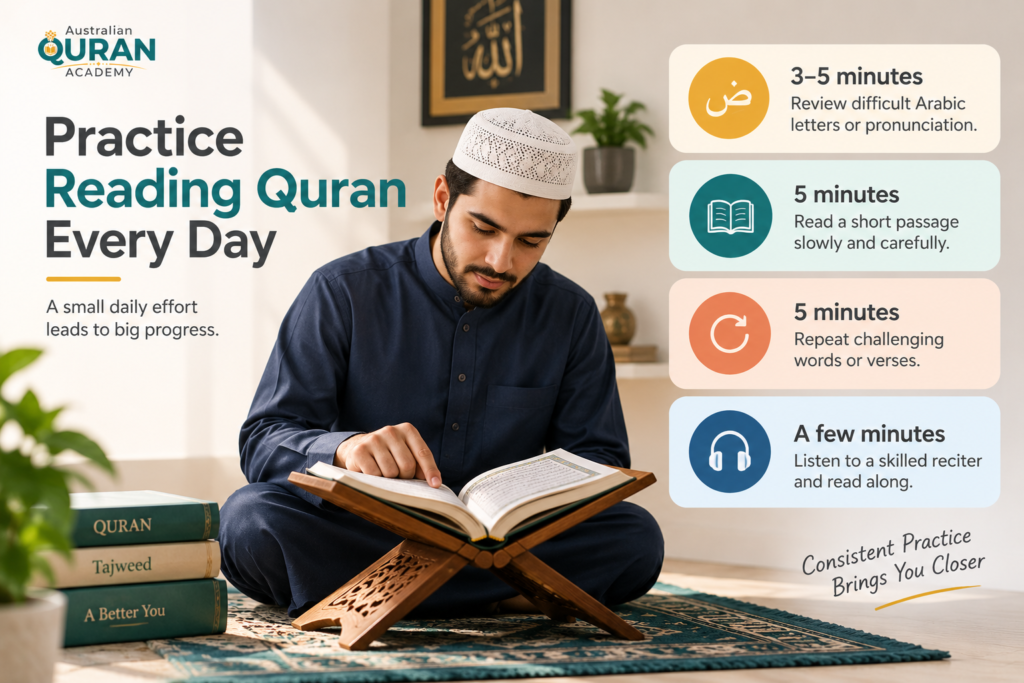
A simple daily routine could include:
- 3-5 minutes: Review difficult Arabic letters or pronunciation.
- 5 minutes: Read a short passage slowly and carefully.
- 5 minutes: Repeat challenging words or verses.
- A few minutes: Listen to a skilled reciter and read along.
Try to maintain the same routine throughout the week. As your confidence improves, you can gradually increase the amount of Quran you read.
The key is consistency, not quantity. Regular Quran reading practice helps you build stronger habits and makes accurate recitation feel more natural over time.
7- Repeat Difficult Verses Instead of Simply Moving Forward
When you come across a word or verse that feels difficult to read, do not simply move on.
Repeating challenging passages is an important part of improving Quran reading, because it gives you more opportunities to correct pronunciation and strengthen fluency.
Read the difficult phrase slowly several times. First, focus on individual words and their pronunciation. Then connect the words and read the complete phrase without stopping. Once you can read it accurately, repeat the verse at a natural pace.
You can also use a simple repetition cycle:
- Listen to the verse from a skilled reciter.
- Read it slowly while looking at the Mushaf.
- Repeat the difficult words several times.
- Read the complete verse independently.
- Return to it later to check whether the improvement remains.
Do not measure your progress by how many times you make a mistake. Instead, pay attention to whether the same mistake becomes less frequent. Focused repetition helps turn difficult Quranic words and patterns into familiar reading skills.
Read Also: How To Make Reading Quran More Interesting In Australia?
8- Record Yourself Reading the Quran
Recording your own recitation can be a useful way to improve Quran reading, especially when you are practising between lessons.
Hearing your voice afterward allows you to notice unclear pronunciation, uneven pacing, or places where you hesitate.
Choose a short passage and record yourself reading it at a comfortable pace. Then listen to the recording while following the same verses in the Mushaf.
Compare your recitation with a reliable recording from a skilled reciter and note any areas that need more practice.
Focus on a few things:
- Are you pronouncing the Arabic letters clearly?
- Are you observing the Tajweed rules you have learned?
- Are you rushing through certain words or verses?
- Where do you hesitate or lose fluency?
- Which words do you consistently find difficult?
You do not need to correct everything at once. Pick one or two areas, practise them, and record yourself again later. Over time, these recordings can help you recognize your progress and identify areas where teacher feedback would be most valuable.
9- Get Feedback From a Qualified Quran Teacher
Self-practice is valuable, but learning with a qualified Quran teacher can help you identify mistakes that you may not notice yourself. This is particularly important for Makhraj, pronunciation, and applying Tajweed correctly while reading.
A teacher can listen to your recitation, point out specific errors, explain how to correct them, and track your progress over time. Instead of trying to fix several problems at once, you can work on the areas that need the most attention.
When choosing a Quran teacher in Australia, look for someone who can provide:
- Regular one-to-one or small-group feedback.
- Clear instruction in Quran reading and Tajweed.
- Lessons suited to your current reading level.
- Opportunities to practise recitation during each lesson.
- Constructive correction and ongoing progress guidance.
For learners who cannot attend a local class conveniently, online Quran classes in Australia can provide a flexible alternative. The important thing is to have consistent interaction with a teacher rather than relying entirely on self-study.
Combining teacher guidance with daily practice, listening, and repetition can make your Quran reading journey more structured and effective.
A Simple 30-Day Quran Reading Improvement Plan
A structured routine can make it easier to turn Quran reading practice into a lasting habit.
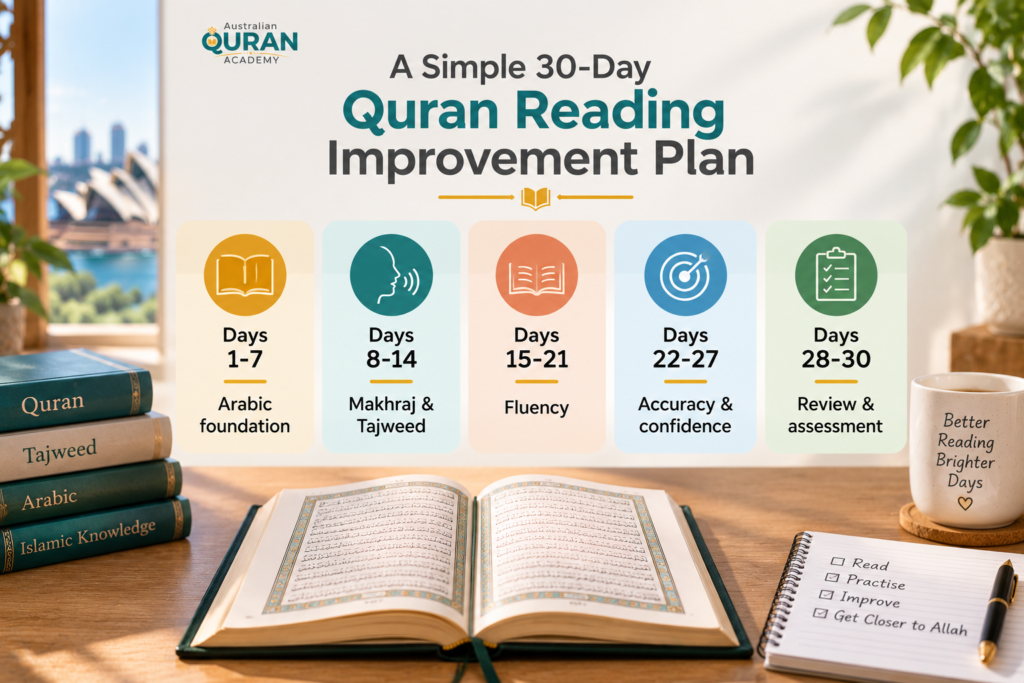
The following 30-day Quran reading plan gradually develops pronunciation, Tajweed, fluency, and confidence without requiring long daily sessions.
| Days | Main Focus | What to Practise |
| 1-7 | Arabic foundation | Review Arabic letters, vowel marks, and difficult sounds. Read slowly and focus on accurate pronunciation. |
| 8-14 | Makhraj & Tajweed | Practise articulation points and introduce basic Tajweed rules. Apply each rule while reading short verses. |
| 15-21 | Fluency | Read the same passages repeatedly, listen to a skilled reciter, and practise reading along without rushing. |
| 22-27 | Accuracy & confidence | Record your recitation, identify recurring mistakes, and repeat difficult words or verses until they become easier. |
| 28-30 | Review & assessment | Read a familiar passage independently, compare your progress with your earlier recordings, and identify areas for continued improvement. |
Try to dedicate 10-20 minutes each day to focused practice. If you are taking lessons with a Quran teacher, use part of your practice time to work specifically on the mistakes identified during your lessons.
Read Also: How To Learn To Read Quran Word By Word In Australia?
Inside Our Virtual Classrooms
We believe in full transparency and proven quality. Take a look at these actual snippets from our live classes to experience our modern learning platform, patient instructors, and interactive student participation.
Start Your Quranic Journey in Australia
Join our leading online academy and learn with expert tutors through a structured, personalized curriculum.
Book Your Free TrialLearn Quran Reading Online With Australian Quran Academy
If you are looking for a structured way to improve your Quran reading in Australia, Australian Quran Academy provides online Quran learning designed to help students develop their reading and recitation skills from home.
With a consistent online learning routine, students can work on:
- Reading Arabic letters and Quranic words correctly.
- Improving pronunciation and Makhraj.
- Learning and applying Tajweed gradually.
- Reading Quranic verses with greater fluency.
- Correcting recurring mistakes through teacher feedback.
- Building a regular Quran reading habit.
For students and families across Australia, online learning can also remove the need to travel to a local class, making it easier to maintain a consistent schedule.
Our Quran Courses
- Quran Online Academy
- Quran Recitation Classes
- Quran Reading Classes
- Online Quran Classes for Kids
- Quran Classes for Adults
- Quran Classes for Female/Sisters
- Learn Quran Course for Beginners
- Quran Memorization (Hifz) Course
- Hifz Classes for Adults
- Quran Memorization and Hifz Course for Kids
- Quran Hifz Course for Ladies
- Quran Ijazah Program
- Quran Qirat Learning Course
- Quran Tafsir Course
- Noorani Qaida Course
- Noorani Qaida Course for Kids
- Weekend Quran Classes
- Intensive Quran Course
- Al-Azhar Quran Course
- Online Tajweed Classes
- Tajweed Course for Kids
- Tajweed Course for Adults
- Tajweed Course for Ladies

Conclusion
Australian Quran Academy offers live, one-on-one online Quran lessons with qualified teachers, allowing students across Australia to learn from home and build a structured Hifz routine around school, work, and family commitments.
Take the first step today and make improving your Quran reading a consistent part of your routine.
If your goal is to get better at reading Quran in Australia, combining regular practice at home with structured guidance from a qualified teacher can give your learning a clear and sustainable direction.
Start your Hifz journey with expert guidance – book your free trial lesson today.
FAQs
Can I improve my Quran reading without a teacher?
Yes, self-study can help you practise letters, listening, repetition, and reading fluency. However, a qualified teacher can identify pronunciation and Tajweed mistakes that may be difficult to recognize on your own.
Is online Quran learning effective in Australia?
Yes. Online Quran classes can provide structured lessons and direct teacher feedback without requiring students to travel. They can be particularly convenient for learners who need flexible lesson times.
Should I learn Tajweed before reading the Quran?
You can begin reading while learning Tajweed gradually. Start with basic pronunciation and essential Tajweed rules, then apply each rule during your regular Quran reading practice.
How can I improve my Quran pronunciation?
Focus on the correct Makhraj of each Arabic letter, listen to accurate Quran recitation, repeat difficult sounds, and ask a qualified teacher to correct your pronunciation. Avoid focusing on speed until your pronunciation becomes more consistent.
What should I do if I keep making the same reading mistake?
Identify the specific word, letter, or Tajweed rule causing the problem and practise it separately. Listen to a correct recitation, repeat the difficult section several times, and ask your teacher for targeted feedback.







Leave a Reply