 Quran
Quran
The first female Hafiz of the Quran was Hafsa bint Umar ibn al-Khattab (RA) — a wife of the Prophet ﷺ, daughter of the second Caliph, and the woman entrusted with the very Mushaf that underpins every copy of the Quran read today. Her story is not just inspiring; it is foundational to the preservation of the Quran itself.
Across the Muslim world — from Australia and Indonesia to Egypt and the United States — millions of women and girls carry the Quran in their hearts, continuing a tradition the female Companions established fourteen centuries ago. Whether you are asking who began this legacy, which Companions built it, or how a girl can become a Hafiza today, this guide covers all of it.
Who Is the First Female Hafiz of the Quran?
The first female Hafiz of the Quran is Hafsa bint Umar ibn al-Khattab (RA). She memorized the entire Quran during the lifetime of the Prophet ﷺ and was chosen — above all other Companions, male or female — to be the custodian of the first official compiled Mushaf.
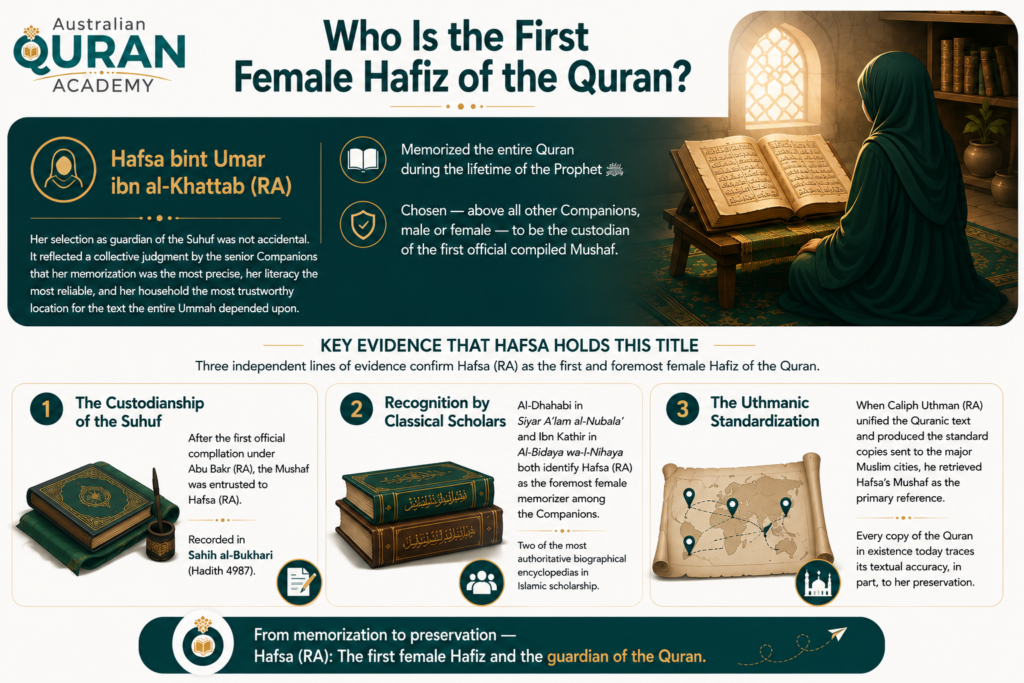
Her selection as guardian of the Suhuf was not accidental. It reflected a collective judgment by the senior Companions that her memorization was the most precise, her literacy the most reliable, and her household the most trustworthy location for the text the entire Ummah depended upon.
Key Evidence That Hafsa Holds This Title
Three independent lines of evidence confirm Hafsa (RA) as the first and foremost female Hafiz of the Quran.
The custodianship of the Suhuf: After the first official compilation under Abu Bakr (RA), the Mushaf was entrusted to Hafsa (RA). This is recorded in Sahih al-Bukhari (Hadith 4987). No other woman — and few men — were granted this responsibility.
Recognition by classical scholars: Al-Dhahabi in Siyar A’lam al-Nubala’ and Ibn Kathir in Al-Bidaya wa-l-Nihaya both identify Hafsa (RA) as the foremost female memorizer among the Companions. These are two of the most authoritative biographical encyclopedias in Islamic scholarship — not peripheral sources.
The Uthmanic standardization: When Caliph Uthman (RA) unified the Quranic text and produced the standard copies sent to the major Muslim cities, he retrieved Hafsa’s Mushaf as the primary reference. Every copy of the Quran in existence today traces its textual accuracy, in part, to her preservation.
If you want to deepen your understanding alongside your memorization, the Academy’s Quran Hifz for Ladies builds the language comprehension that makes memorized verses meaningful — not just sounds, but understood words.

Which Female Companions Memorized the Quran?
The female Companions who memorized the Quran were not exceptions — they were a recognized category of scholars within the early Muslim community. Classical Islamic biographical literature documents four female Companions who memorized the Quran fully during the era of the Prophet ﷺ.
Each was a distinct religious authority: a transmitter of Sunnah, a teacher, and in at least one case, a prayer leader appointed directly by the Prophet ﷺ himself.
Hafsa bint Umar (RA)
Hafsa (RA) was the daughter of Umar ibn al-Khattab (RA) and a wife of the Prophet ﷺ. She combined literacy with oral memorization — a combination that made her the most qualified individual to guard the Mushaf. Her home served as the repository of the Quran’s written form across three caliphates.
Aisha bint Abi Bakr (RA)
Aisha (RA) memorized the entire Quran and reviewed it annually with the Prophet ﷺ through the same Mura’ada (mutual review) practice that Jibreel (AS) conducted with him. She is the primary transmitter of roughly a third of all Islamic jurisprudence and corrected the recitation of senior male Companions after the Prophet’s death. Her scholarly authority as a female Hafiz of the Quran was recognized across all four major madhabs.
Umm Salama (RA)
Umm Salama (RA) was a wife of the Prophet ﷺ known for the precision of her recitation and narration. She transmitted detailed accounts of how the Prophet ﷺ recited — including his practice of pausing at the end of each verse — making her an important source for both memorization and Tajweed methodology in the classical tradition.
Umm Waraqah bint Abdullah (RA)
Umm Waraqah (RA) holds a uniquely significant place in this history. She had memorized the entire Quran and collected written Quranic materials in her home. The Prophet ﷺ visited her personally — a mark of reverence — and designated her as the prayer leader for the members of her household. This was a direct, prophetic recognition that a woman’s Hifz qualifies her for religious leadership within her sphere. He also called her “the martyr,” and classical hadith collections record this appointment as authentic.
Can a Girl Be a Hafiz of the Quran?
Yes — a girl can memorize the entire Quran and is called a Hafiza (حافظة), the Arabic feminine form of the title. There is no Islamic prohibition, no scholarly disagreement, and no jurisprudential barrier to a girl or woman completing Hifz at any age.
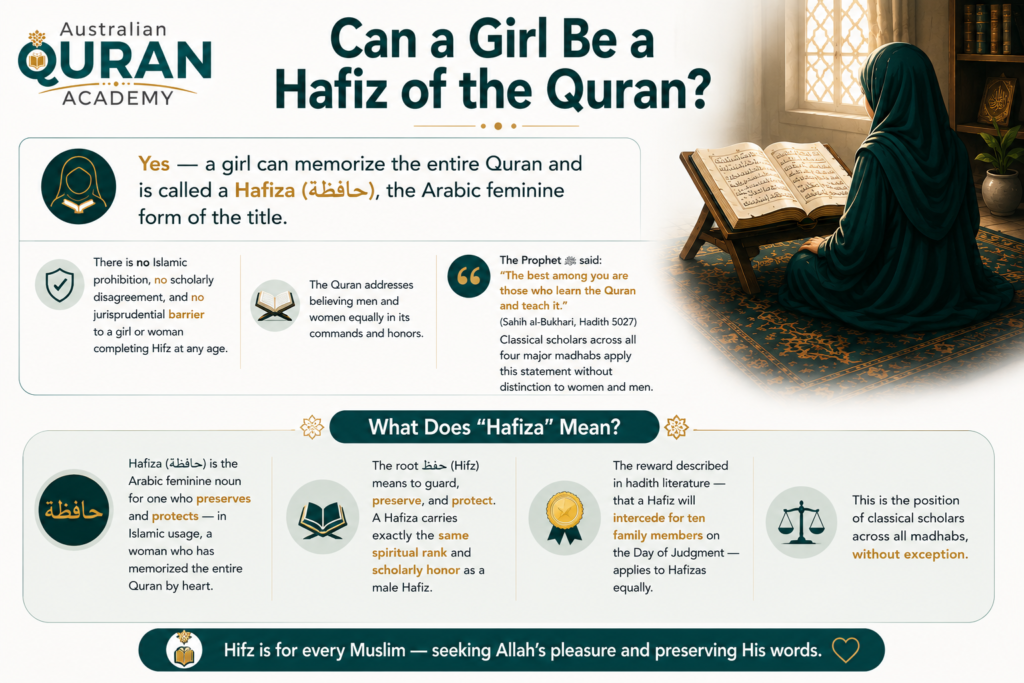
The Quran addresses believing men and women equally in its commands and honors. The Prophet ﷺ said: “The best among you are those who learn the Quran and teach it” (Sahih al-Bukhari, Hadith 5027). Classical scholars across all four major madhabs apply this statement without distinction to women and men.
What Does “Hafiza” Mean?
Hafiza (حافظة) is the Arabic feminine noun for one who preserves and protects — in Islamic usage, a woman who has memorized the entire Quran by heart. The root حفظ (Hifz) means to guard, preserve, and protect.
A Hafiza carries exactly the same spiritual rank and scholarly honor as a male Hafiz. The reward described in hadith literature — that a Hafiz will intercede for ten family members on the Day of Judgment — applies to Hafizas equally. This is the position of classical scholars across all madhabs, without exception.
Read also: How to Stay Motivated During Hifz?
How Can a Girl Become a Hafiza?
Becoming a Hafiza requires four pillars working together: correct Tajweed, a structured memorization system, consistent revision, and qualified guidance. The most common reason girls plateau or abandon Hifz is not a lack of ability — it is missing one or more of these four elements.
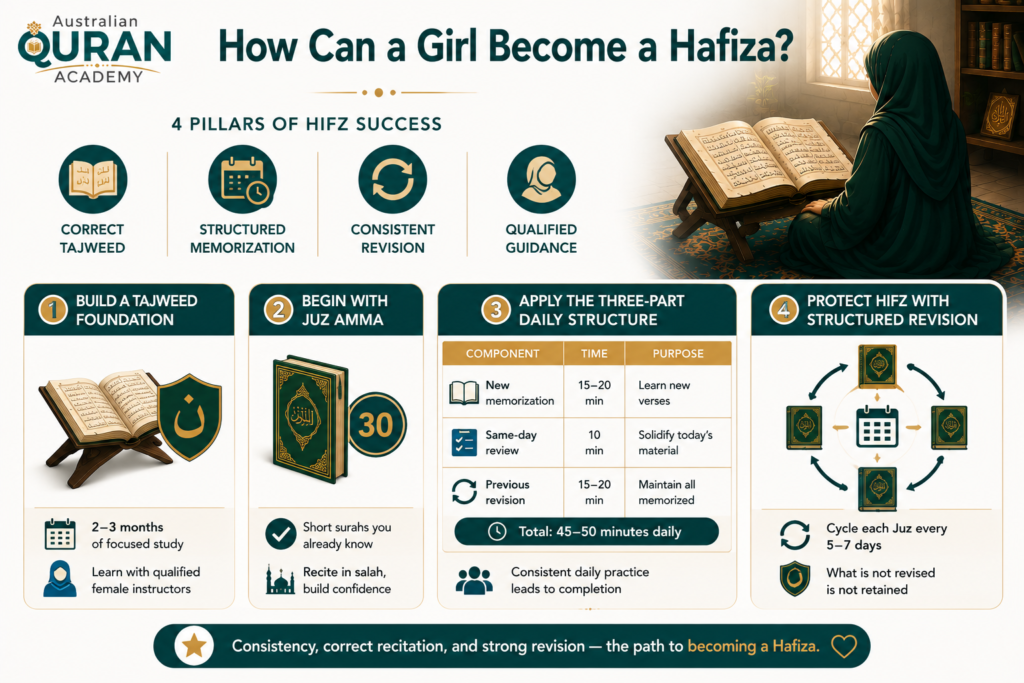
The following framework draws on established practices among experienced Hifz instructors and applies to girls beginning at any age.
Step 1: Build a Tajweed Foundation Before Memorizing
The most common mistake girls make when starting Hifz is memorizing before their recitation is correct. When you memorize with pronunciation errors, you memorize the errors — and correcting entrenched mispronunciations after hundreds of repetitions is far harder than learning accurately from the start.
A minimum of two to three months of focused Tajweed study before beginning Hifz is the standard recommendation among qualified Hifz teachers. For women in Australia, the dedicated Tajweed classes for ladies at Australian Quran Academy build phonetic accuracy through one-on-one sessions with qualified female instructors — the right foundation before the first memorization session begins.
Step 2: Begin with Juz Amma and Build Confidence
Juz 30 contains the short surahs most commonly recited in daily prayer. Starting here serves two purposes: a girl memorizes what she already partially knows, and she hears her memorized surahs immediately in salah — the strongest reinforcement loop available. Early wins build the confidence needed for the longer, more demanding surahs ahead.
This is not the only valid starting point — some structured programs begin from Surah Al-Baqarah — but for most beginners, Juz 30 is the most confidence-building and practically useful entry point.
Step 3: Apply the Three-Part Daily Session Structure
Every effective daily Hifz session must contain three distinct components. Skipping any one of them is the primary structural reason students lose previously memorized material.
| Session Component | Time | Purpose |
| New memorization | 15–20 minutes | Learning new verses with full accuracy |
| Same-day review | 10 minutes | Solidifying today’s material before it fades |
| Previous revision | 15–20 minutes | Maintaining all previously memorized portions |
This three-part structure, applied consistently over 45–50 minutes daily, is what separates students who complete Hifz from those who plateau. The total daily commitment is under one hour — manageable for school-age girls, working women, and mothers in Australia and everywhere else.
See Us in Action!
Curious about what our online classrooms look like? Watch the short clips below to see how our interactive, one-on-one sessions bring learning to life with real-time feedback and engaging teaching methods.
Start Your Quranic Journey in Australia
Join our leading online academy and learn with expert tutors through a structured, personalized curriculum.
Book Your Free TrialStep 4: Protect Memorization Through Structured Revision
New memorization without revision disappears. The most consistent pattern among female students who struggle is strong new memorization paired with weak revision — leading to accumulated loss that eventually feels overwhelming.
A practical revision system assigns each memorized Juz to a rotating daily slot. A girl who has memorized five Juz should cycle through each one every five to seven days, keeping the entire memorized portion active rather than letting older sections fade. The principle is simple: what is not revised is not retained. Building revision into the daily structure from day one — not as an afterthought but as a non-negotiable component — is the single most important habit a girl can establish in her Hifz journey.
Where Are Female Hafizas Thriving Around the World Today?
Female Quran memorisation is a well-established tradition across Muslim communities worldwide. From formal Islamic institutions and Quran academies to community schools and online programmes, women today have multiple pathways to complete Hifz, strengthen their recitation, and continue towards advanced Quranic study.
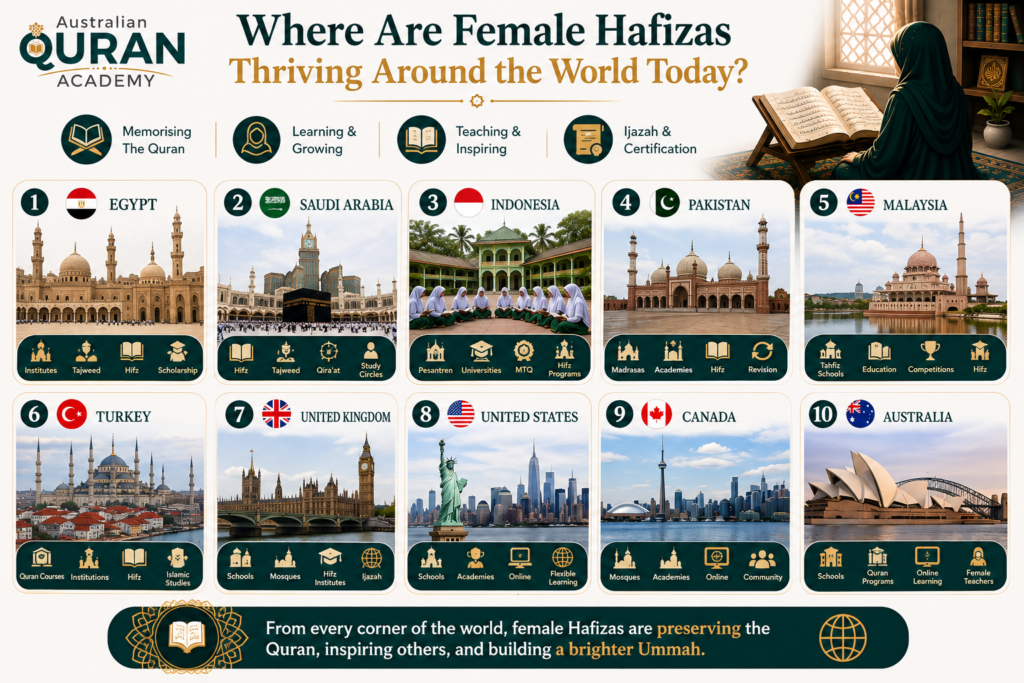
Women can also pursue Ijazah, an authenticated authorization in Quranic recitation that connects students to established chains of transmission. Opportunities and teaching traditions vary by country, but female Hafizas continue to play an important role as memorizers, teachers, and reciters.
Egypt
Egypt has a long-standing tradition of Quranic education for women, supported by Al-Azhar and numerous Quran institutes and local learning circles. Female students can pursue structured memorisation, Tajweed, recitation, and advanced Quranic studies under qualified teachers.
For many students, Egypt’s appeal lies in its established scholarly environment and the availability of teachers experienced in traditional Quran instruction.
Saudi Arabia
Saudi Arabia has numerous Quranic learning opportunities for women, particularly in Makkah and Madinah. Female students can study Hifz, Tajweed, and advanced recitation with qualified instructors through Quran institutes and study circles.
Some students also continue beyond memorisation to study different Qira’at, depending on their level and the programmes available to them.
Read also: How Long Does It Take To Become A Hafiz?
Indonesia
Indonesia has one of the world’s most extensive Quranic education cultures. Girls and women study Hifz through pesantren, Islamic schools, universities, and dedicated Quran programmes across the country.
The country’s Musabaqah Tilawatil Quran (MTQ) competitions also provide opportunities for female participants to demonstrate memorisation and recitation at different levels.
Pakistan
Pakistan has a deeply rooted female Hifz tradition, with girls studying through madrasas, Islamic schools, Quran academies, and private instruction.
Many programmes place considerable emphasis on repetition and regular revision, helping students strengthen previously memorised portions while continuing with new lessons.
Malaysia
Malaysia combines traditional Quranic learning with a highly organised Islamic education system. Girls can pursue Quran memorisation through religious schools, Tahfiz institutions, and specialised programmes alongside their wider education.
Female students also participate in Quran recitation and memorisation competitions, providing opportunities to develop their skills beyond the classroom.
Turkey
Turkey has an established network of Quran education programmes where women can pursue memorisation and religious studies. Quran courses and religious educational institutions provide structured pathways for students seeking to complete Hifz and develop their recitation.
Some female Hafizas later continue into Quran teaching and broader Islamic education.
United Kingdom
The United Kingdom has a growing community of female Hafizas studying through Islamic schools, local mosques, dedicated Hifz institutes, and private teachers.
Cities with large Muslim communities, including London, Birmingham, and Manchester, provide a range of opportunities for women and girls seeking structured Quran memorisation. Some students also continue towards Ijazah and advanced Tajweed studies after completing Hifz.
United States
Female Hifz education has also expanded across Muslim communities in the United States. Islamic schools, mosques, Quran academies, and online programmes provide memorisation opportunities for girls and adult women.
Flexible learning options are particularly important for students balancing Quran study with school, university, careers, or family responsibilities.
Canada
Canada has a developing network of Islamic schools, mosques, Quran academies, and online programmes supporting female Quran memorisation.
In major Muslim communities such as Toronto, Ottawa, and Vancouver, women can find both in-person and remote learning options, making it easier to build Hifz around existing commitments.
Australia
Australia’s female Hifz community continues to grow through Islamic schools, local Quran programmes, private instruction, and online learning.
For women who cannot attend a traditional full-time programme, flexible online study can provide access to qualified female instructors while allowing them to balance memorisation with work, university, and family life.
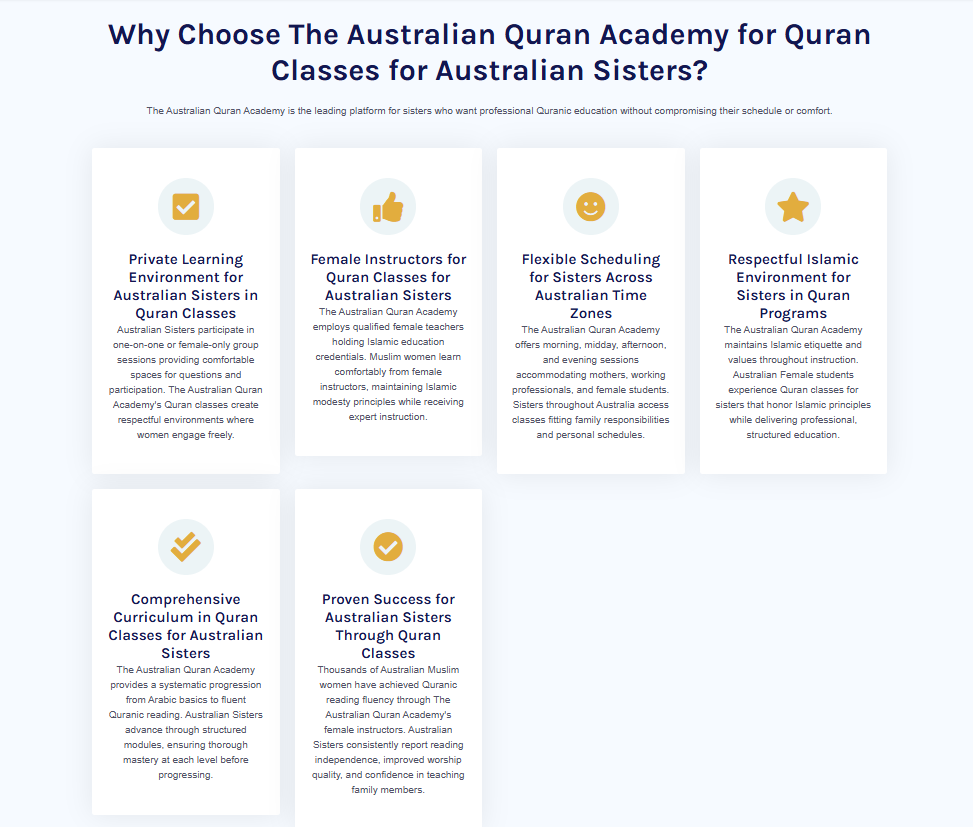
Australian Quran Academy offers dedicated Quran classes for sisters for women seeking structured Quran study from across Australia. Flexible scheduling allows students to work towards their Quran and Hifz goals while maintaining their everyday responsibilities.
Read also: How Long Does It Take to Memorize the Quran in Australia?
Inside Our Virtual Classrooms
We believe in full transparency and proven quality. Take a look at these actual snippets from our live classes to experience our modern learning platform, patient instructors, and interactive student participation.
Begin Your Path as a Female Hafiz of the Quran with Australian Quran Academy
Australian Quran Academy connects you with qualified female instructors for private, one-on-one sessions designed around your life — flexible enough to fit your schedule, structured enough to produce real results.
Whether you are starting from the beginning or returning to a memorization you set aside, the Academy provides a clear path: Tajweed first, then Hifz, with real-time correction and individualized revision planning at every stage.
[ Book Your Free Trial Class ]
Our Quran Courses
- Quran Tafsir Course
- Noorani Qaida Course
- Noorani Qaida Course for Kids
- Weekend Quran Classes
- Intensive Quran Course
- Al-Azhar Quran Course
- Online Tajweed Classes
- Tajweed Course for Kids
- Tajweed Course for Adults
- Tajweed Course for Ladies
Start Your Quranic Journey in Australia
Join our leading online academy and learn with expert tutors through a structured, personalized curriculum.
Book Your Free Trial
Conclusion
The female Hafiz of the Quran is not a modern development — she is the continuation of a tradition as old as the Quran’s preservation itself. Hafsa bint Umar (RA) was not simply the first female memorizer; she was the guardian of the text every Muslim on earth reads today. Aisha (RA), Umm Salama (RA), and Umm Waraqah (RA) each extended that tradition in documented, distinct ways — as scholars, narrators, teachers, and prayer leaders.
Today, female Hafizas from Egypt, Saudi Arabia, Indonesia, Pakistan, Malaysia, Turkey, the United Kingdom, the United States, Canada, and Australia continue this unbroken chain across every continent. The title Hafiza carries exactly the same spiritual weight as Hafiz — and the path to earning it is clear: correct Tajweed, a structured daily session with all three components, consistent revision, and qualified guidance.
For any girl or woman asking whether this goal is within reach — the answer from Islamic history, classical scholarship, and the experience of every instructor who has guided a female student to completion is an unambiguous yes.
Frequently Asked Questions
What is a female Hafiz of the Quran called?
A female Hafiz of the Quran is called a Hafiza (حافظة) — the Arabic feminine form of the title. It comes from the root حفظ (Hifz), meaning to preserve and protect. A Hafiza holds the same spiritual honor and scholarly recognition as a male Hafiz, with no distinction in reward or rank.
Who was the first female Hafiz of the Quran?
The first female Hafiz of the Quran was Hafsa bint Umar ibn al-Khattab (RA), wife of the Prophet ﷺ and daughter of Caliph Umar (RA). She memorized the Quran during the Prophet’s lifetime, was literate in Arabic, and was chosen as the custodian of the first official compiled Mushaf — the primary reference for the Uthmanic standardization, as recorded in Sahih al-Bukhari (Hadith 4987).
Which female Companions memorized the Quran?
Four female Companions are documented in classical scholarship as having memorized the complete Quran: Hafsa bint Umar (RA), Aisha bint Abi Bakr (RA), Umm Salama (RA), and Umm Waraqah bint Abdullah (RA). Umm Waraqah (RA) is particularly notable — the Prophet ﷺ appointed her to lead her household in prayer as direct recognition of her complete memorization.
Can a girl be a Hafiz of the Quran?
Yes. A girl can memorize the entire Quran and earns the title Hafiza (حافظة). There is no Islamic prohibition or scholarly disagreement on this point across any of the four major madhabs. The Prophet ﷺ said the best among people are those who learn and teach the Quran — a statement classical scholars apply equally to women and men.
How long does it take a girl to memorize the Quran?
With daily sessions of 45–60 minutes and consistent three-part revision, most girls complete the Quran in two to five years. Girls who begin between ages seven and twelve — the strongest memorization window — often complete it in three to four years. Adults typically take four to six years with sustainable pacing. Consistency of daily sessions, not session length, is the strongest predictor of completion.
At what age can a girl start Hifz?
Girls can begin structured Hifz as early as age four to six, once basic letter recognition is established. Ages seven to twelve represent the optimal window — memory retains more easily and revision habits form quickly at this stage. Adults can successfully complete Hifz at any age with a patient, structured approach and a qualified teacher who understands adult learning needs.





Leave a Reply