 Quran
Quran
Motivation is the reason most students begin Hifz. It is rarely the reason they finish it.
Most students who abandon their Quran memorization don’t quit because they lack ability. They quit because motivation collapses at a predictable point, for predictable reasons — and no one warned them it was coming, or gave them a system to move through it.
Knowing how to stay motivated during Hifz is not a personality trait. It is a skill built deliberately through the right habits, the right structure, and the right mindset applied at the right moment. The 10 steps below are drawn from what actually separates students who complete their Hifz from those who pause indefinitely — addressing the specific breakdown points instructors observe again and again across every student profile.
1. Build Your Hifz Motivation on Intention, Not Feeling
Motivation built on feeling will fail you by Juz 3. Motivation rooted in intention will carry you through Juz 30.
Before each memorization session, take sixty seconds to consciously renew your niyyah — not as a ritual formality, but as a deliberate act of reconnecting to why you began. Write your intention down and place it where you memorize. Read it before you open the Mushaf.
The distinction between these two types of motivation is the single most reliable predictor of whether a student completes their Hifz. Feeling-based motivation collapses the moment tiredness, distraction, or a difficult passage arrives. Intention-based motivation functions independently of how you feel on any given day — because it has already answered the question of why you are there.
The Quran itself anchors this: “And whatever good you do — indeed, Allah is Knowing of it.” (Al-Baqarah 2:215). Every session made sincerely for Allah’s sake is recorded — including the ones that feel difficult.
If you’re beginning your journey or restarting after a break, a structured Hifz program gives your intention a concrete framework — turning a sincere commitment into a guided, daily reality with accountability built in.
Memorize the Quran Step by Step in Australia with a FREE Trial Class

2. Identify Your Motivational Collapse Window Before You Hit It
The excitement of beginning Hifz will not remain at the same level throughout the journey. As the amount of memorized Quran grows, so does the amount requiring revision.

This means students can reach a stage where new memorization no longer feels as exciting, while Muraja’ah requires considerably more effort. Instead of waiting until this happens, prepare for periods of low motivation in advance.
Create a Hifz Motivation Rescue Plan
Before you reach a difficult phase, prepare a simple plan you can return to:
- Write down three specific reasons you began Hifz.
- Choose someone who can check in with you regularly.
- Speak to your teacher when motivation starts declining instead of silently disappearing from lessons.
- Keep Quran memorization stories from students who completed Hifz under circumstances similar to yours.
- Decide in advance what your reduced Hifz routine will look like during difficult weeks.
Preparation is not pessimism. It means a predictable period of low motivation becomes something you already know how to handle rather than a reason to stop.
3. Make Hifz Part of a Fixed Daily Routine
Motivation becomes less important when memorization becomes part of your normal day.
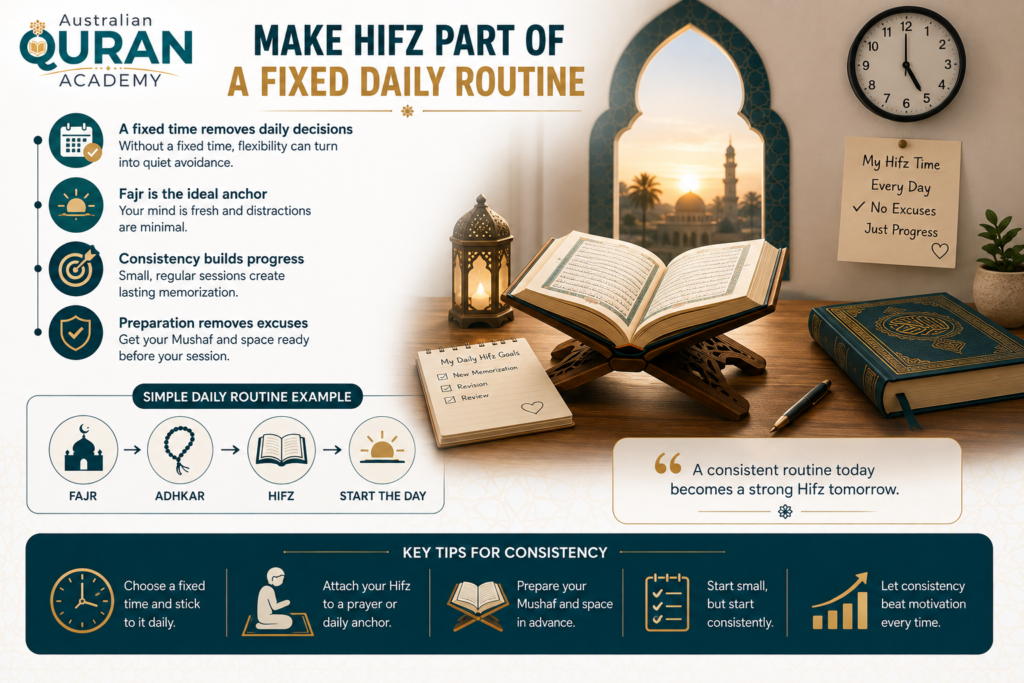
If your Hifz session happens after school one day, late at night the next, and whenever you “find time” after that, every session requires a new decision. Eventually, flexibility can turn into quiet avoidance A fixed daily slot removes much of that friction.
For many students, attaching Hifz to a prayer provides a natural anchor. Fajr is particularly practical because the mind is rested and daily distractions have not yet accumulated.
A simple routine might be:
Fajr → Adhkar → Hifz → Start the day
If Fajr does not work with your schedule, choose another prayer or fixed daily event. The important part is consistency.
Prepare your Mushaf and memorization space beforehand as well. Small obstacles — finding the Mushaf, charging a device, clearing a desk — can become surprisingly effective excuses when motivation is already low.
4. Separate New Memorization from Muraja’ah
Trying to complete new Hifz and all your revision in one unstructured session can quickly become overwhelming.
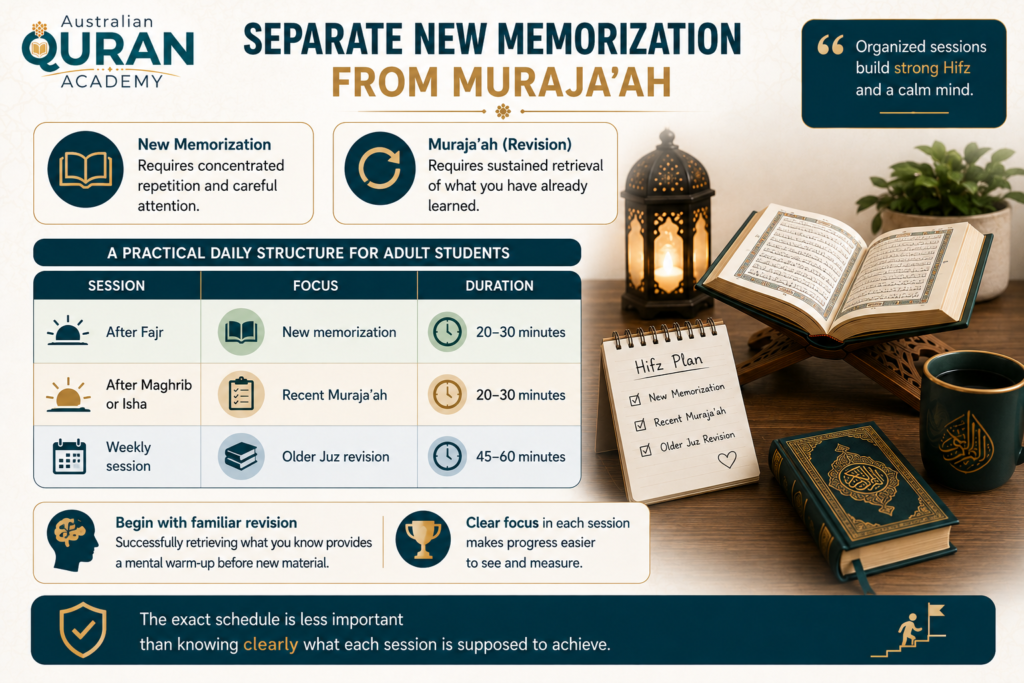
New memorization requires concentrated repetition and careful attention. Muraja’ah requires sustained retrieval of material you have already learned. Giving each one a clear place in your routine makes progress easier to see.
A practical daily structure for adult students could look like this:
| Session | Focus | Duration |
| After Fajr | New memorization | 20–30 minutes |
| After Maghrib or Isha | Recent Muraja’ah | 20–30 minutes |
| Weekly session | Older Juz revision | 45–60 minutes |
When possible, begin a session with familiar revision before moving into new material. Successfully retrieving something you already know can provide a useful mental warm-up before the more demanding work begins.
The exact schedule is less important than knowing clearly what each session is supposed to achieve.
Read also: How Long Does It Take to Memorize the Quran in Australia?
5. Turn the Quran into Smaller Hifz Milestones
Looking at all 604 pages as one enormous goal can make completion feel impossibly far away.
Instead, divide the journey into smaller milestones. Twenty milestones of roughly 30 pages each, for example, transform one distant finish line into a series of reachable checkpoints.
| Milestone | Progress |
| Milestone 1 | Pages 1–30 |
| Milestone 5 | Pages 1–150 |
| Milestone 10 | Pages 1–300 — approximately halfway |
| Milestone 15 | Pages 1–450 |
| Milestone 20 | Pages 1–604 — completion |
Each milestone gives you visible evidence that your daily sessions are accumulating into something substantial.
Mark important checkpoints meaningfully. Make du’a in gratitude, share the achievement with family, write down what has changed in your relationship with the Quran, or simply record the date The purpose is not the reward itself. It is to make long-term progress visible.
Strong reading skills also reduce the amount of correction required during Hifz. Dedicated Quran reading classes can help establish the recitation foundation needed before memorization becomes more demanding.
Improve Your Quran Reading in Australia with a FREE Trial Class

See Us in Action!
Curious about what our online classrooms look like? Watch the short clips below to see how our interactive, one-on-one sessions bring learning to life with real-time feedback and engaging teaching methods.
Start Your Quranic Journey in Australia
Join our leading online academy and learn with expert tutors through a structured, personalized curriculum.
Book Your Free Trial6. Recite Regularly to Someone Who Can Correct You
Memorizing completely alone creates two problems: mistakes can remain unnoticed, and there is no external accountability when motivation drops.

Regular recitation to a teacher or capable listening partner helps address both.
A qualified instructor can provide:
- Immediate correction: Errors can be fixed before they become deeply memorized.
- Accountability: Missing sessions becomes visible rather than a private decision.
- Progress monitoring: Your teacher can recognise when your pace or revision load needs adjustment.
- Encouragement: Difficult periods can be addressed before they become long breaks.
Even a short regular listening session can be valuable when combined with consistent self-study.
7. Understand What You Are Memorizing
Hifz can become mechanical when the words feel disconnected from meaning.
Before memorizing a page or passage, spend a few minutes reading its translation and understanding the general theme. You don’t necessarily need a full Tafsir session every time. Even basic understanding can give the ayat a meaningful sequence instead of leaving them as isolated sounds.
Ask yourself:
- What is this passage discussing?
- How does one ayah lead into the next?
- Is there a repeated idea or contrast?
- Which words or phrases carry the central meaning?
Understanding does not replace repetition, but it gives repetition context.
Recitation quality can also deepen your engagement with the text. Students developing their recitation through Qirat study can work on how Quran is recited alongside what they are memorizing.
Learn Quran Qirat in Australia and Start with a FREE Trial Class

8. Make Your Hifz Progress Visible
Muraja’ah can create a frustrating illusion: because you are repeatedly returning to Quran you already memorized, it may feel as though you are standing still.
A progress tracker provides objective evidence that you are not.
You can keep this extremely simple:
- Put a checkmark on a calendar for every completed Hifz day.
- Record new and revised pages in a notebook.
- Track cumulative pages in a spreadsheet.
- Mark completed surahs and Juz on a Quran progress chart.
- Record each completed Muraja’ah cycle.
Don’t track only new pages. Track revision as progress too.
A day where you memorized nothing new but strengthened ten weak pages is still a productive Hifz day.
Read also: How Long Does It Take To Become A Hafiz?
9. Keep a Minimum Hifz Routine for Difficult Days
One of the biggest threats to Hifz is not slowing down. It is stopping completely.
A student may miss one session because of work, illness, exams, family responsibilities, or exhaustion. One day becomes three, then a week, and eventually restarting feels harder than the original memorization.
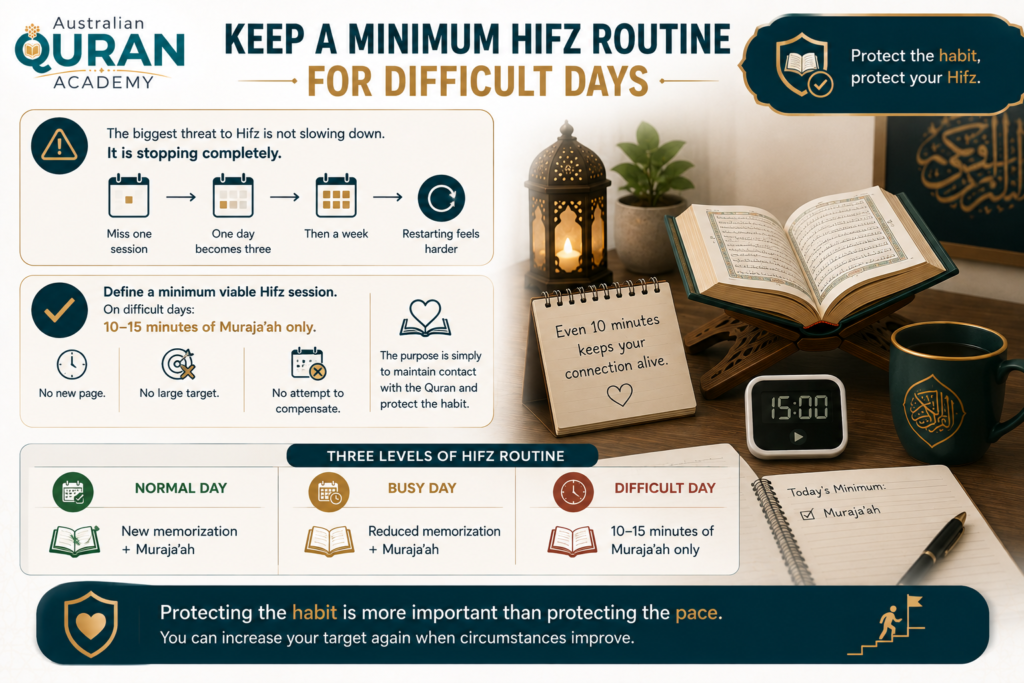
Instead of using an all-or-nothing system, define a minimum viable Hifz session.
On difficult days, this might mean:
10–15 minutes of Muraja’ah only No new page. No large target. No attempt to compensate for everything you missed The purpose is simply to maintain contact with the Quran and protect the habit.
Think of your routine in three levels:
| Type of Day | Hifz Target |
| Normal day | New memorization + Muraja’ah |
| Busy day | Reduced memorization + Muraja’ah |
| Difficult day | 10–15 minutes of Muraja’ah only |
Protecting the habit is more important than protecting the pace. You can increase your target again when circumstances improve.
10. Use Quran Memorization Stories to Rebuild Motivation
Quran memorization stories are not inspirational decoration. They are evidence that what you are attempting is achievable — and that the specific obstacles you are facing are not unique to your situation.
When motivation collapses, the underlying problem is almost always doubt: doubt that you can finish, that your progress is normal, that your circumstances are too difficult. Real Quran memorization stories dissolve those doubts in a way that abstract encouragement cannot, because they answer the question the struggling student is actually asking — has anyone else overcome exactly this and made it through?
Seek out stories from people who share your specific context: an adult who completed Hifz at 45 while working full time, a mother who memorized between school runs, a convert with no Arabic background who finished all 30 Juz over four years. These stories matter because they dismantle the mental narrative that your obstacles are unique obstacles that preclude completion.
Read also: Female Hafiz of the Quran – History, Role Models, and How to Become One
Inside Our Virtual Classrooms
We believe in full transparency and proven quality. Take a look at these actual snippets from our live classes to experience our modern learning platform, patient instructors, and interactive student participation.
Build a Hifz Routine That Keeps You Moving Forward
Staying motivated during Hifz becomes much easier when your effort is supported by the right structure. A clear memorization plan, realistic daily goals, regular revision, and consistent accountability can help you continue through difficult periods instead of depending on motivation alone.
At Australian Quran Academy, students receive structured guidance designed to support steady, long-term progress. By balancing new memorization with Muraja’ah and adapting the routine around each student’s pace and daily commitments, the focus remains on building Hifz that stays strong as you move toward completion.
Enroll today and take your first step with a system designed for completion, not just a start.
Our Quran Courses
- Quran Online Academy
- Quran Recitation Classes
- Quran Reading Classes
- Online Quran Classes for Kids
- Quran Classes for Adults
- Quran Classes for Female/Sisters
- Learn Quran Course for Beginners
- Quran Memorization (Hifz) Course
- Hifz Classes for Adults
- Quran Memorization and Hifz Course for Kids
- Quran Hifz Course for Ladies
- Quran Ijazah Program
- Quran Qirat Learning Course
- Quran Tafsir Course
- Noorani Qaida Course
- Noorani Qaida Course for Kids
- Weekend Quran Classes
- Intensive Quran Course
- Al-Azhar Quran Course
- Online Tajweed Classes
- Tajweed Course for Kids
- Tajweed Course for Adults
- Tajweed Course for Ladies
Start Your Quranic Journey in Australia
Join our leading online academy and learn with expert tutors through a structured, personalized curriculum.
Book Your Free Trial
Conclusion
Staying motivated during Hifz requires more than enthusiasm — it requires a system that functions on the days when feeling alone would not be enough to open the Mushaf.
Root your memorization in a renewed intention so tiredness never becomes a reason to stop. Identify your collapse window before you reach it. Fix your daily time, separate your sessions structurally, break the Quran into 20 visible milestones, and protect the habit above all else when life becomes difficult. When doubt creeps in, let Quran memorization stories from those who completed before you remind you that your obstacles are not disqualifying — they are ordinary parts of a journey that thousands have navigated and finished.
The Quran responds to consistency, not perfection. Every session — including the short ones, including the difficult ones — is recorded and rewarded. The strategies above are your map. The rest is the walk.
FAQs: How to Stay Motivated During Hifz
When do most students lose motivation during Hifz?
Most students experience their sharpest motivational drop between Juz 3 and Juz 7. This is when the novelty of beginning has faded, revision load is increasing, and the gap between current progress and completion feels widest. Preparing an accountability structure and a motivational rescue plan before reaching this phase is the most effective response.
How do I stay motivated after missing several days in a row?
Return immediately with a reduced session — 10 to 15 minutes of Muraja’ah only, with no pressure to cover new material. Re-establishing the daily habit takes priority over catching up on missed material. One small session resets momentum and prevents a missed week from becoming a missed month.
Do Quran memorization stories from other students actually help?
Yes — particularly stories from students who share your specific circumstances. Quran memorization stories from adults, converts, and students balancing Hifz with work or family provide direct evidence that your obstacles are not unique and that completion is genuinely achievable from your position. Seek specific stories, not generic inspiration.
How many new lines should I aim for each day?
Most adult students sustain consistent memorization at half a page to one full page of new material per day, alongside adequate Muraja’ah. Exceeding one page daily without a corresponding revision system typically leads to retention breakdown within weeks. If your schedule tightens, reduce new lines — but never skip revision entirely.
What is the difference between intention-based and feeling-based motivation?
Feeling-based motivation depends on how you feel on a given day and collapses under tiredness or difficulty. Intention-based motivation is rooted in your niyyah and functions regardless of feeling — because it has already answered the question of why you are there. Renewing your intention before every session builds a motivational anchor that holds through phases where feeling alone would not.
Is morning or evening better for Hifz memorization?
Morning memorization after Fajr consistently produces stronger retention than evening sessions. The mind is rested, distractions have not accumulated, and the spiritual atmosphere of early morning supports focus in a way evening sessions rarely replicate. If Fajr isn’t possible, fix a consistent evening time and hold it — regularity matters more than the ideal time slot.








Leave a Reply