 Quran
Quran

Have you ever sat down to revise a surah you’ve known for weeks, only to find it suddenly difficult to recall? You weren’t distracted. You had recited it successfully before. Yet when you tried again, the ayat simply would not come.
This experience can be connected to psychological barriers in memorization — mental and emotional conditions that interfere with learning or with retrieving information that has already been learned. For Quran students, these barriers may appear during new memorization, Muraja’ah, recitation in front of a teacher, or even when attempting to recite a familiar surah in Salah.
Understanding psychological barriers in memorization can help Hifz students distinguish between weak memorization, temporary retrieval problems, and difficulties connected with stress, anxiety, or emotional pressure. More importantly, understanding the cause gives you a clearer idea of what to change in your Hifz routine.
What Are Psychological Barriers in Memorization?
A psychological barrier in memorization is the sudden inability to retrieve or retain information that was previously learned, caused not by a lack of knowledge but by interference from mental or emotional states. Researcher Tobore Onojighofia Tobore defines it as “a memory block or mental block — the sudden inability to focus and remember due to a failure of learning and mental representation.”
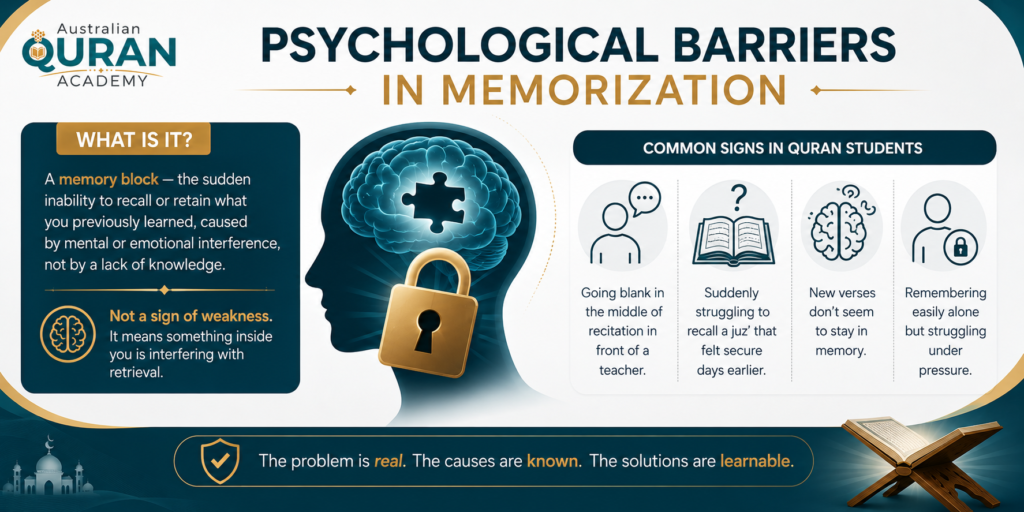
This definition matters because it shifts the blame away from personal weakness. Psychological barriers in memorization are not signs that you lack intelligence or sincerity. They are signs that your brain’s internal conditions — stress levels, emotional state, preparation depth — are interfering with the retrieval process.
For Quran students, these barriers commonly appear as:
- Going blank in the middle of recitation in front of a teacher.
- Suddenly struggling to recall a juz’ that felt secure days earlier.
- Finding that new verses simply do not seem to stay in memory.
- Remembering an ayah easily alone but struggling under pressure.
The problem is real. The causes are well-documented. And the solutions are learnable.
How Does Stress Affect Memory Psychology in Hifz Students?
If you have ever wondered how does stress affect memory psychology, the answer begins with understanding what happens to attention and retrieval when the brain perceives pressure.
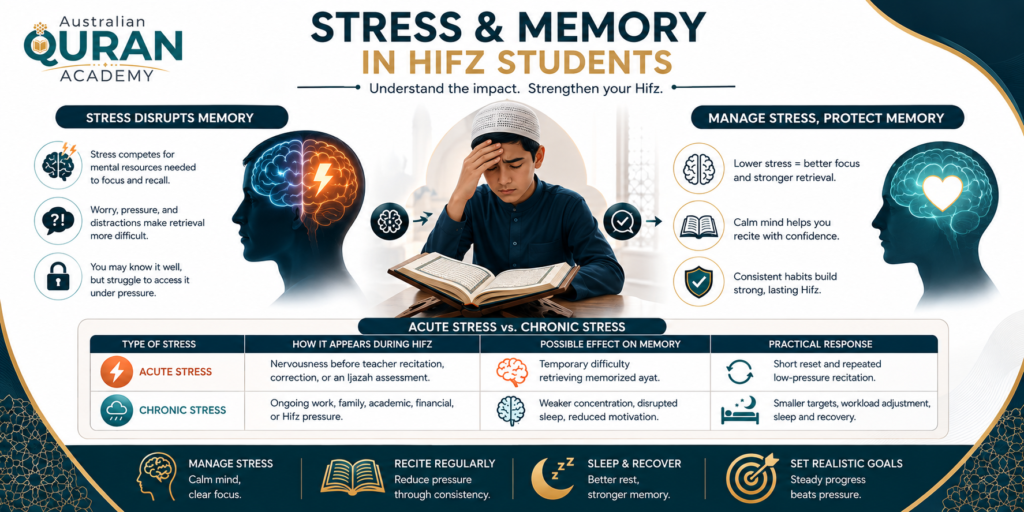
For Hifz students, memorization requires attention when learning new ayat and reliable retrieval when reciting them later. Stress can interfere with these processes by competing for the mental resources needed to focus on and retrieve the Quran.
This is why a student may know a surah well but suddenly find it much harder to access during an assessment, an Ijazah session, or recitation in front of a teacher.
Why Performance Pressure Can Cause a Sudden Memory Block?
The limbic system is closely involved with emotion and memory, while the hippocampus plays an important role in forming and retrieving memories.
When pressure rises, part of your attention may shift away from the Quran and toward the stressful situation itself. Instead of focusing entirely on the next ayah, you may start thinking:
“What if I forget?”
“My teacher is waiting.”
“I shouldn’t have made that mistake.”
That additional mental activity can make retrieval more difficult.
A familiar Hifz example is a student who recites Surah Al-Kahf confidently alone but suddenly struggles with its opening when asked to recite it in front of a teacher. The initial hesitation may be small, but worrying about that hesitation can make the block worse.
Acute Stress and Memory vs. Chronic Stress and Memory
Acute stress and memory problems are different from the effects of chronic stress and memory. Acute stress can temporarily make retrieval more difficult during a high-pressure moment, while chronic stress may affect the wider conditions required for consistent learning, including concentration, sleep, and motivation.
The distinction can be seen clearly:
| Type of Stress | How It Appears During Hifz | Possible Effect on Memory | Practical Response |
| Acute Stress | Nervousness before teacher recitation, correction, or an Ijazah assessment | Temporary difficulty retrieving memorized ayat | Short reset and repeated low-pressure recitation |
| Chronic Stress | Ongoing work, family, academic, financial, or Hifz pressure | Weaker concentration, disrupted sleep, reduced motivation | Smaller targets, workload adjustment, sleep and recovery |
Acute stress is generally short-lived. Once the immediate pressure decreases, the student may discover that the supposedly “forgotten” passage is accessible again.
Chronic stress is different because it accumulates over time. A student who is continually sleep-deprived, overwhelmed by revision, or attempting to maintain an unrealistic memorization target may find both new learning and old Muraja’ah becoming increasingly difficult.
In that situation, the solution is not simply to calm down before the next session. The overall Hifz structure may need to change.
The Impact of Emotion on Perception, Attention, Memory, and Decision-Making
The impact of emotion on perception, attention, memory, and decision-making is particularly relevant to Quran memorization because Hifz depends on sustained attention during learning and reliable retrieval later.
Emotion can influence which information receives attention and how strongly an experience is remembered. This helps explain why some Quranic ayat associated with meaningful moments — gratitude, grief, reflection, fear, hope, or spiritual awakening — may remain particularly vivid.
For Hifz students, the practical lesson is that quality of attention matters alongside quantity of repetition.
Reading an ayah dozens of times while checking your phone, thinking about another task, or rushing to finish a daily target does not create the same learning conditions as focused repetition.
This doesn’t mean you need to reach a perfect emotional state before memorizing. It means creating conditions that allow your attention to remain on the Quran.
Memory and Emotion: The Part of the Brain That Connects Both
When discussing memory and emotion, the part of the brain most relevant to their relationship includes structures such as the hippocampus and amygdala.
The hippocampus is closely involved in forming memories, while the amygdala plays an important role in processing emotional significance. Their interaction helps explain why emotional state can influence what receives attention and how experiences are later remembered.
For Quran students, there is a simple practical takeaway: prepare your mind before you begin.
Making wudu, choosing a quiet place, renewing your intention, removing unnecessary distractions, and spending a moment settling your attention can create a clearer transition between everyday responsibilities and your Hifz session.
Read also: How to Memorize the Quran in Australia?
Does Stress Affect Memory Recall During Quran Recitation?
Does stress affect memory recall? It can. Stress and anxiety can occupy mental resources that would otherwise be available for the task in front of you.
For a Hifz student, this may produce the familiar feeling:
“I know this ayah, but I can’t get it out.”
That doesn’t automatically mean you need to relearn the entire surah. First determine whether the memorization itself is weak or whether the problem occurs mainly under particular conditions.
If you can recite the passage accurately alone but repeatedly struggle when someone is listening, performance pressure may be contributing to the problem.
Regular teacher-guided recitation can help because it gives you repeated opportunities to retrieve memorized Quran while being observed. Over time, the situation itself becomes more familiar.
Regular teacher-guided recitation practice can be valuable here. Reciting frequently in a low-pressure environment makes the experience of retrieving memorized Quran in front of another person increasingly familiar.
Common Psychological Barriers Quran Students Face Worldwide
Across our students in Australia, Canada, India, Malaysia, Indonesia, the UAE, Nigeria, Pakistan, Egypt, the USA, the UK, New Zealand, Bangladesh, and South Africa, a recognizable set of psychological barriers appears regardless of cultural context or level of education.
Poor Preparation Weakens Memorization
The most prevalent psychological barrier in memorization is insufficient preparation depth. Students often confuse exposure with encoding. Reading an ayah thirty times is not the same as having tested recall — pausing, looking away, and attempting to retrieve it from memory without prompting.
Anthony Metivier, who has studied and trained memory professionally, identifies “sloppy preparation” as the root cause of most memory blocks: “Sloppy reading prevents the brain from forming enough connections to frame a complete enough picture. Instead of a study foundation, you wind up with mental sand that easily blows away in the wind.”
In Hifz terms: hearing the ayah repeated, or reading it while following along, builds recognition but not recall. The preparation gap closes only when a student regularly practices retrieving material under conditions that approximate actual recitation — eyes off the page, no prompts.
Beginners who start with the right foundations make far faster long-term progress. The Noorani Qaida course builds this kind of solid phonetic and reading foundation before memorization begins — which dramatically reduces the cognitive overload that triggers psychological blocks in early Hifz stages.

Read also: How to Memorize the Quran for Non-Arabic Speakers?
Anxiety Can Block Quran Recall
The second major barrier is what cognitive behavioral therapy identifies as cognitive fusion with fear — not just feeling anxious, but participating in the anxiety as though it defines reality. Students in exams tell themselves, “I don’t know this,” and repeat it until it crowds out the retrieval attempt. Hifz students go blank before a session and tell themselves, “I always forget,” turning a temporary retrieval failure into a self-fulfilling prediction.
Research by Brady and colleagues (2017) found that encouraging students to reappraise anxiety — viewing it as a signal of engagement rather than a signal of failure — produced measurable improvements in both immediate performance and course outcomes over time. The internal narrative matters, and it can be changed.
Lack of Recall Weakens Old Hifz
When Quran memorization is new, it is cognitively demanding — every letter, word, and tajweed rule requires conscious attention. As proficiency develops, familiar sections become automatic, freeing cognitive resources for new material. This is healthy. The problem occurs when students stop actively testing their recall of familiar sections, assuming that automaticity equals permanent retention.
Automaticity fades without periodic active recall. A student who memorized Juz’ Amma three years ago and has never recited it under conditions that require genuine recall — as opposed to following along with audio — will experience a sharp retrieval block the first time they attempt it without support. This isn’t memory loss. It’s the expected result of encoding without retrieval practice.
See Us in Action!
Curious about what our online classrooms look like? Watch the short clips below to see how our interactive, one-on-one sessions bring learning to life with real-time feedback and engaging teaching methods.
Start Your Quranic Journey in Australia
Join our leading online academy and learn with expert tutors through a structured, personalized curriculum.
Book Your Free TrialHow to Reverse Memory Loss from Stress?
Learning how to reverse memory loss from stress begins with identifying what is actually causing the difficulty. A temporary retrieval block, chronic overload, shallow memorization, and insufficient revision are different problems and should not all be treated in the same way.
For Hifz students, the following seven strategies address these problems from different angles.
1. Clear Your Mind Before Starting a Hifz Session
Avoid moving directly from a stressful task into Quran memorization whenever possible.
Before opening the Mushaf, spend two or three minutes allowing your attention to settle. Slow your breathing, recite ta’awwudh and bismillah with presence, renew your intention, and remove obvious distractions.
These minutes are not reducing your Hifz time. They are preparing you to use the following session more effectively.
You can keep the routine simple:
- Put your phone away.
- Sit in your regular memorization place.
- Take a moment to settle your attention.
- Renew your intention.
- Begin with a realistic target for that session.
Consistency matters more than making the routine complicated.
2. Separate New Memorization from Quran Revision
New memorization and Muraja’ah place different demands on your attention. Completing both in one long session may become mentally exhausting, particularly as the amount you have memorized increases.
A divided routine can make the workload easier to manage:
| Time | Hifz Task |
| After Fajr | New memorization |
| Afternoon | Recent Sabaq revision |
| Evening | Older Muraja’ah |
| Revision-only day | Strengthen weak portions without adding new material |
The exact times can change according to work, school, family responsibilities, and your personal energy levels.
The important principle is that new memorization should not continually consume the time needed to protect what you have already learned.
3. Test Your Memory Instead of Relying Only on Repetition
Repetition builds familiarity. Retrieval tells you whether the ayah is actually accessible without assistance.
After reading an ayah several times, close or cover the Mushaf and attempt to recite it independently.
Use this simple cycle:
Read → Close → Recall → Check → Correct → Recall Again
If you forget, don’t immediately interpret the failed attempt negatively. The failure has shown you exactly which part is still weak.
Correct that section, repeat it, and test yourself again.
This is more useful than repeatedly reading an ayah while never checking whether you can produce it independently.
4. Use Simple Retrieval Cues When an Ayah Will Not Come to Mind
Sometimes you know that a passage is stored in memory but cannot retrieve the next word.
Repeatedly forcing yourself to remember it can increase frustration and pressure. Instead, pause and use a small retrieval cue.
You might think about:
- The meaning of the previous ayah.
- The opening sound of the missing word.
- The final words of the previous ayah.
- The relationship between the two ayat.
- Where the passage appears visually on your Mushaf page.
Once the missing phrase returns, check it against the Mushaf. Then recite the complete sequence again without depending on the cue.
The cue is a temporary bridge, not something you should need permanently.
5. Reduce Your Hifz Load When Chronic Stress Affects Your Memory
When memory difficulties happen repeatedly over weeks rather than during one isolated session, look at your wider routine.
Chronic stress and memory difficulties may be connected with an Hifz schedule that has become unrealistic alongside work, study, family responsibilities, or insufficient sleep.
Three areas deserve particular attention:
- Daily volume: Reduce new memorization if it consistently overwhelms Muraja’ah.
- Sleep: Protect sufficient rest instead of regularly sacrificing sleep to reach a Hifz target.
- Recovery: Include revision-only sessions or days when your older memorization requires more attention.
Reducing your daily target is not necessarily reducing your long-term progress.
Memorizing half a page that remains strong is more valuable than memorizing a full page today and repeatedly losing it next week.
Read also: What Is the Best Way to Memorize the Quran in Australia?
6. Keep Your Hifz Environment Consistent to Support Recall
Memory can be influenced by contextual cues, so creating a familiar Hifz environment may help make your memorization routine more consistent.
You don’t need an elaborate study space. Focus on a few repeatable elements:
- Use the same Mushaf.
- Memorize at approximately the same time when possible.
- Choose a familiar quiet location.
- Follow the same short pre-Hifz routine.
- Study with a consistent teacher where possible.
Over time, these conditions become closely associated with memorization and recitation.
At the same time, don’t become so dependent on one environment that you can only recall Quran there. Once a passage becomes strong, test it in different situations — while walking, in Salah, or in front of your teacher — to strengthen flexible recall.
7. Use Every Memorization Mistake to Improve Your Revision
Forgetting becomes much more useful when you diagnose the error instead of simply becoming frustrated by it.
Whenever you go blank, ask three questions:
- Where exactly did I forget?
- What type of mistake did I make?
- Has the same problem happened before?
Your answer should determine your next revision step.
If two ayat are similar, compare them directly. If the transition between two passages keeps disappearing, practise the final words of the first together with the opening words of the second. If the problem occurs mainly in front of your teacher, increase low-pressure teacher recitation.
Instead of seeing mistakes only as failures, use them as a map of what your Muraja’ah needs to target next.
Sisters who are looking for a structured, supportive environment that honours both consistency and flexibility may find dedicated online Quran classes for sisters a practical solution — the routine itself becomes part of the memory anchor.
Learn Quran Online with Female Tutors in Australia — Start with a FREE Trial Class

Inside Our Virtual Classrooms
We believe in full transparency and proven quality. Take a look at these actual snippets from our live classes to experience our modern learning platform, patient instructors, and interactive student participation.
Start Your Hifz With the Right Structure Behind You
Psychological barriers in memorization don’t disappear through determination alone. They respond to system design — the right teacher, the right pacing, the right method of practice, and the right emotional environment.
At Australian Quran Academy, our Al-Azhar-trained instructors work one-on-one with students across Australia, the UK, USA, Canada, UAE, Pakistan, Malaysia, Nigeria, South Africa, Egypt, Bangladesh, Indonesia, New Zealand, and India — building personalised Hifz programs that account for each student’s pace, schedule, and the specific challenges that cause retention to stall.
Whether you are starting from the foundations or working through a plateau in your memorization, we have a structured path for you.
Book your free trial class today and take your first session with a qualified teacher who will meet you exactly where you are.
Our Quran Courses
- Quran Online Academy
- Quran Recitation Classes
- Quran Reading Classes
- Online Quran Classes for Kids
- Quran Classes for Adults
- Quran Classes for Female/Sisters
- Learn Quran Course for Beginners
- Quran Memorization (Hifz) Course
- Hifz Classes for Adults
- Quran Memorization and Hifz Course for Kids
- Quran Hifz Course for Ladies
- Quran Ijazah Program
- Quran Qirat Learning Course
- Quran Tafsir Course
- Noorani Qaida Course
- Noorani Qaida Course for Kids
- Weekend Quran Classes
- Intensive Quran Course
- Al-Azhar Quran Course
- Online Tajweed Classes
- Tajweed Course for Kids
- Tajweed Course for Adults
- Tajweed Course for Ladies
Start Your Quranic Journey in Australia
Join our leading online academy and learn with expert tutors through a structured, personalized curriculum.
Book Your Free Trial
Conclusion
Psychological barriers in memorization are neurological events, not personal failures. When stress activates the limbic system, retrieval pathways close — temporarily, and reversibly. When anxiety occupies working memory, recall capacity shrinks. When preparation is shallow, the encoded material was never durable to begin with.
The good news is that each of these causes has a known, practical response. Pre-session nervous system resets, retrieval practice over repetition, structural management of chronic stress, and consistent emotional presence during memorization all directly address the mechanisms that create blocks — not just the symptoms.
Your Hifz journey is not measured by the sessions where everything flows. It is built in the sessions where you work through difficulty with knowledge, patience, and the right support behind you.
Read also: How to Memorize the Quran for Non-Arabic Speakers?
Frequently Asked Questions About Psychological Barriers in Memorization
What are the most common psychological barriers in memorization for Quran students?
The most common psychological barriers in memorization are performance anxiety (which activates the fight-or-flight response and temporarily blocks retrieval), negative thought loops that compound an initial blank into sustained failure, chronic stress that degrades working memory over time, and shallow preparation that produces recognition without durable recall. Each barrier has a specific, learnable response.
How does stress affect memory recall during Hifz recitation?
Stress triggers the limbic system’s fight-or-flight response, which clears both short-term and long-term retrieval pathways to redirect cognitive resources toward perceived threat. The result is a temporary but complete retrieval block — the material is stored, but the pathway to it is inaccessible until the nervous system resets. Relaxation techniques, consistent pre-session routines, and regular low-stakes practice in front of a teacher progressively reduce this response.
What is the difference between acute stress and chronic stress in memorization?
Acute stress causes short-duration retrieval failure — a blank during a recitation session that resolves once pressure passes. Chronic stress builds over weeks and months, reducing working memory capacity, disrupting sleep-based memory consolidation, and eroding motivation. Acute stress responds to breathing techniques and short resets. Chronic stress requires structural changes: realistic daily portions, regular revision, and recovery sessions.
Can memory loss from stress be reversed in Hifz students?
Yes. Stress-related memory disruption is not permanent damage. Consistent retrieval practice (testing recall rather than repeating readings), pre-session nervous system resets, adequate sleep, and managed daily workloads progressively restore retrieval function. Students who address chronic stress structurally — not just symptomatically — typically see meaningful improvement within two to four weeks of consistent adjusted practice.
Why do I go completely blank mid-recitation even when I know the surah?
Going blank mid-recitation is almost always the limbic system temporarily overriding retrieval pathways in response to performance pressure. The surah is stored and intact. The retrieval pathway is blocked by the stress response. Pausing, breathing slowly, and relaxing physically — rather than pushing harder to remember — is the most effective immediate response. Longer-term, regular recitation in front of your teacher builds tolerance for the retrieval act under observation, progressively reducing the blank response.
How does emotion improve memory in Quran memorization?
The amygdala evaluates incoming information for emotional significance and signals the hippocampus to consolidate material it judges as important. Memorizing in states of gratitude, presence, or sincere intention creates stronger emotional encoding — which produces more durable long-term retention. This is the neuroscientific basis for classical Islamic practices of wudu, intention, and consistent adab before engaging the Quran: they create the emotional conditions that the brain is designed to encode deeply.








Leave a Reply