 Quran
Quran
Muslims across Australia — whether in Sydney’s western suburbs, Melbourne’s north, Brisbane’s southside, the communities of Perth and Adelaide, or the more spread-out populations of Hobart, Darwin, and Canberra — share a common aspiration: to carry the words of Allah in their hearts.
For most people, the question is not whether to memorize the Quran. It is how — and more specifically, how to do it here, in Australia, around full-time work, school runs, shift rotations, and a life that does not pause for Hifz.
The answer is not a single tip. It is a system. This guide lays out 10 ordered steps built from both proven memorization science and traditional Hifz practice — adapted specifically for Australian Muslim life.
Quran memorization is not a talent — it is a trained system. The students who complete Hifz are not those with the sharpest memories; they are the ones who follow a consistent method, correct mistakes early, and never abandon revision. These 10 steps lay out that system in order.
Step 1: Make Your Intention Clear — and Keep Renewing It
Before any technique, any schedule, or any teacher, the first step is internal.
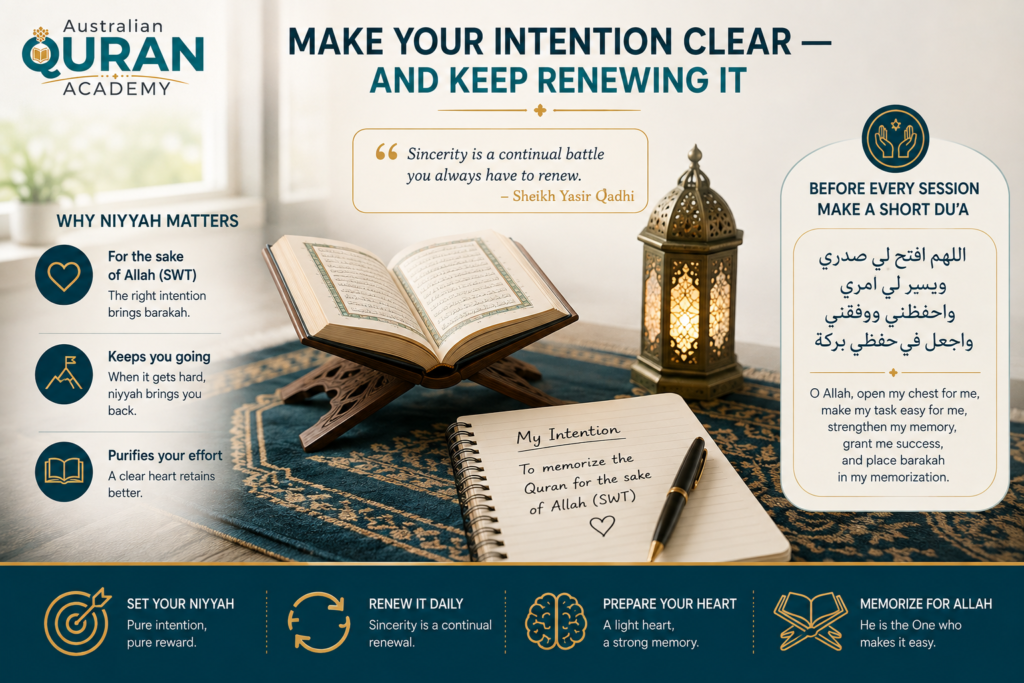
Begin by purifying your niyyah — memorizing solely for the sake of Allah (SWT). Sheikh Yasir Qadhi, who memorized the Quran during his teenage years, described sincerity as “a continual battle you always have to renew” — not a one-time declaration, but an active, ongoing commitment. When the journey becomes difficult — and it will — a clear intention is what pulls you back to the page.
Practically: before each session, make a short du’a asking Allah to open your chest, strengthen your memory, and place barakah in your effort. A heavy heart retains words poorly; spiritual preparation is not separate from memorization — it is part of it.
Step 2: Build Your Tajweed Foundation Before You Memorize
This step is where most self-taught students lose months of effort.
Do You Have to Memorize the Quran with Tajweed?
Yes — and starting correctly is far easier than correcting deeply ingrained errors later. Tajweed is not a separate subject added after memorization; it is how the Quran has been transmitted since the time of the Prophet ﷺ through unbroken oral chains.
When you memorize with incorrect pronunciation, you lock that error into long-term memory. Correcting it later requires re-learning, not just reviewing — which is significantly harder.
How to Memorize the Quran with Tajweed?
You do not need to master every Tajweed rule before beginning Hifz. However, a few foundations should be in place from your first memorization session:
- Makharij: Learn the correct articulation points of Arabic letters.
- Madd: Understand the basic elongation rules.
- Noon and Meem Sakinah: Learn their core pronunciation rules.
- Teacher correction: Recite your daily memorization to a qualified teacher who can catch errors in real time.
The last point is especially important. Errors you cannot hear in your own recitation often become obvious the moment a trained ear listens.
If you are starting from the beginning, Australian Quran Academy’s beginner Quran classes build Tajweed alongside early recitation from lesson one — so your foundation is correct from the first surah, not corrected after the tenth.
Start Learning Quran for Beginners in Australia with a FREE Trial Class

Step 3: Start from Juz Amma — Not Al-Baqarah
One of the most common mistakes new students make is opening to Surah Al-Baqarah and working forward. The traditional and pedagogically sound approach is the opposite: start from Juz 30 (Amma).
Juz Amma contains shorter surahs, a wide variety of verse structures, and covers all the essential Tajweed rules within a compact scope. It provides early wins — real, completed surahs — that build genuine confidence and establish the habits you will carry through the longer, harder portions of the Quran.
Rather than tackling the longest surahs immediately, you can structure your Hifz journey progressively:
| Stage | Memorization Focus | Purpose |
| Stage 1 | Juz 28–30 | Build confidence with shorter surahs |
| Stage 2 | Surah Al-Kahf through Juz 28 | Transition into longer passages |
| Stage 3 | Al-Baqarah to Al-Kahf | Complete the longer portion of the Quran |
Building from the back gives you a psychological foundation through shorter, completed surahs before you move into the longer sections of the Quran.
Step 4: Choose One Mushaf and Never Change It
Your brain does not just memorize words — it memorizes the visual layout of the page.
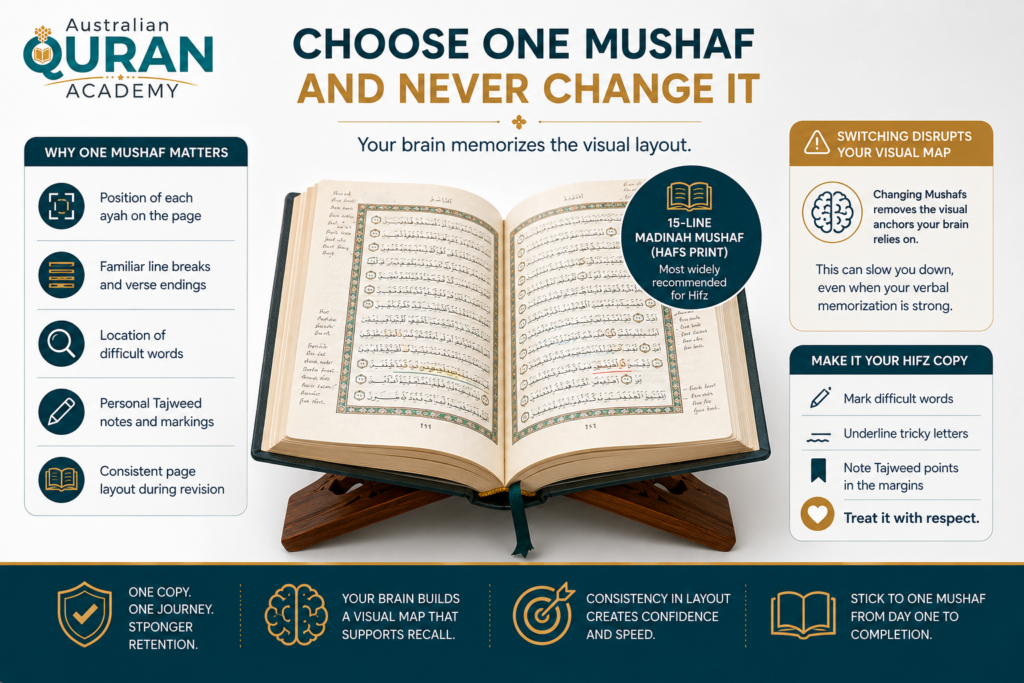
The position of a verse on the page, the shape of a line break, and the words at the end of a column can all become spatial memory anchors. Using the same Mushaf consistently gives your brain several visual cues that support recall:
- The position of each ayah on the page
- Familiar line breaks and verse endings
- The location of difficult words
- Personal Tajweed notes and markings
- A consistent page layout during revision
When you switch between different Quran prints, you disrupt this visual map entirely.
The 15-line Madinah Mushaf (Hafs print) is the most widely recommended for Hifz because of its consistent, clean layout. Choose one copy from day one. Mark difficult words, underline tricky letters, and note Tajweed points in the margins.
This is your personal Hifz copy — treat it as such. Students who switch Mushafs mid-journey routinely report slowing down, even when their verbal memorization was solid, because the visual anchor has been removed.
Read also: How to Memorize the Quran in Australia?
Step 5: Set a Fixed Daily Time — Fajr First
Consistency beats intensity every time in Quran memorization.
Thirty focused minutes at the same time every day will outperform two-hour sessions done irregularly. The most effective time — supported by scholars and consistent with how memory consolidation works — is immediately after Fajr. The mind is calm, distractions are minimal, and the spiritual atmosphere of early morning creates conditions where retention is naturally stronger. Sheikh Yasir Qadhi recorded that he memorized one full page per hour at the start and reduced that to 15–20 minutes through the morning habit alone.
For Australians: Fajr times vary significantly across states and seasons. In New South Wales and Victoria, summer Fajr can fall as early as 4:30 am. In Western Australia, the time shifts accordingly. In Queensland, South Australia, the Northern Territory, and Tasmania, it shifts again. Set your memorization appointment around your local Fajr time, and protect it as a non-negotiable daily commitment — the same way you protect your work schedule.
Step 6: Use the 7×3 or 10×10 Repetition Method
Raw repetition is the engine of Hifz. The question is not whether to repeat — it is how to structure that repetition so each verse locks in accurately.
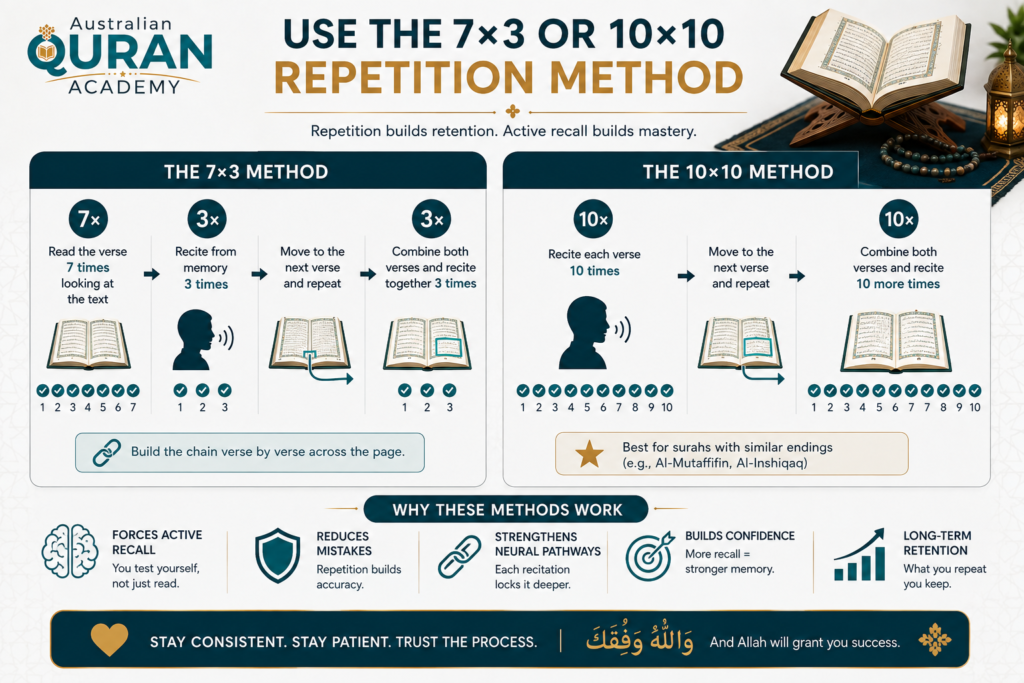
The 7×3 Method
Read the verse 7 times looking at the text, then recite it 3 times from memory. Move to the next verse, apply the same process, then combine both verses and recite them together 3 times. Build the chain verse by verse across the page.
The 10×10 Method
Recite each verse 10 times — even when you feel confident by repetition 7 or 8. Move to the next verse, repeat 10 times, then combine both for 10 more recitations. This method is particularly effective for surahs with rhyming endings that are easily confused (such as Surah Al-Mutaffifin or Surah Al-Inshiqaq), where incorrect syllables from one verse slip into the next.
Both methods work because they force active recall — you test yourself, not just read at the page. Every recitation from memory strengthens the neural pathway that stores those words.
Australian Quran Academy’s Al-Azhar certified program integrates structured Muraja’ah directly into each student’s learning plan — revision is built into the session, not left to chance.
Learn Quran Through a Structured Al-Azhar Program in Australia with a FREE Trial Class

Step 7: Apply the 6446 Daily Strategy
The 6446 method is a structured daily distribution system that allows serious memorizers to cover more ground without trying to complete all their Hifz in one sitting.
Instead, memorization and revision are distributed across four points in the day:
| Time | Task | Target |
| After Fajr | New memorization | 6 ayahs |
| Afternoon — lunch or after Dhuhr | New memorization | 4 ayahs |
| Evening — after Asr | New memorization | 4 ayahs |
| Before sleep | Revision | 6 previously memorized ayahs |
This structure works because it spreads cognitive load across the day and aligns with how the brain consolidates memory during sleep. Instead of front-loading all new content into one session, it creates repeated daily exposure — the same mechanism behind spaced repetition.
For Australians across the ACT, Queensland, South Australia, Western Australia, New South Wales, Victoria, the Northern Territory, and Tasmania, the 6446 method adapts naturally to the standard work-and-prayer day. Fajr is the primary session; the afternoon and evening slots can fit into lunch breaks and after-work time.
See Us in Action!
Curious about what our online classrooms look like? Watch the short clips below to see how our interactive, one-on-one sessions bring learning to life with real-time feedback and engaging teaching methods.
Start Your Quranic Journey in Australia
Join our leading online academy and learn with expert tutors through a structured, personalized curriculum.
Book Your Free TrialStep 8: Prioritize Muraja’ah (Revision) Above New Memorization
This is the step most students underestimate — and the one that separates those who complete Hifz from those who plateau.
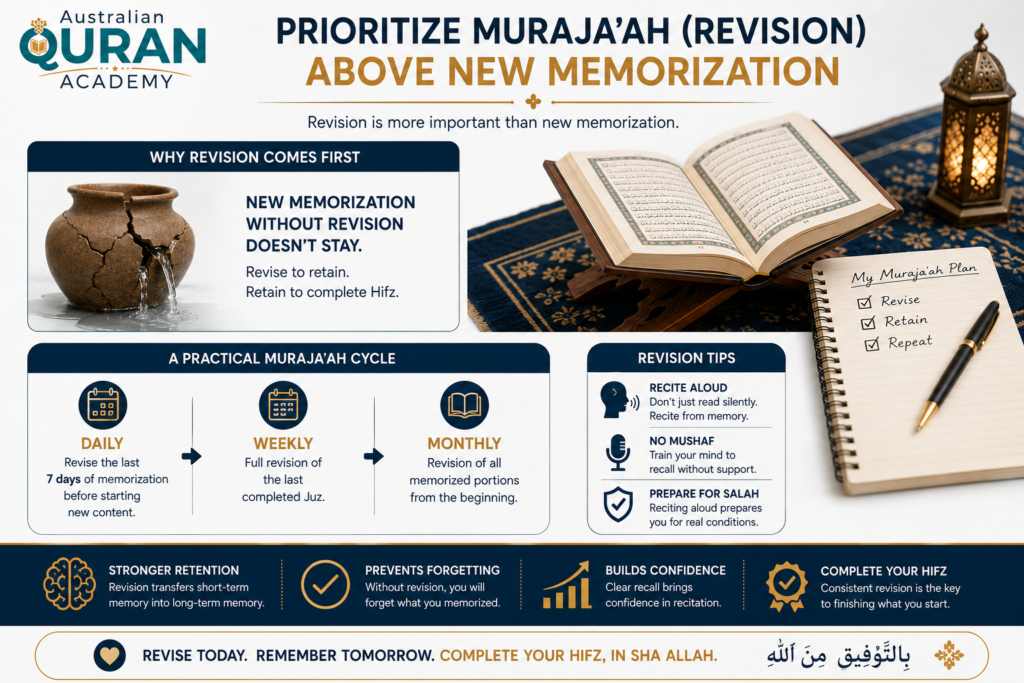
Muraja’ah (structured revision) must be treated as more important than learning new content. Before every new session, revise your Sabaq — the last 7 days of memorization. At a separate time during the day, revise the material before those 7 days — a minimum of 4–5 pages. New memorization without active revision is water poured into a cracked vessel: it simply does not hold.
A practical Muraja’ah cycle:
- Daily: Revise the last 7 days of memorization before starting new content
- Weekly: Full revision of the last completed Juz
- Monthly: Revision of all memorized portions from the beginning
Reciting your revision aloud — not reading silently — consolidates memory significantly faster, because it replicates the actual condition of reciting in Salah: no Mushaf, no support, only recall.
Read also: Psychological Barriers in Memorization – Why Your Brain Blocks Quran Hifz and How to Break Through?
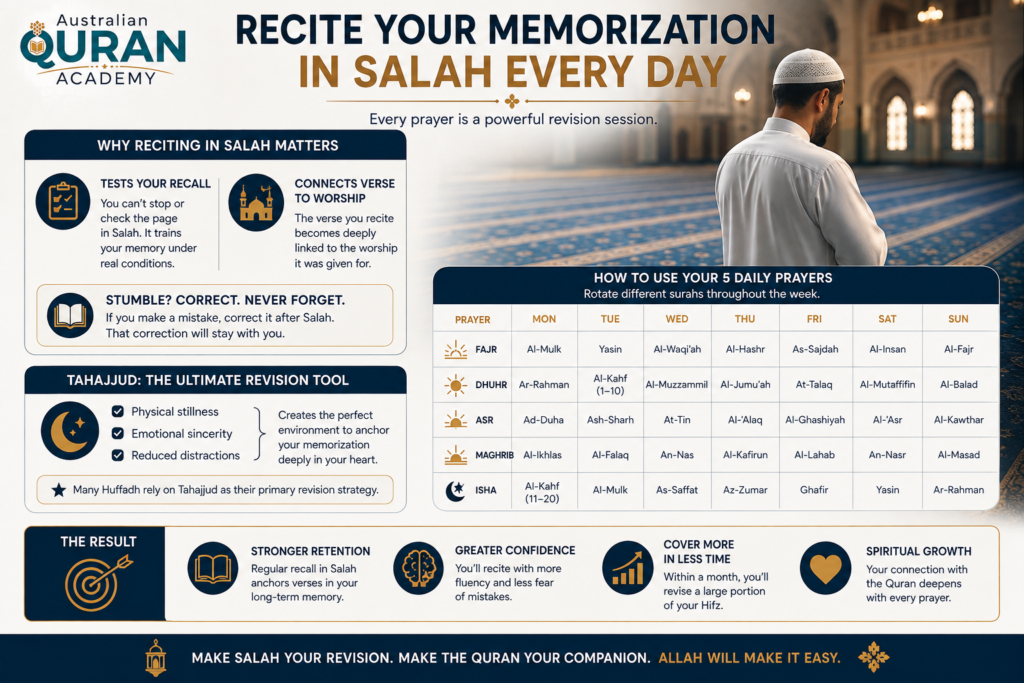
Step 9: Recite Your Memorization in Salah Every Day
Every obligatory prayer is a built-in revision session — if you use it deliberately.
Make a habit of reciting your most recently memorized surahs in your daily prayers. This does two things simultaneously: it tests your recall under conditions that matter — you cannot stop and look at the page mid-Salah — and it creates a deep association between the verse and the act of worship for which it was given. If you stumble on a word during Salah, you will go straight to the Mushaf afterward and correct it. That correction will never be forgotten.
The Tahajjud prayer is particularly valuable for revision. The combination of physical stillness, emotional sincerity, and reduced cognitive interference creates conditions where previously memorized material becomes deeply anchored. Many Huffadh consider Tahajjud their primary revision strategy — not an extra act, but a core memorization tool.
Rotate different surahs across your five daily prayers throughout the week. Within a month, you will cover a significant portion of your memorized content through Salah alone.
Step 10: Learn Under a Qualified Online Teacher from Day One
Every major Hifz scholar says the same thing: you cannot complete authentic Quran memorization without reciting to a teacher. This is not tradition for its own sake — it is the mechanism by which the Quran has been transmitted accurately for over 1,400 years.
The practical reason: errors invisible to you become immediately apparent when recited aloud to a trained listener. Subtle word substitutions, transposed phrases, missing letters in long ayahs — these mistakes compound silently when unchecked, and become significantly harder to correct after months of repetition.
How to Hifz Quran at Home in Australia?
The geographic barrier no longer exists. A student in Darwin, Hobart, Canberra, regional Western Australia, or anywhere across the eight states and territories can access qualified, Ijazah-certified teachers through live, one-on-one online sessions — with the same quality of instruction available to students in Madinah or Cairo.
What to look for in an online Hifz tutor: an Ijazah (a certified chain of transmission back to the Prophet ﷺ), experience teaching non-Arabic speakers, real-time Tajweed correction in every session, and a structured revision system built into the program.
Australian Quran Academy’s Ijazah program connects Australian students with Ijazah-certified scholars who assess recitation accuracy in real time and build personalized memorization and revision plans around each student’s schedule, pace, and current level.
Join the Online Quran Ijazah Program in Australia and Start Your FREE Trial Class

Inside Our Virtual Classrooms
We believe in full transparency and proven quality. Take a look at these actual snippets from our live classes to experience our modern learning platform, patient instructors, and interactive student participation.
Continue Your Quran Memorization with Expert Guidance
Memorizing the Quran becomes more manageable when you have a qualified teacher correcting your recitation, guiding your daily memorization, and making sure revision remains part of your routine. With the right support, you can progress at a pace that fits your current level without sacrificing accuracy.
Australian Quran Academy offers live, one-on-one online Quran lessons with qualified teachers, allowing students across Australia to learn from home and build a structured Hifz routine around school, work, and family commitments.
Start your Hifz journey with expert guidance — book your free trial lesson today.
Our Quran Courses
- Quran Online Academy
- Quran Recitation Classes
- Quran Reading Classes
- Online Quran Classes for Kids
- Quran Classes for Adults
- Quran Classes for Female/Sisters
- Learn Quran Course for Beginners
- Quran Memorization (Hifz) Course
- Hifz Classes for Adults
- Quran Memorization and Hifz Course for Kids
- Quran Hifz Course for Ladies
- Quran Ijazah Program
- Quran Qirat Learning Course
- Quran Tafsir Course
- Noorani Qaida Course
- Noorani Qaida Course for Kids
- Weekend Quran Classes
- Intensive Quran Course
- Al-Azhar Quran Course
- Online Tajweed Classes
- Tajweed Course for Kids
- Tajweed Course for Adults
- Tajweed Course for Ladies
Start Your Quranic Journey in Australia
Join our leading online academy and learn with expert tutors through a structured, personalized curriculum.
Book Your Free Trial
Conclusion
Memorizing the Quran in Australia is not an exception — it is a realistic, achievable goal for any Muslim who follows a structured approach. The 10 steps in this guide form a complete system: intention, Tajweed, correct starting point, visual memory anchors, fixed daily timing, structured repetition, daily distribution, active revision, Salah-based reinforcement, and qualified teacher guidance.
Whether you are memorizing from a home in Sydney, an apartment in Melbourne, a house in Brisbane, a suburb of Perth, a neighborhood in Adelaide, or anywhere across New South Wales, Victoria, Queensland, Western Australia, South Australia, Tasmania, the ACT, or the Northern Territory — the method is the same. The access is the same. And the reward, inshAllah, is the same.
Frequently Asked Questions
Do you have to memorize the Quran with Tajweed?
Yes. Tajweed is not an optional layer added after memorization — it is part of how the Quran has been transmitted since the time of the Prophet ﷺ. Memorizing with incorrect pronunciation locks errors into long-term memory, making them significantly harder to correct later. Learn the core rules before or alongside your first lessons, not after.
How long does it take to memorize the Quran in Australia?
It depends on daily commitment and method. Students who dedicate 30–60 focused minutes per day with a qualified teacher typically complete Hifz in 3–6 years. Those following an intensive schedule with larger daily portions can finish in 1–2 years. Consistency over time matters more than the volume of any single session.
Can I memorize the Quran at home without going to a mosque?
Yes. Online one-on-one Hifz programs replicate the teacher-student dynamic entirely. The requirement is not physical presence — it is regular recitation to an Ijazah-certified teacher who provides real-time Tajweed correction and a structured revision plan. Many students across regional Australia, Western Australia, and Tasmania complete full Hifz entirely online.
What is the best Mushaf to use for Hifz?
The 15-line Madinah Mushaf (Hafs print) is most widely recommended because of its consistent, clean layout. Choose one printing from day one and never switch — your visual memory of the page layout becomes a recall tool that speeds up revision significantly.
How do I avoid forgetting what I’ve already memorized?
Structured Muraja’ah is the answer. Before starting any new content, revise your last 7 days of memorization. At a separate time of day, revise all material before that. Additionally, recite your memorized surahs in daily Salah — stumbling during prayer is the fastest correction mechanism available.
Is it too late to start Hifz as an adult?
No. Adults carry a genuine advantage: deeper comprehension of meaning, stronger motivation, and life experience that makes the content personally resonant. What adult learners need is a realistic pace, qualified guidance, and a revision system built for a full life — not a childhood schedule.






Leave a Reply