 Arabic
If you’re raising Muslim children in Australia, you’ve probably felt the pull in two directions — English everywhere, and Arabic calling from the Quran, the prayer, the heritage. Teaching your child Arabic here isn’t just possible; thousands of Australian families are doing it right now, most without a fluent speaker at home.
Teaching Arabic to children in a non-Arabic environment like Australia is a specific challenge. The language doesn’t show up on street signs, in school, or on TV. That means your approach has to be deliberate and consistent — not intensive and stressful.
The 10 steps below are sequenced by skill development, not by age. Move through them at your child’s pace.
Step 1: Start With Sound Before Script
The most common mistake Australian parents make when teaching Arabic is jumping straight to the written alphabet before the child is comfortable with Arabic sounds. Arabic has letters — ح, خ, ع, غ — that simply don’t exist in English. If a child can’t hear and reproduce these sounds, teaching them the script first creates confusion that takes months to undo.
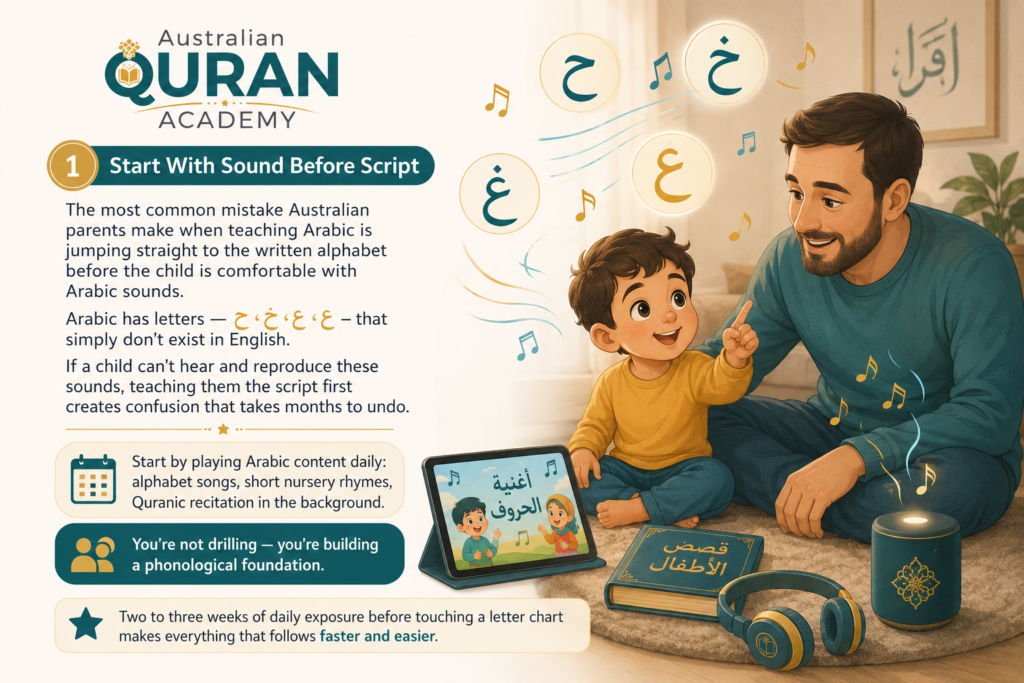
Start by playing Arabic content daily: alphabet songs, short nursery rhymes, Quranic recitation in the background. You’re not drilling — you’re building a phonological foundation. Two to three weeks of daily exposure before touching a letter chart makes everything that follows faster and easier.
Step 2: Introduce the Arabic Alphabet in Groups, Not All at Once
Once your child is comfortable with Arabic sounds, introduce the 28 letters — but in four groups, not all at once. Presenting all 28 together is overwhelming for young learners and slows retention.
A proven grouping used in structured Arabic programs:
- Group 1: أ ب ت ث ج ح خ
- Group 2: د ذ ر ز س ش ص ض
- Group 3: ط ظ ع غ ف ق ك
- Group 4: ل م ن هـ و ي
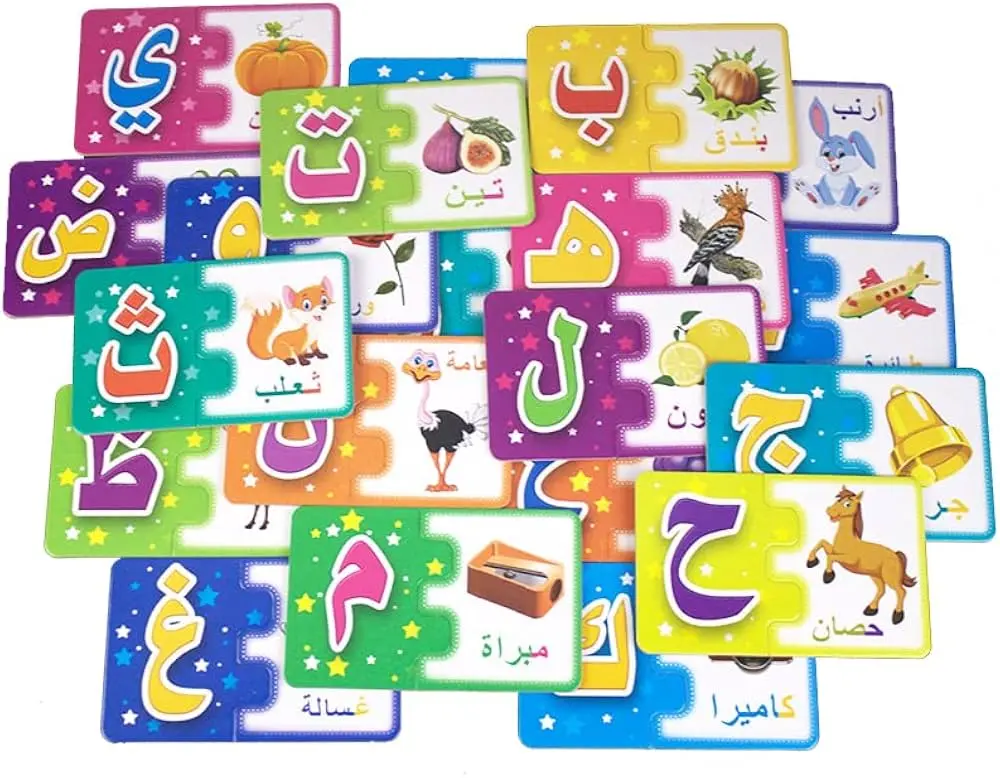
Spend three to five days on each group before moving forward. Pair every letter with a concrete Arabic word — أسد (lion) for Alif, بيت (house) for Ba — so your child learns vocabulary and the alphabet simultaneously. Letter recognition alone is a half-built skill.
One detail most resources skip: teach visually similar letters together — ص and ض, ق and ك, ب and ت and ث — so children learn to distinguish them early. Confusion between these pairs is the single most common source of reading errors in young non-native learners.
Step 3: Teach Vowel Marks Before Attempting Full Words
Arabic is written without vowels in most real-world contexts, but children learning to read Arabic — especially for Quranic reading — work with fully vowelled text. This is actually an advantage: it tells the reader exactly how to pronounce every letter.
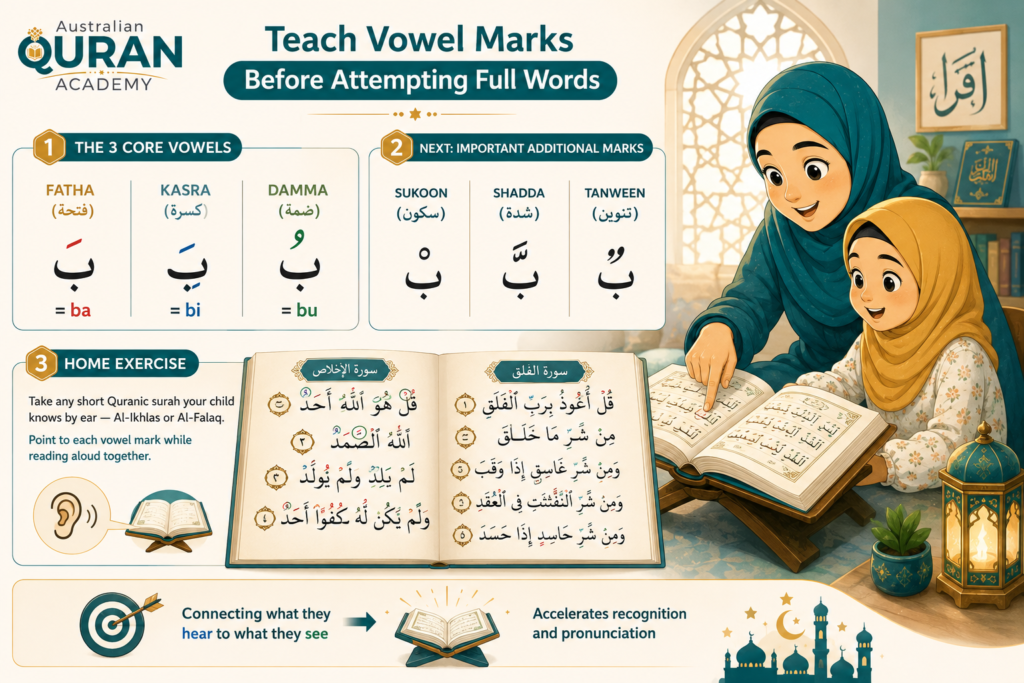
Teach the three core vowels before moving to word reading:
- Fatha (فتحة) — the short “a” sound (بَ = ba)
- Kasra (كسرة) — the short “i” sound (بِ = bi)
- Damma (ضمة) — the short “u” sound (بُ = bu)
Once these three are solid, introduce Sukoon (سكون), Shadda (شدة), and Tanween (تنوين). Don’t rush this stage. Children who have shaky vowel recognition read slowly and lose confidence. Children who master vowels early read Quran with speed and accuracy.
A useful home exercise: take any short Quranic surah your child knows by ear — Al-Ikhlas or Al-Falaq — and point to each vowel mark while reading aloud together. Connecting what they hear to what they see on the page accelerates both recognition and pronunciation.
Step 4: Build Letter-Position Awareness for Fluent Reading
Arabic letters change shape depending on where they appear in a word — beginning, middle, or end. This surprises many English-speaking parents and is genuinely one of the harder concepts for young learners to absorb.
Learning how to teach a child to read Arabic without covering letter positions produces a child who can identify isolated letters but freezes when they see them inside actual words.
Introduce each letter in all three positions once the child knows the isolated form confidently. Use simple, high-frequency words rather than abstract grammar explanations. For example:
- ب at the start: بيت (bayt – house)
- ب in the middle: connected text
- ب at the end: كتاب (kitaab – book)
Visual letter-position charts, which many Arabic learning apps include, are highly effective here. Physical letter tiles and magnetic boards let children physically connect and disconnect letters — this kinesthetic activity builds understanding faster than worksheets alone.
If your child is in primary school and ready for a structured curriculum that covers letter positions systematically, Australian Quran Academy’s Elementary School Arabic Course is designed specifically for this age group and stage.

Read also: 10 Arabic Games for Kids – Fun Activities That Actually Teach the Language
Step 5: Teach Arabic Speaking Through Dialogue, Not Translation
Speaking practice should start earlier than most parents expect — around the same time as alphabet learning, not after it. Children who only practice reading and writing but never use Arabic verbally develop a silent relationship with the language that limits confidence long-term.
Begin with structured mini-dialogues your child can actually use:
- اسمي… (Ismi… – My name is…)
- كيف حالك؟ / بخير، شكراً (Kaifa haluk? / Bikhayr, shukran – How are you? / Fine, thanks)
- ما هذا؟ / هذا… (Ma haatha? / Haatha… – What is this? / This is…)
For Australian children, connecting these phrases to their existing Islamic vocabulary accelerates uptake dramatically. They already say السلام عليكم and الحمد لله — build from what they know.
After any short Arabic story or reading passage, ask your child to retell it in their own words, however simple. This produces the most underrated speaking skill: the ability to use Arabic to express, not just repeat.
See Us in Action!
Curious about what our online classrooms look like? Watch the short clips below to see how our interactive, one-on-one sessions bring learning to life with real-time feedback and engaging teaching methods.
Start Your Quranic Journey in Australia
Join our leading online academy and learn with expert tutors through a structured, personalized curriculum.
Book Your Free TrialStep 6: Introduce Arabic Writing Correctly — Letter-by-Letter First
Writing is the skill most children find hardest, and rushing it creates habits that are difficult to break. The correct sequence for how to teach a child to read and write Arabic is: isolated letter formation first, then connecting letters, then short words, then simple sentences.
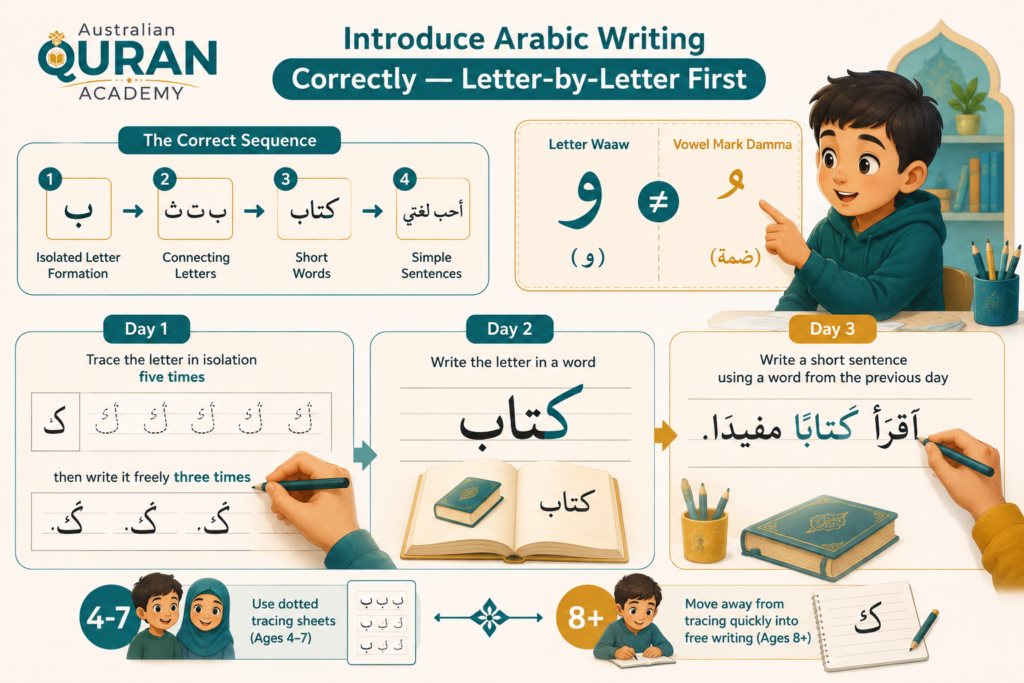
A specific detail that matters: teach your child the difference between the letter Waaw (و) and the vowel mark Damma (ضمة). They look superficially similar to beginners, and children who confuse them make consistent writing errors across all their work.
Practical writing exercises for home:
- Day 1: Trace the letter in isolation five times, then write it freely three times
- Day 2: Write the letter in a word — ك in كتاب — connecting it to meaning
- Day 3: Write a short sentence using a word from the previous day
Dotted letter tracing sheets are freely available online and are effective for ages 4–7. For children aged 8 and up, move away from tracing quickly and into free writing — dependence on dotted guides slows the development of genuine letter fluency.
Step 7: Teach Arabic Grammar Through Stories, Not Rules
Grammar is where many children — and parents — hit a wall. The instinct is to reach for a grammar textbook and teach rules explicitly. For children under 10, this approach produces students who can recite rules but can’t apply them.
Instead, introduce grammar through stories and guided questions. Read a short Arabic passage and ask: “Is this word a he or a she?” (introducing masculine/feminine). “Who did this action?” (introducing verb-subject agreement). The child encounters the rule in context and absorbs it through pattern recognition.
Start with these three grammar concepts before anything else:
- Masculine and feminine nouns — e.g., كتاب (masc.) vs.
مدرسة (fem.) - The definite article ال — al-Shamsiyya vs. al-Qamariyya letters
- Basic verb conjugation — ذهب (he went) vs.
ذهبت (she went)
Sun letters (حروف شمسية) and moon letters (حروف قمرية) are a specific concept that confuses many learners from an English background. When ال is added to a sun letter, the ‘l’ sound assimilates — الشمس is pronounced ash-shams, not al-shams. Teaching this through listening and repetition before formal explanation prevents a very common pronunciation error in Quranic recitation.
For families whose children are ready for more structured grammar study, Australian Quran Academy’s Arabic Grammar Course provides a graded curriculum taught by qualified instructors who specialise in non-native learners.

Step 8: Add Arabic Numbers Through Games and Counting Routines
Arabic numerals (١ ٢ ٣ ٤ ٥…) are a separate script system from Western Arabic numerals (1 2 3 4 5). Non-native children need explicit practice recognising and writing them.
Integrate number learning into daily routines rather than isolating it as a separate lesson. Count stairs in Arabic, say the date in Arabic, use Arabic numbers when cooking or shopping together. The goal is for Arabic numbers to feel as natural as English ones — and that only comes from consistent environmental exposure, not worksheets.
Games are particularly effective here. Number matching games, counting songs, and simple board games where children say the number in Arabic before moving are low-effort, high-retention activities that work for ages 3–8.
Read also: Arabic Vocabulary for Kids – Easy Words, Phrases & Fun Learning Activities
Step 9: Build a Home Environment That Normalises Arabic
In Australia, Arabic is an invisible language outside Muslim communities. If it only appears in formal lesson time, children subconsciously file it under “school subject” — something to get through, not a language to love.
Practical ways to make Arabic a natural part of home life:
- Label household objects in Arabic — باب (door), كرسي (chair), مطبخ (kitchen)
- Display the alphabet chart somewhere your child sees it daily
- Keep Arabic books alongside English books on the same shelf — normalising rather than separating them
- Say common duas aloud throughout the day so Arabic becomes woven into routine
- Watch short Arabic cartoons together on YouTube — look for content in Fusha (Modern Standard Arabic) rather than regional dialects for non-native learners
The goal of a home Arabic environment isn’t immersion — it’s normalisation. When a child sees, hears, and uses Arabic daily, even briefly, it stops being foreign and starts becoming familiar.
Step 10: Partner With a Qualified Online Arabic Program
Home support is powerful, but it has a ceiling. Most Australian parents — even those with some Arabic background — cannot provide pronunciation correction, structured curriculum progression, and the consistent motivation that a qualified teacher offers.
This is where partnering with an expert-led online Arabic program makes a significant difference. Online learning has removed the biggest practical barrier Australian Muslim families face: the shortage of qualified Arabic teachers in most cities outside Sydney and Melbourne.
When choosing a program for your child, look for:
- Native Arabic teachers trained to work with English-speaking children
- Short sessions (20–30 minutes) matched to children’s attention spans — not 60-minute adult-format classes
- Live, interactive lessons rather than pre-recorded video
- Structured curriculum covering alphabet, reading, writing, speaking, and grammar in sequence
- Flexible scheduling that accommodates Australian time zones
One of the most common reasons Australian families abandon Arabic learning is a mismatch between the program format and children’s actual capacity to focus. A 7-year-old in a 60-minute grammar class is a 7-year-old who will resist the next lesson. Australian Quran Academy’s Arabic courses are structured around children’s real attention spans, with options spanning beginner to advanced levels across all age groups.

Read also: 10 Arabic Poems for Kids That Make Language Learning Stick
Inside Our Virtual Classrooms
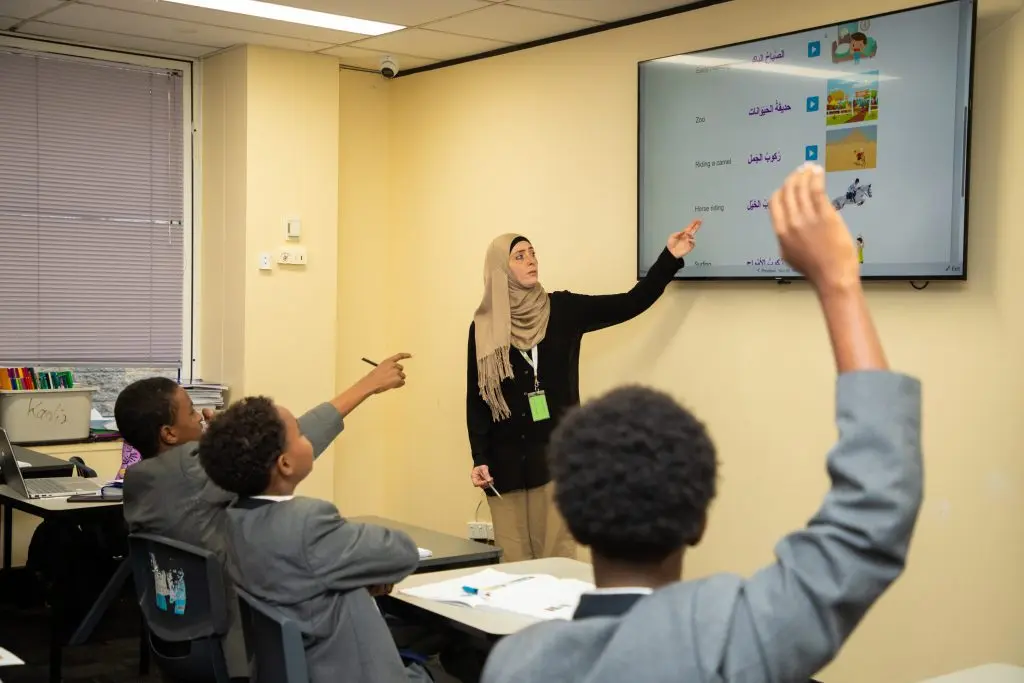
We believe in full transparency and proven quality. Take a look at these actual snippets from our live classes to experience our modern learning platform, patient instructors, and interactive student participation.
Start Your Child’s Arabic Journey with Australian Quran Academy
Your child doesn’t need to be in an Arabic-speaking country to learn Arabic properly. Australian Quran Academy brings expert Arabic instruction directly into your home — live, interactive lessons taught by qualified teachers who specialise in non-native children.
Sessions are designed for Australian family schedules, delivered across all time zones, and built around how children actually learn — through stories, games, and structured skill progression that makes Arabic genuinely enjoyable.
Our Arabic Courses
- Online Arabic Academy
- Online Arabic Course
- Classical Arabic Course
- Arabic Course for Beginners
- Advanced Arabic Course
- Quranic Arabic Course
- Arabic Grammar Course
- Modern Standard Arabic Course
- Arabic Conversation / Speaking Course
- Intensive Arabic Course
- Online Arabic Classes for Kids
- Arabic Classes for Adults
- Arabic Classes for Ladies
- Fusha Arabic Course
- Business Arabic Course
- Al-Azhar Arabic Course
- Madinah Arabic Course
- Learning Arabic for Non-Arabic Speakers
- Arabic Elementary School
- Arabic Intermediate School
- Arabic Lessons for Kindergarten
Start Your Quranic Journey in Australia
Join our leading online academy and learn with expert tutors through a structured, personalized curriculum.
Book Your Free Trial
Conclusion
Learning how to teach kids Arabic in Australia comes down to sequence and consistency. Start with sounds before script, introduce the alphabet in manageable groups, master vowel marks before reading full words, build letter-position awareness, develop speaking through dialogue, teach writing letter-by-letter, introduce grammar through stories, add numbers through games, normalise Arabic at home, and support it all with qualified instruction.
None of these steps require you to be a fluent Arabic speaker. They require intentionality, patience, and the right tools. The children who succeed at Arabic in Australia are not the ones whose parents were experts — they’re the ones whose parents were consistent.
Frequently Asked Questions
What is the best age to start teaching Arabic to kids in Australia?
Exposure can begin as early as age 2–3 through songs and rhymes. Structured alphabet and reading lessons work best from age 4–6. Children who begin formal Arabic instruction before age 7 develop near-native pronunciation significantly more easily than later starters.
How can I teach my child to read Arabic if I don’t speak Arabic myself?
You can support Arabic reading at home by using vowelled texts, Arabic alphabet apps, letter tracing sheets, and Arabic picture books. Pair this with a qualified online teacher who handles pronunciation correction and curriculum progression. Your role is reinforcement, not instruction.
How to teach a child to read Arabic for free?
Free resources include Arabic alphabet songs on YouTube, printable letter tracing sheets from Islamic educational websites, and Arabic learning apps with free tiers. These work best as supplements to structured instruction rather than the sole learning method.
How long does it take for a child to learn to read Arabic?
Most children aged 5–8 with consistent twice-weekly practice can recognise all Arabic letters within 4–8 weeks and read simple vowelled words within 3–4 months. Confident Quranic reading typically takes 12–18 months of structured study.
Should my child learn Fusha or a dialect first?
For Australian children learning Arabic for Quranic understanding and Islamic education, Fusha (Modern Standard Arabic) should come first. It provides the foundation for Quranic reading, formal Islamic texts, and is universally understood across Arabic-speaking communities worldwide.
Is online Arabic learning effective for young children?
Yes — when sessions are short (20–30 minutes), live and interactive, and taught by teachers experienced with young non-native learners. Live online lessons outperform pre-recorded content because they allow real-time pronunciation correction, which is essential at the alphabet and early reading stages.




Leave a Reply