 Arabic
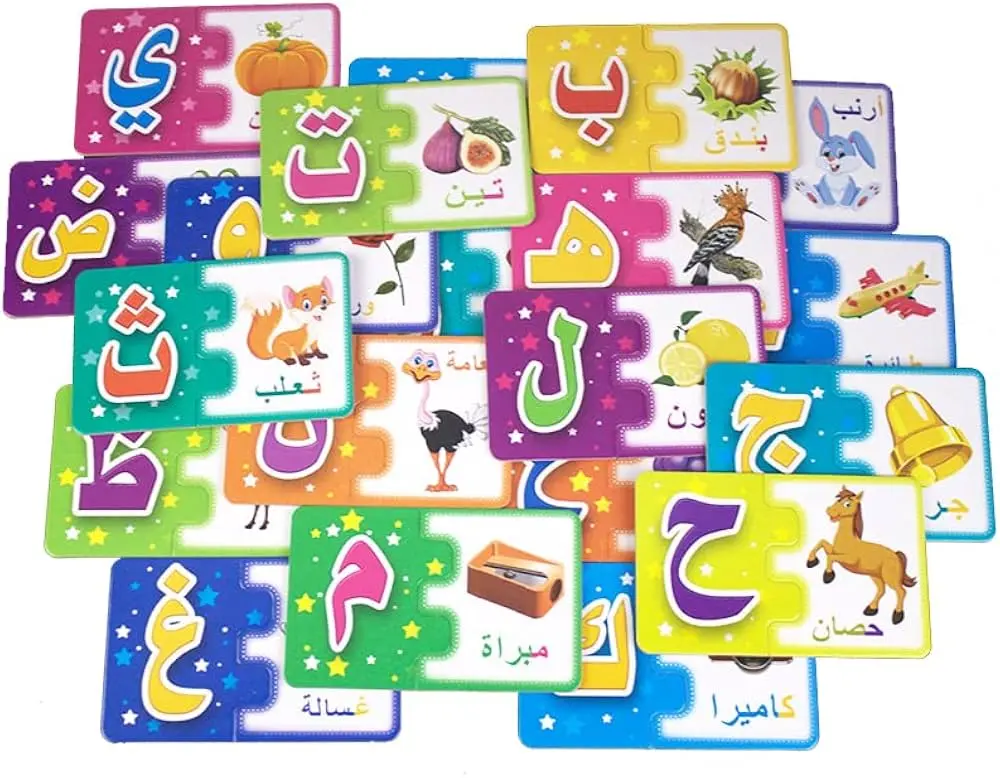
Ask any parent who has tried to run a formal Arabic lesson with a five-year-old: it usually ends within ten minutes. But watch that same child spend half an hour competing in a letter bingo game, and you understand exactly how Arabic language learning is supposed to work for young minds.
Arabic games for kids succeed where textbooks and worksheets often struggle because they combine language with things children naturally enjoy: movement, competition, imagination, repetition, and discovery. Instead of asking children to memorise a list of words, games give them a reason to hear, recognise, repeat, and use those words.
That does not mean every game automatically teaches Arabic. The most useful activities are deliberately matched to a child’s current language skill. A child who is still learning the Arabic alphabet needs different activities from a child who already understands basic vocabulary but struggles to speak in complete sentences.
1. Arabic Alphabet Bingo
Best for: Arabic letter recognition
Recommended age: 4–10
Arabic Alphabet Bingo is one of the easiest ways to turn repeated letter recognition into a game. Create bingo cards using a 5×5 grid and place Arabic letters in the squares. The caller reads a letter aloud, and children find and mark the corresponding letter on their cards. The first player to complete a row wins.
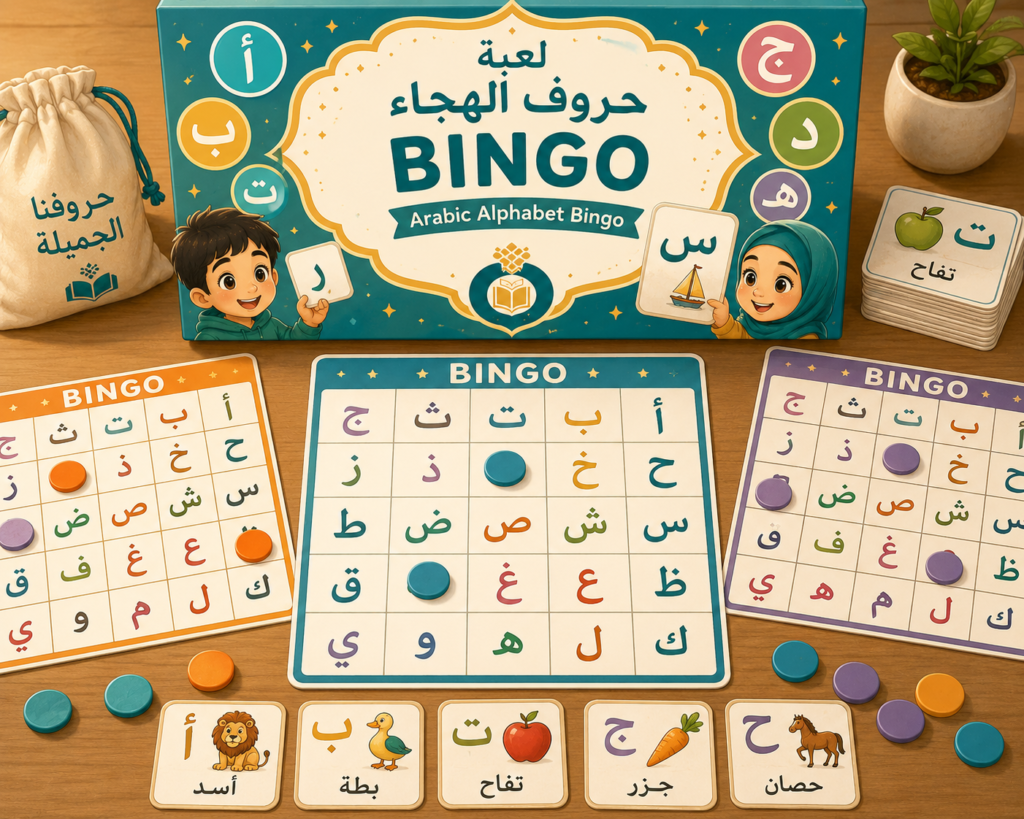
The activity can be completed in just 10–15 minutes, but children may encounter the same Arabic letters several times during one session. That repetition is valuable because early alphabet learning depends heavily on repeated exposure.
You can make the game more challenging by asking children to identify the letter by its sound rather than simply saying its name. You can also ask them to give one Arabic word beginning with the letter before they are allowed to mark their square.
For younger children, use fewer letters at a time. Once they become comfortable, introduce all 28 Arabic letters.
2. Arabic Flashcard Memory Match
Best for: Vocabulary and letter recognition
Recommended age: 4–10
Lay pairs of cards face-down. One card can show an Arabic letter while its matching card shows a picture of a word beginning with that letter. Children take turns flipping two cards and trying to find a match.
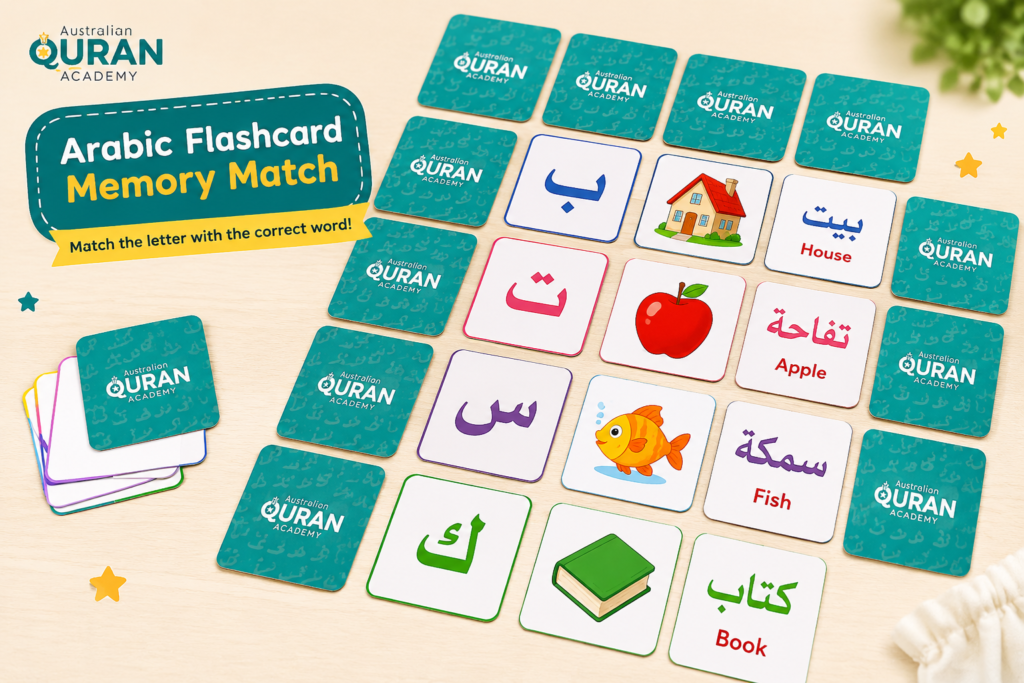
For example:
| Letter Card | Picture Card | Arabic Word | English Meaning |
| ب | House illustration | بيت | House |
| ت | Apple illustration | تفاحة | Apple |
| س | Fish illustration | سمكة | Fish |
| ك | Book illustration | كتاب | Book |
When a child finds a pair, ask them to say the Arabic letter and word aloud. This small addition turns a simple memory game into speaking practice as well.
The game can grow with the child’s vocabulary. Beginners might use four or five pairs, while older children can handle ten or more. You can also reverse the matching system by pairing Arabic words with pictures rather than letters.
The key advantage is that children are not learning vocabulary in isolation. They are connecting the written letter, spoken sound, visual object, and Arabic word in the same activity.
3. Arabic Alphabet Hopscotch
Best for: Letter recognition and vocabulary through movement
Recommended age: 4–8
Take a traditional hopscotch game and replace the numbers with Arabic letters. Draw the grid outdoors using chalk and write one Arabic letter in each square.
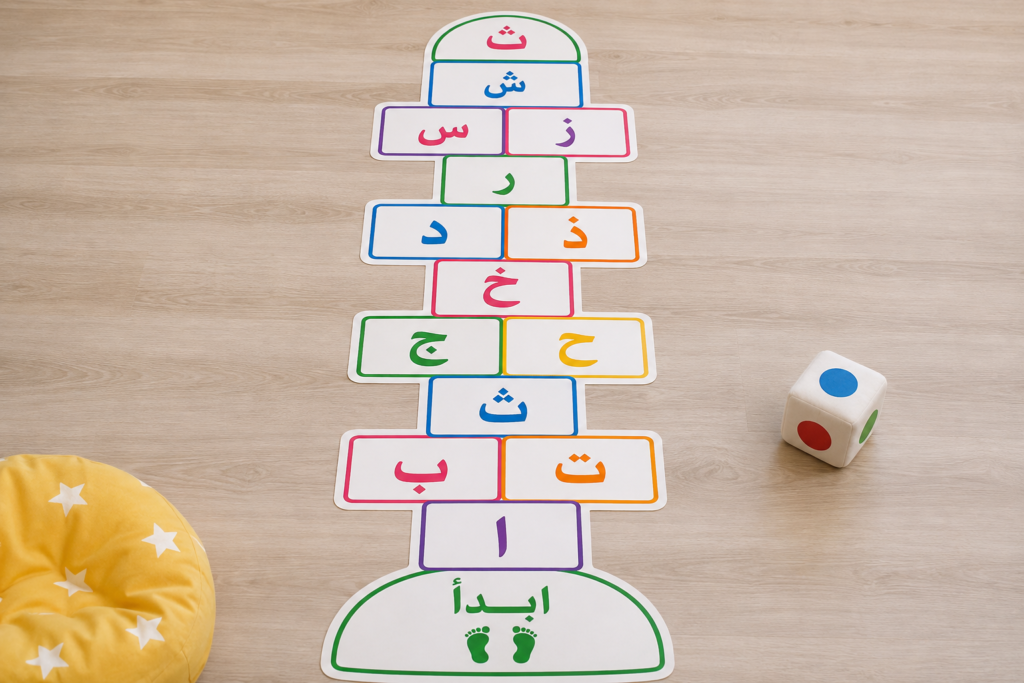
As children hop from one square to another, they call out the name of each letter. To make the game more advanced, ask them to say an Arabic word beginning with that letter before moving to the next square.
For example, when they land on م, they might say ماء (water) before continuing.
This is particularly useful for younger children who struggle with activities that require them to sit at a desk. Movement gives them another way to engage with the language while keeping the activity playful.
For beginners, focus only on identifying letters. Once recognition becomes automatic, add vocabulary. Older children can even be asked to produce two words for each letter.
No special materials are required beyond chalk, making this one of the simplest Arabic games for kids to organise at home.
Children ready to move beyond games into structured sentence-building can explore Australian Quran Academy’s Arabic for Beginners course, where Arabic can be developed through a more systematic learning path.

4. Arabic Freeze Dance
Best for: Listening comprehension and beginner vocabulary
Recommended age: 4–8
Play Arabic children’s songs or let children dance while you call out familiar Arabic vocabulary. When the music stops, say a word and ask the children to freeze in a pose representing its meaning.
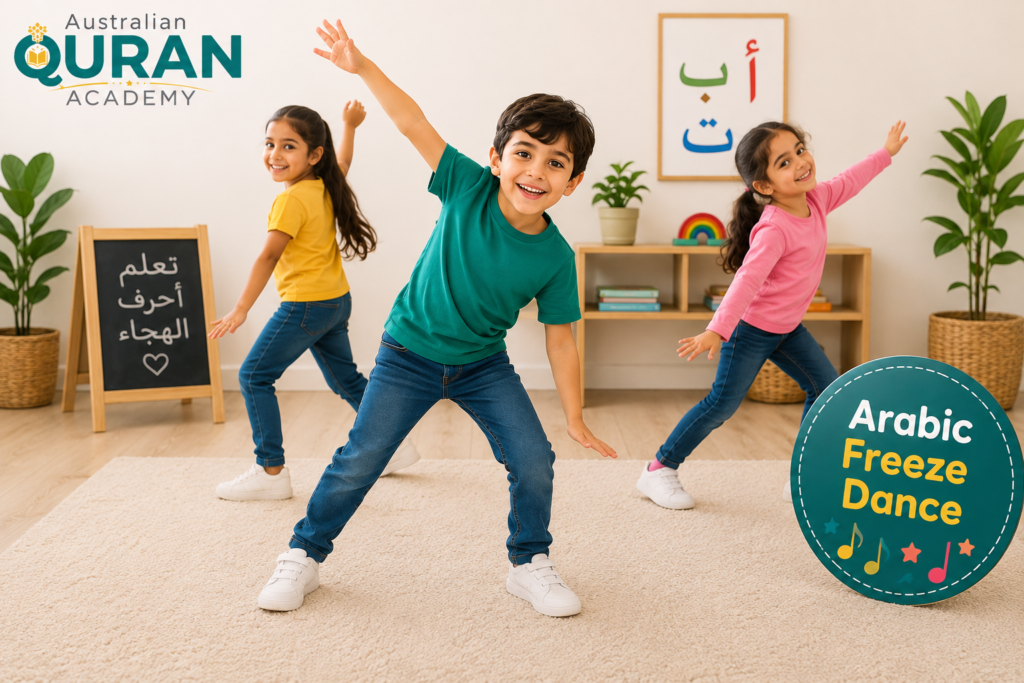
For example:
- قطة — cat: freeze like a cat.
- شجرة — tree: stretch your arms like branches.
- كبير — big: make yourself as large as possible.
- صغير — small: make yourself tiny.
- يجري — runs: freeze in a running position.
The physical response gives children a way to demonstrate comprehension without immediately requiring them to speak complete sentences.
Start with concrete nouns that children can easily act out. As their vocabulary grows, introduce adjectives and action verbs.
You can also make the game more challenging by saying a short phrase rather than a single word. For example, instead of قطة, say القطة تنام — “The cat is sleeping.” Children then need to understand the phrase before creating their frozen pose.
Read also: 10 Arabic Poems for Kids That Make Language Learning Stick
5. Arabic Storytelling Cards
Best for: Speaking confidence and sentence building
Recommended age: 4–12
Create a collection of simple picture cards showing animals, people, food, places, objects, and actions. Ask the child to draw three random cards and create a sentence or short story using them.
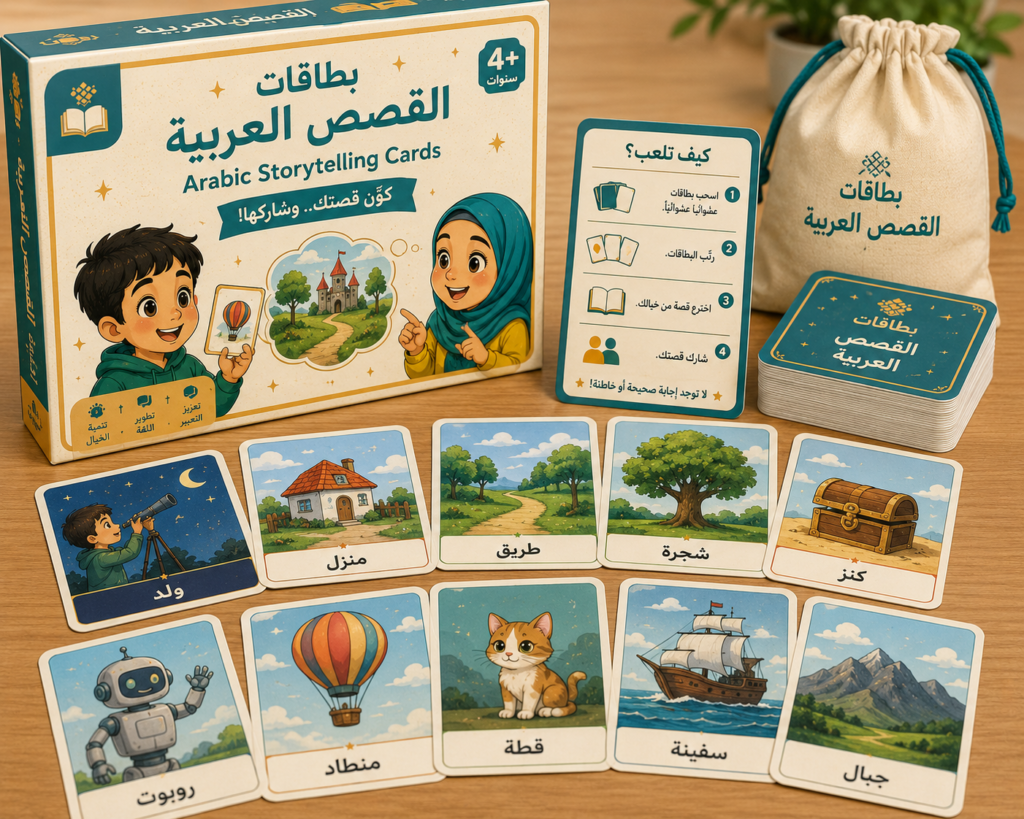
For younger children, one Arabic word per card may be enough. A child might draw a dog, house, and ball and practise the individual words.
For older children, require a complete sentence such as:
الكلب قرب البيت.
“The dog is near the house.”
As children improve, introduce more cards and require longer stories.
The important part is not perfect grammar. Children need opportunities to experiment with Arabic and discover that the language can be used to express their own ideas.
Parents should therefore avoid interrupting every mistake. Correct only errors that prevent understanding or one or two target structures you are deliberately practising.
See Us in Action!
Curious about what our online classrooms look like? Watch the short clips below to see how our interactive, one-on-one sessions bring learning to life with real-time feedback and engaging teaching methods.
Start Your Quranic Journey in Australia
Join our leading online academy and learn with expert tutors through a structured, personalized curriculum.
Book Your Free Trial6. Arabic Pictionary
Best for: Vocabulary and visual memory
Recommended age: 6–12
Arabic Pictionary turns vocabulary review into a drawing challenge.
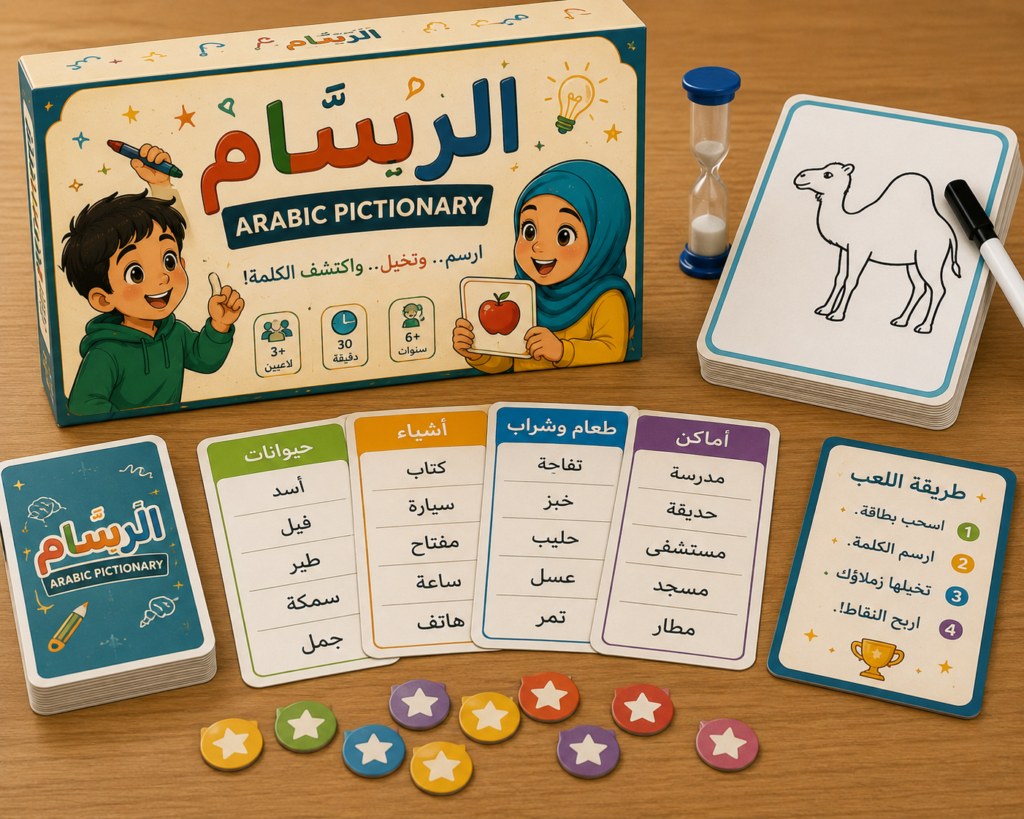
One child chooses a word and draws it without speaking. The other players must guess the Arabic word. Start with simple concrete nouns such as animals, foods, colours, clothing, and household objects.
For example, a child might draw a cat while the others try to say قطة.
Once children become comfortable, introduce verbs. Drawing يأكل (eats) or يجري (runs) is more challenging because children have to communicate an action rather than a physical object.
A colour-only round is particularly useful for younger children. Every player must draw something representing a particular colour, while the others guess the Arabic colour name.
The game can also become a vocabulary review tool. Before playing, select 10 words from the child’s recent Arabic lessons and use only those words in the game.
Read also: Arabic Vocabulary for Kids – Easy Words, Phrases & Fun Learning Activities
7. Arabic Scrabble Variants
Best for: Spelling, vocabulary, and Arabic letter forms
Recommended age: 8+
You do not need an official Arabic Scrabble board to play this game. Create simple letter tiles using index cards, with one Arabic letter on each card and multiple copies of commonly used letters.
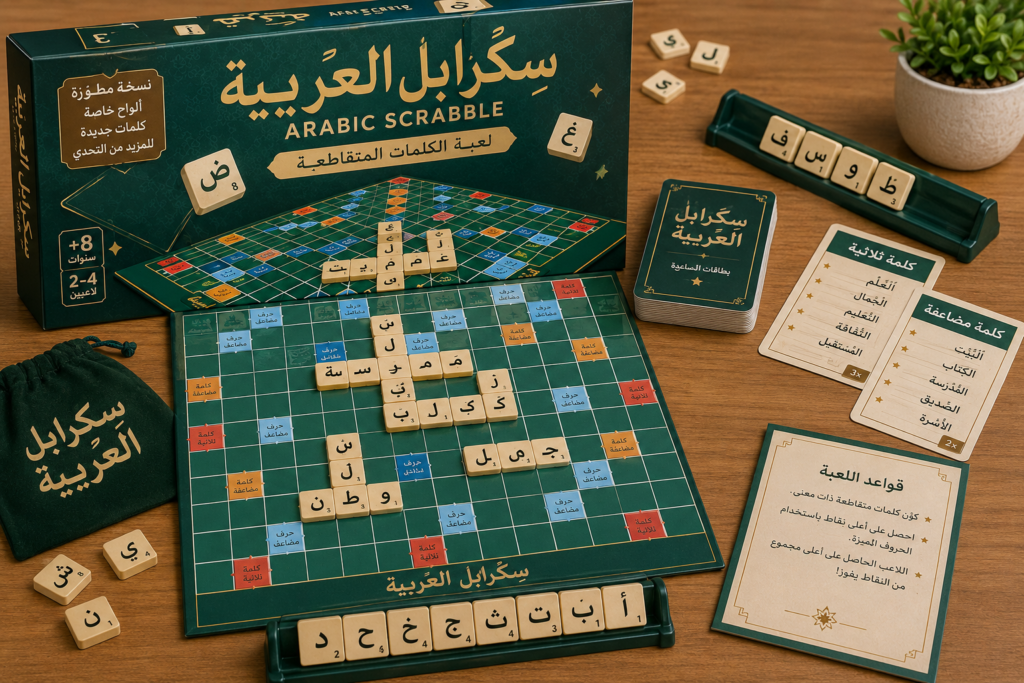
Children draw tiles and build Arabic words from them. Award points according to word length or introduce additional rules for older learners.
| Age Group | Rule Adaptation | Skill Focus |
| Ages 8–10 | Three-letter words only | Basic spelling |
| Ages 11–13 | Any word length | Expanded vocabulary |
| Ages 14+ | More advanced vocabulary | Roots and word structure |
One particularly useful feature of Arabic word-building games is that children encounter different letter forms naturally.
They begin to notice that a letter such as ب can look different depending on whether it appears at the beginning, middle, or end of a word. Instead of memorising this as an abstract grammar rule, they encounter it repeatedly while constructing real words.
Older students who are ready to formalise their understanding of Arabic structure can continue with Australian Quran Academy’s Arabic Grammar course.

8. Arabic “I Spy” Letter Sound Game
Best for: Phonemic awareness and everyday vocabulary
Recommended age: 4–10
This is one of the easiest Arabic games for kids because it requires almost no preparation.
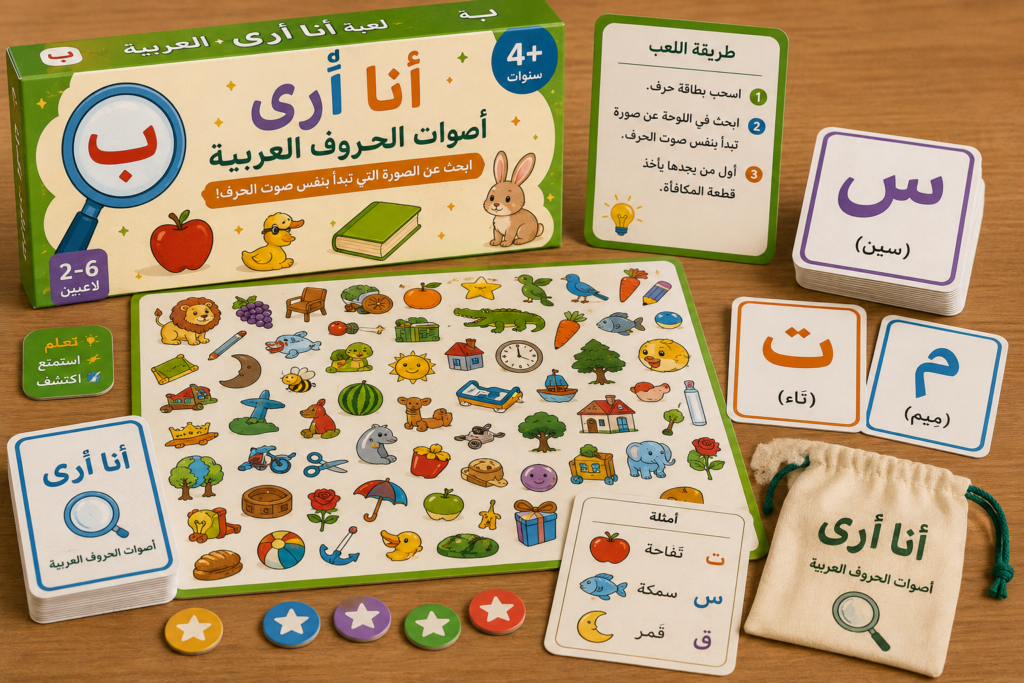
Choose an object that the child can see and say:
“I spy something starting with Alif — أ.”
The child looks around the room and tries to identify an object beginning with that sound.
You can play it with household objects, pictures in a book, items in a supermarket, or things you see while travelling.
The game becomes more useful when children are encouraged to say the Arabic word rather than simply point to the object.
For example, if the target sound is ب, a child might identify باب (door) or بيت (house).
For younger children, focus on recognising the initial sound. Older children can be challenged to find several words beginning with the same letter.
Because the game can happen spontaneously, it is an excellent way to add small amounts of Arabic practice to everyday life without scheduling another formal lesson.
9. Arabic Yes-or-No Quiz
Best for: Listening comprehension and vocabulary confidence
Recommended age: 4–12
Ask children simple Arabic questions and let them respond with a thumbs-up or thumbs-down.
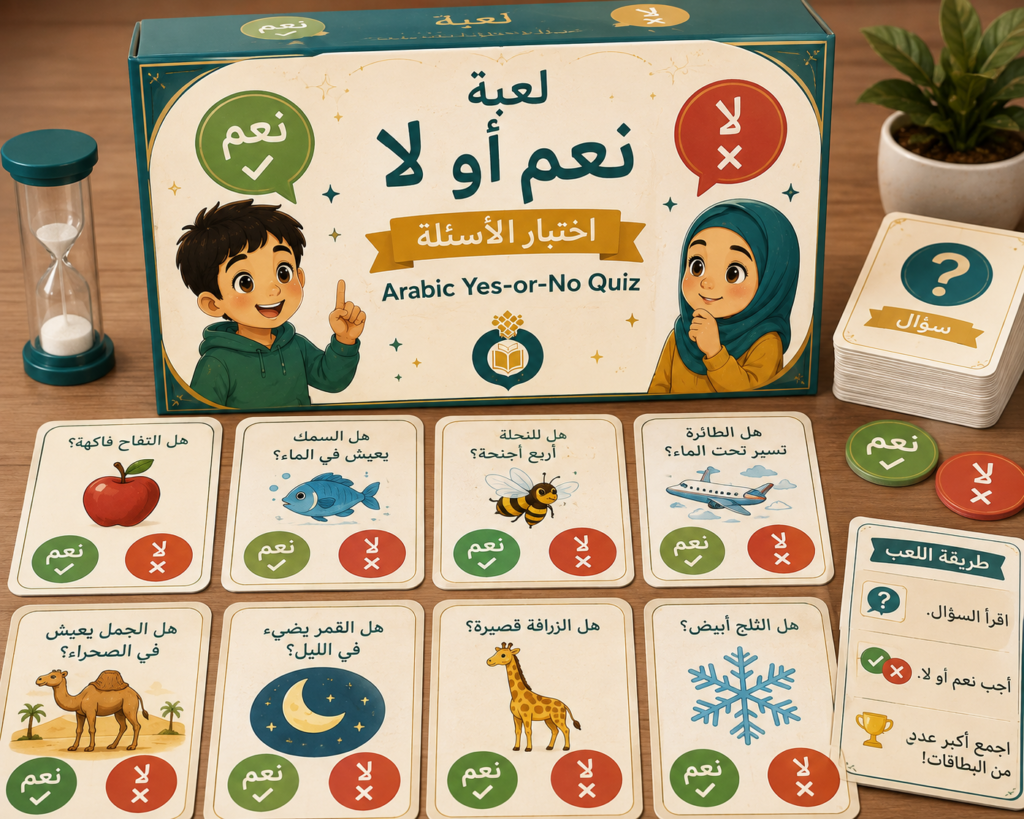
For example:
- قمر — Is this the moon?
- كلب — Is this a cat?
- تفاحة — Is this an apple?
- شجرة — Is this a tree?
The beauty of this activity is that children do not need to produce Arabic immediately.
For beginners, producing a word while simultaneously trying to understand a question can be difficult. A yes-or-no format allows them to focus on comprehension first.
Once children become comfortable, gradually remove the visual support and ask them to answer verbally.
You can also turn the game into a correction challenge. Deliberately make some statements wrong and ask children to identify them.
For example:
“الكلب قطة.”
“The dog is a cat.”
The child can respond “No” and then give the correct Arabic word.
This creates a natural bridge from comprehension toward speaking.
Read also: How to Teach Kids Arabic in Australia? – 10 Practical Steps That Actually Work
10. Arabic Letter Sand Tracing
Best for: Letter formation and early writing
Recommended age: 4–7
Fill a shallow tray with fine sand or salt. Call out an Arabic letter and ask the child to trace it with their finger.
If the child makes a mistake, simply smooth the surface and let them try again.
The activity is particularly useful for children who can recognise Arabic letters but have difficulty forming them correctly. Instead of concentrating on pencil control, they can focus on the shape and movement of the letter.
Start with individual letters. Once children become comfortable, ask them to trace simple combinations or short words.
Parents can make the activity more interactive by saying the letter aloud while the child traces it. The child then receives auditory, visual, and tactile input at the same time.
For children who dislike worksheets, this can provide a low-pressure introduction to Arabic writing before moving to pencil-and-paper practice.
How to Make Arabic Games More Effective?
The game itself is only part of the learning process. How you use it matters just as much.
Keep Sessions Short
Young children rarely need a 45-minute game session. Ten to twenty minutes of focused practice can be enough, especially when the activity is repeated regularly.
The goal is to finish while the child is still enjoying the game rather than continuing until they become frustrated.
Repeat Familiar Vocabulary
Do not introduce completely new vocabulary every time you play. Reuse words from previous games.
A child might encounter بيت in Flashcard Memory Match, then use it again in Storytelling Cards, and finally hear it during an I Spy activity.
Repeated encounters in different contexts help transform recognition into usable vocabulary.
Increase Difficulty Gradually
A good Arabic game should grow with the child.
Start with:
Letter → word → phrase → sentence → short conversation.
For example, a child may first identify ب, then say بيت, then say البيت كبير, and eventually answer a question about the house.
This keeps the activity challenging without making it overwhelming.
Focus on Communication, Not Perfection
Games should create positive associations with Arabic. Correct every single mistake and the child may begin to associate Arabic with failure rather than communication.
Choose one or two things to correct during each session and let the rest of the conversation continue naturally.
Inside Our Virtual Classrooms
We believe in full transparency and proven quality. Take a look at these actual snippets from our live classes to experience our modern learning platform, patient instructors, and interactive student participation.
Give Your Child Structured Arabic Learning at Australian Quran Academy
Games build the spark. Structured instruction helps turn that spark into lasting Arabic ability.
Australian Quran Academy offers online Arabic and Quranic education for learners at different levels, with structured learning pathways covering foundational literacy through more advanced Arabic skills.
For children who are beginning to develop their Arabic skills, structured instruction can complement the informal practice they receive through games. A teacher can identify gaps in pronunciation, reading, vocabulary, grammar, and sentence construction and then organise lessons around those needs.
The most effective approach is not to choose between games and structured lessons. Use games to make Arabic part of everyday life, then use guided instruction to organise and deepen what the child is learning.
Book Your Child’s Free Trial Lesson →
Our Arabic Courses
- Online Arabic Academy
- Online Arabic Course
- Classical Arabic Course
- Arabic Course for Beginners
- Advanced Arabic Course
- Quranic Arabic Course
- Arabic Grammar Course
- Modern Standard Arabic Course
- Arabic Conversation / Speaking Course
- Intensive Arabic Course
- Online Arabic Classes for Kids
- Arabic Classes for Adults
- Arabic Classes for Ladies
- Fusha Arabic Course
- Business Arabic Course
- Al-Azhar Arabic Course
- Madinah Arabic Course
- Learning Arabic for Non-Arabic Speakers
- Arabic Elementary School
- Arabic Intermediate School
- Arabic Lessons for Kindergarten
Start Your Quranic Journey in Australia
Join our leading online academy and learn with expert tutors through a structured, personalized curriculum.
Book Your Free Trial
Conclusion
Arabic games for kids make language learning active, engaging, and memorable. The 10 activities in this guide support key skills including letter recognition, vocabulary, listening, speaking, spelling, and early writing.
Choose games based on your child’s current level, keep sessions short and regular, and repeat useful vocabulary in different contexts. Games are excellent for building confidence and motivation, while structured Arabic instruction provides the guidance and progression needed for deeper language development.
Games make Arabic fun. Consistent practice makes it familiar. Structured learning turns that familiarity into real language ability.
Frequently Asked Questions
What are the best Arabic games for kids who are just starting to learn the alphabet?
Arabic Alphabet Bingo builds letter recognition, while Sand Tracing helps children practise letter formation through touch.
How old should a child be before starting Arabic language games?
Many games can start around age three. Movement games suit younger children, while vocabulary and word-building games work well as they get older.
How often should children play Arabic games each week?
Two to four sessions per week, lasting 10–20 minutes, can work well. Regular practice is more important than long sessions.
Can Arabic games replace formal Arabic lessons?
No. Games reinforce vocabulary, listening, and motivation, while structured lessons provide systematic instruction in pronunciation, reading, writing, and grammar.
When is a child ready to move from Arabic games into structured classes?
When they can recognise basic Arabic letters, understand simple vocabulary, follow instructions, and participate in more structured activities, they can begin formal learning.
Do these games work for children who have never heard Arabic before?
Yes. Games like Freeze Dance, Yes-or-No Quiz, Sand Tracing, and Alphabet Bingo can introduce Arabic gradually through movement, repetition, and context.
What is the best way to keep children interested in Arabic games?
Rotate different activities, let children make simple choices, and keep sessions short. Most importantly, keep the experience fun rather than turning every game into a formal lesson.






Leave a Reply