 Quran
Quran

Australian Muslims who speak English as their primary language have a clear, structured path to Quranic learning — one that no longer requires Arabic fluency or proximity to a local Islamic centre.
Knowing how to learn Quran in English in Australia means finding a method that fits real Australian life — after-school routines, shift work schedules, and the distance many families face from qualified teachers in regional towns across New South Wales, Queensland, and Western Australia.
Step 1. Learn Quran in English in Australia with a Clear Intention
Setting a sincere intention (niyyah) is the first and most essential step before any Quranic study begins. Every act of worship in Islam is measured by the purpose behind it — not by speed or volume.
Take a quiet moment before your first lesson and say inwardly: “I am doing this to seek Allah’s guidance and draw closer to Him.” This single step transforms study from a task into an act of worship from day one.
Select a Reliable Modern English Quran Translation
Two translations work best for English-speaking beginners. The Clear Quran uses contemporary, natural English without archaic phrasing that obscures meaning. Sahih International is the other widely trusted option, valued for scholarly precision and global acceptance.
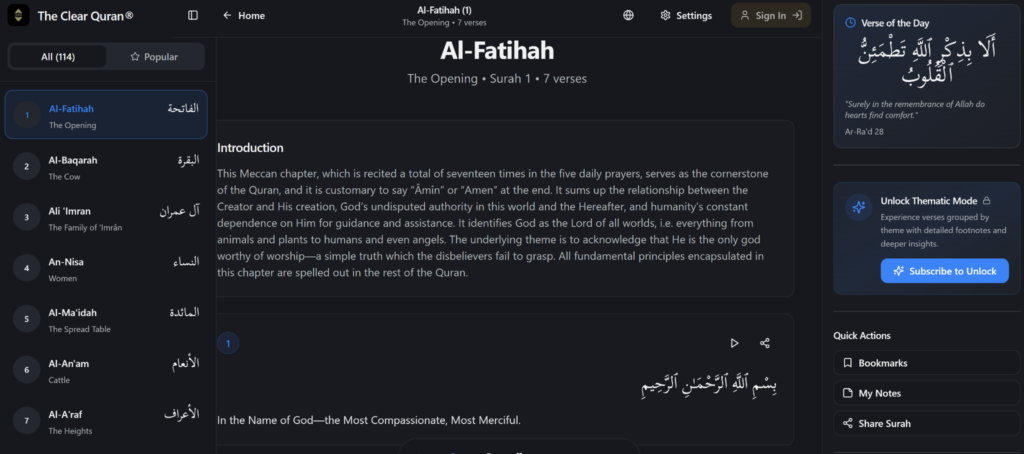
Choose one and stay with it throughout your study. Switching between multiple translations in the early stages creates confusion rather than depth.
Treat Your English Translation as an Entry Point
English translations are scholarly interpretations — not word-for-word equivalents of the original Arabic. A single Quranic word like taqwa (God-consciousness) or sabr (patient perseverance) carries layers of meaning that no English word fully captures.
Your translation opens the door to the Quran’s meanings. Deeper understanding grows as your Arabic reading and vocabulary develop over time.
See Us in Action!
Curious about what our online classrooms look like? Watch the short clips below to see how our interactive, one-on-one sessions bring learning to life with real-time feedback and engaging teaching methods.
Start Your Quranic Journey in Australia
Join our leading online academy and learn with expert tutors through a structured, personalized curriculum.
Book Your Free TrialStep 2. Master Arabic Letters Through Noorani Qaida
Arabic letter recognition is the non-negotiable foundation of Quranic reading. English-medium instruction does not remove this requirement — it makes the teaching process faster and clearer by explaining every concept in plain English from lesson one.
The Arabic alphabet contains 28 letters. Most change shape depending on their position in a word — initial, medial, final, or isolated. This connected-script stage is where most self-studying beginners stall without structured guidance.
Group Arabic Letters by Shared Base Shape
Arabic letters are not 28 completely independent shapes. Several share a base form and differ only in dot placement. The letters ب (Baa), ت (Taa), and ث (Thaa) all share the same “boat” base — only dots distinguish them.
Learning letters in these shape-based clusters cuts memorisation time significantly compared to studying each letter in complete isolation.
Build Correct Articulation Points from Lesson One
Each Arabic letter has a precise articulation point (Makhraj) in the throat, tongue, or lips. A small articulation error changes a Quranic word’s meaning entirely.
Students who skip Makharij at the beginning spend far more time in correction later. Getting this right from the very first lesson is the highest-value investment a beginner makes in their entire Quranic journey.
Australian Quran Academy’s Noorani Qaida Course takes complete beginners through every letter, shape group, and articulation point in structured English-language online sessions with Ijazah-certified instructors.
Start your Arabic foundation with expert guidance today
Step 3. Read Quranic Words Using Arabic Vowel Markers
Once Arabic letters are recognised confidently, the next step is reading them with their short vowel markers — called Harakat. These small signs placed above and below letters tell you precisely how to pronounce each syllable.
There are three primary vowels: Fathah (ـَـ) producing an “a” sound, Kasrah (ـِـ) producing an “i” sound, and Dammah (ـُـ) producing a “u” sound. Together, they bring written letters to life as spoken Quranic words.
Blend Vowel Sounds Across Connected Quranic Letters
Take the Quranic word “كُتِبَ” (kutiba), meaning “it was written.” The Dammah on the first letter, Kasrah on the second, and Fathah on the third produce the syllable sequence ku-ti-ba.
This is the direct mechanical process of Quranic reading: identify each letter, apply its vowel, and blend right to left across the connected word.
Recognise Tanween and Shaddah in Quranic Text
Tanween (doubled vowel markings) adds an “n” sound to the final vowel of a word, producing “-an,” “-in,” or “-un.” The Shaddah (ـّـ) doubles a consonant and requires a brief pause before its release.
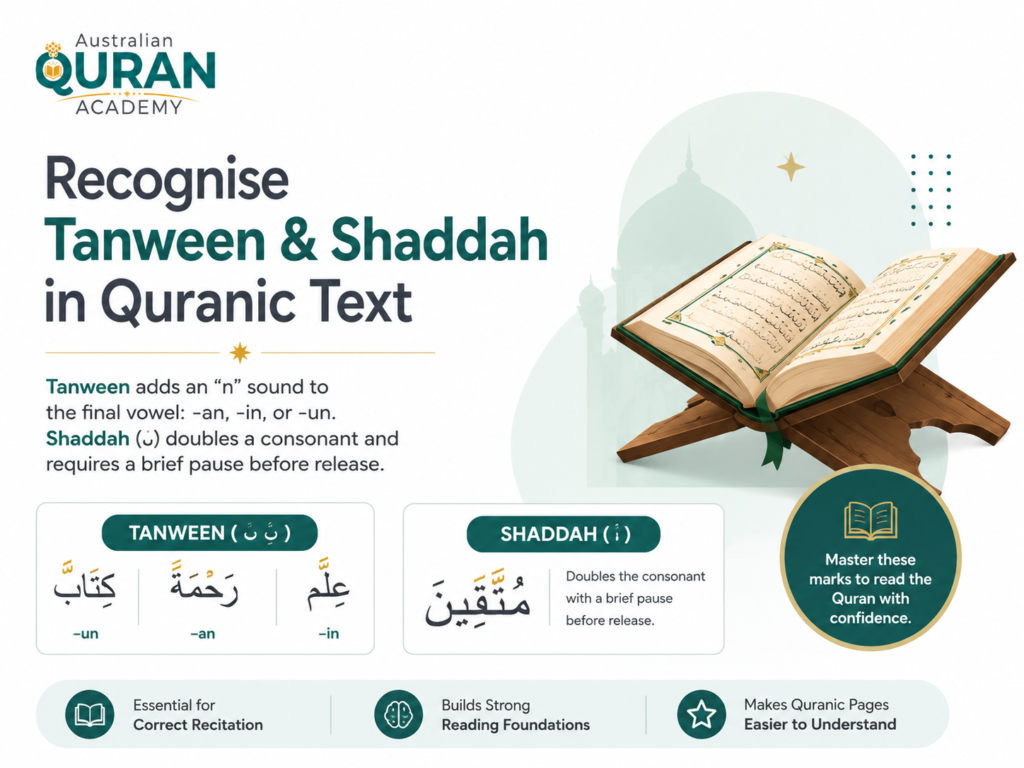
Both markings appear constantly throughout Quranic text. Getting comfortable with them early makes full Quranic pages far less intimidating when you first encounter them independently.
Step 4. Apply Foundational Tajweed Rules for Correct Recitation
Tajweed is the science of reciting the Quran with correct pronunciation, rhythm, and sound. Applying even basic Tajweed rules from day one prevents deeply embedded errors that become very difficult to correct once they become habitual.
Allah emphasises the importance of precise Quranic recitation clearly:
وَرَتِّلِ الْقُرْآنَ تَرْتِيلًا
(Wa rattil il-Qur’āna tartīlā)
(“And recite the Quran with measured recitation.”)
Learn Madd Elongation Rules for Accurate Recitation
The Madd rule requires elongating a vowel sound for two counts when a short vowel is followed by its corresponding long vowel letter (ا، ي، or و). In the word “قَالَ” (qaala), the sound “qaa” must be held for two full counts — not cut short.
This is not a stylistic choice. Cutting a Madd short alters the phonetic structure of the Quranic text in ways that affect meaning.
Apply Izhar for Clear Noon Sound Pronunciation
Izhar means “to make clear.” When a silent Noon (نْ) or Tanwin is followed by one of the six throat letters (ء، هـ، ع، ح، غ، خ), the Noon sound must be pronounced fully and distinctly — with no nasal blending into the following letter.
This is among the most commonly violated rules by English-speaking beginners and one of the easiest to correct when addressed early with live teacher feedback.
Australian Quran Academy’s Online Tajweed Classes teach these rules in English with real-time pronunciation correction. No pre-recorded video catches articulation errors the way a live qualified teacher does.

Refine your recitation with structured Tajweed instruction today
Step 5. Build a Daily Quran Study Routine in Australia
One of the most consistent reasons Australian Muslims stall in Quranic learning is not a lack of motivation — it is a structural mismatch between rigid class timetables and the realities of Australian family and work life.
Consistency over volume is the key principle. Fifteen focused minutes daily produces far more lasting progress than a two-hour session once a fortnight. Small repeatable habits compound rapidly across months.
Fit Quran Practice into Australian After-School Hours
School-aged children across Australia typically finish classes between 3:00 and 3:30 PM. Online Quran sessions scheduled from 5:00 to 7:00 PM AEST slot naturally into the after-school window — after homework and before dinner — without competing with Saturday morning sport commitments.
Short sessions of 20 to 30 minutes work best for primary school children. Secondary students can comfortably manage 30 to 45 minutes per session. Families in Perth operating on AWST can shift the same window two to three hours earlier without disrupting the daily structure.
Design a Simple Daily Practice Habit for Adults
Adults with shift work, healthcare rosters, or long commutes need a practice structure that fits available pockets of time — not ideal conditions.
A practical three-part habit works well: five minutes of Arabic letter or vowel marker review, five minutes of slow Quranic reading from a current Surah, and five minutes of listening to a certified reciter. This covers reading, recitation, and ear training in under 15 minutes daily.
Start Your Quranic Journey in Australia
Join our leading online academy and learn with expert tutors through a structured, personalized curriculum.
Book Your Free TrialStep 6. Use Digital Tools to Support Quranic Practice
Structured daily practice between lessons converts classroom knowledge into lasting skill. Several free digital tools make this practical whether you are in inner-city Melbourne or a regional town three hours from the nearest Islamic centre.
These tools do not replace a qualified teacher — they reinforce what is learned in live sessions and keep daily momentum consistent between lessons.
Use Quran.com for Daily Reading and Listening
Quran.com provides the full Quran in authenticated Uthmani script, word-by-word English translation, transliteration, and audio recitation from multiple certified reciters — entirely free of charge.
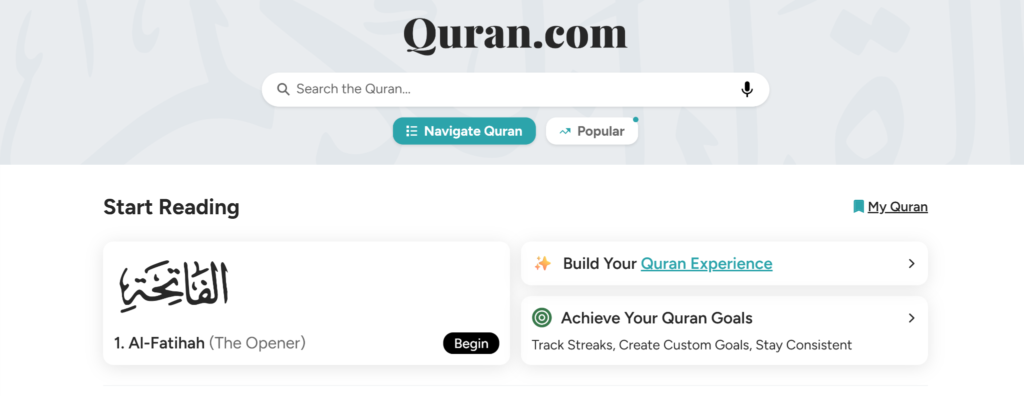
The word-by-word mode lets you tap any individual word to hear its isolated pronunciation, see its grammatical root, and read its English meaning. This trains reading recognition and basic Quranic vocabulary simultaneously.
Listen to Murattal Recitation for Quranic Ear Training
Active listening to certified reciters in Murattal style — measured, rule-compliant recitation — builds an internal sound model that correction alone cannot produce. Sheikh Mahmoud Khalil Al-Husary’s Murattal recording is widely recommended for beginners due to its clarity and steady pace.
Many students listen during daily commutes on public transport across Sydney and Melbourne — a practical use of travel time that compounds meaningfully over weeks of consistent listening.
Step 7. Find a Qualified Quran Teacher in Australia
The Quran was transmitted from the Prophet ﷺ to his Companions through direct oral instruction — voice to voice, person to person. That tradition of verified transmission continues today through the Ijazah system: a certified chain linking every qualified reciter back to the Prophet ﷺ himself.
No app, worksheet, or pre-recorded video replicates the real-time ear of a trained teacher. Makhraj errors — the most damaging category of recitation mistake — are often completely inaudible to the reciter themselves. Only a qualified teacher listening live can catch and correct them precisely.
Access Certified Female Instructors for Sisters
Australian Muslim sisters who prefer learning from a qualified female teacher no longer need to compromise on instruction quality or wait for a local solution. Australian Quran Academy’s Quran Classes for Sisters pair female students exclusively with certified female Quran instructors in private, respectful online sessions.
Lessons fit around family responsibilities and are completely free from the social pressures that mixed-gender environments can create.
Choose Age-Appropriate Instruction for Young Learners
Children learn Quran differently from adults. Effective children’s instruction uses shorter sessions, positive reinforcement, and engaging activities rather than the logic-based explanations that work well for adult learners.
Instructors trained in child development hold children’s attention and build genuine confidence. Australian Quran Academy’s Online Quran Classes for Kids serve children aged 4 to 15 through structured, progressive sessions from Arabic alphabet recognition to fluent Quranic reading.
Enrol your child with a certified Quran teacher today
Step 8. Memorise Short Surahs for Daily Prayer in Australia
Memorising short Surahs from Juz Amma is the most immediately practical Quranic skill an English-speaking Australian Muslim can develop. These chapters are recited in every Salah — learning them connects study directly to daily worship.
The Prophet ﷺ said, as recorded in Sahih Bukhari:
خَيْرُكُمْ مَنْ تَعَلَّمَ الْقُرْآنَ وَعَلَّمَهُ
(Khayrukum man ta’allama al-Qur’āna wa ‘allamah)
(“The best among you are those who learn the Quran and teach it.”)
Read Also: Best Website to Learn Quran Online in Australia
Begin Memorisation with Surah Al-Ikhlas and Al-Falaq
Surah Al-Ikhlas (4 verses), Surah Al-Falaq (5 verses), and Surah An-Nas (6 verses) are the standard starting point for new memorisers. Each is short, frequently recited, and immediately applicable in daily prayer.
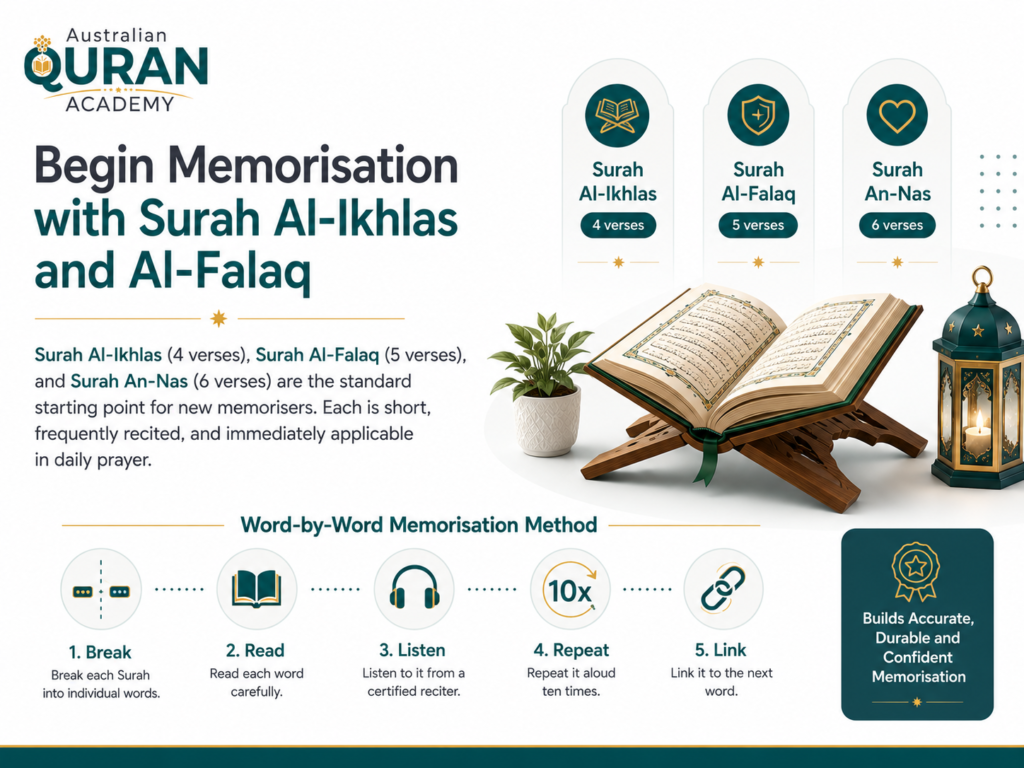
Break each Surah into individual words. Read each word, listen to it from a certified reciter, repeat it aloud ten times, then link it to the next word. This word-by-word accumulation method builds accurate, durable memorisation.
Read Also: Best Online Quran Learning Platforms In Australia
Use Consistent Revision to Retain Memorised Surahs
Memorisation without revision is lost memorisation. A simple revision rule: revise yesterday’s memorised portion before beginning any new material.
For Australian adults with busy weekday schedules, dedicated revision during the Fajr window — typically between 5:00 and 6:30 AM across AEST cities — is the most protected and consistent time slot available in a full working day.
Inside Our Virtual Classrooms
We believe in full transparency and proven quality. Take a look at these actual snippets from our live classes to experience our modern learning platform, patient instructors, and interactive student participation.
Start Your Quranic Journey in Australia
Join our leading online academy and learn with expert tutors through a structured, personalized curriculum.
Book Your Free TrialRead also: How Long Does It Take to Learn the Quran in Australia?
Book Your Free Trial at Australian Quran Academy
Australian Quran Academy brings certified, English-medium Quran instruction directly to your home — no driving across the city, no fixed local timetables, and no language barrier between you and your teacher.
Whether you are a complete beginner starting from the Arabic alphabet, an adult revert building foundations from scratch, a parent enrolling a child, or a sister seeking a qualified female instructor — a structured course and a certified teacher are ready for you right now.
Australian Quran Academy provides a complete curriculum including:
- Noorani Qaida Course for Beginners
- Online Tajweed Classes
- Quran Recitation Classes
- Online Quran Classes for Kids
- Quran Classes for Sisters
- Quran Memorisation (Hifz) Course
- Quranic Arabic Course
Our Quran Courses
- Quran Online Academy
- Quran Recitation Classes
- Quran Reading Classes
- Online Quran Classes for Kids
- Quran Classes for Adults
- Quran Classes for Female/Sisters
- Learn Quran Course for Beginners
- Quran Memorization (Hifz) Course
- Hifz Classes for Adults
- Quran Memorization and Hifz Course for Kids
- Quran Hifz Course for Ladies
- Quran Ijazah Program
- Quran Qirat Learning Course
- Quran Tafsir Course
- Noorani Qaida Course
- Noorani Qaida Course for Kids
- Weekend Quran Classes
- Intensive Quran Course
- Al-Azhar Quran Course
- Online Tajweed Classes
- Tajweed Course for Kids
- Tajweed Course for Adults
- Tajweed Course for Ladies

Book your free trial session with Australian Quran Academy now
Conclusion
Learning Quran in English in Australia follows a clear, repeatable sequence. Set your niyyah and choose a reliable English translation. Build Arabic letter recognition through Noorani Qaida. Apply vowel markers to read complete Quranic words. Learn foundational Tajweed rules from lesson one. Build a daily study habit around Australian school hours and time zones. Use free digital tools for consistent daily practice. Study with a qualified live teacher. And memorise short Surahs to connect your learning directly to daily prayer.
Geography is no longer a barrier for Australian Muslims. Online learning adapted to AEST and AWST schedules, English-medium instruction from Ijazah-certified teachers, and structured courses for every age and starting level mean the full pathway is accessible from anywhere in Australia. The only remaining step is the decision to begin.
Frequently Asked Questions
How long does it take to read the Quran fluently as an English speaker?
With consistent practice of around two hours weekly, most English speakers develop fluent Quranic reading ability within approximately three months. Tajweed proficiency deepens over six to twelve months of structured, teacher-guided study.
Do I need to learn Arabic to understand the Quran?
You do not need Arabic fluency to begin engaging with Quranic meanings — a reliable English translation provides accessible entry from day one. However, basic Arabic script recognition is necessary for recitation, and comprehension grows substantially once foundational Quranic Arabic vocabulary is in place.
Can Australian children learn Quran effectively through online classes?
Yes. Online Quran classes are highly effective for children when sessions are age-appropriate, kept to 20 to 30 minutes, and taught by instructors trained in child engagement. After-school slots from 5:00 PM AEST work well for most primary and secondary school students across Sydney, Melbourne, and Brisbane.
What is the Ijazah certification and why does it matter?
Ijazah is a verified chain of transmission certifying that a teacher received the Quran directly from a qualified teacher in an unbroken line reaching the Prophet ﷺ. It is the Islamic world’s standard quality credential for Quran instruction and guarantees both Tajweed accuracy and scholarly authenticity.
How do Australians in regional areas access qualified Quran teachers?
Online platforms resolve this entirely. Students in regional towns — from Wagga Wagga to Cairns to Bunbury — access the same Ijazah-certified teachers as students in capital cities. Australian Quran Academy schedules sessions across all Australian time zones, meaning distance from a local Islamic centre is no longer a barrier to expert Quran instruction.
Leave a Reply