 Quran
| Key Takeaways |
| Memorising the entire Quran is not an individual obligation for every Muslim, although complete Hifz remains a highly rewarded form of worship. |
| Every Muslim must learn the Quranic recitation required for valid Salah according to personal ability and the recognised rulings of Islamic jurisprudence. |
| Scholars commonly classify preserving the complete Quran through sufficient qualified memorizers as Fard Kifayah, which is a collective Muslim responsibility. |
| Accurate recitation, consistent revision, understanding, and practice matter more than pursuing an unrealistic Hifz target that cannot be maintained. |
Muslims often ask, “Is it mandatory to memorize the Quran?” after meeting a Hafiz, joining a Quran class, or considering what must be recited during the five daily prayers.
This question requires a careful distinction between personal religious duties, communal responsibilities, and voluntary worship. It also affects beginners, parents, working adults, and Muslims in Australia choosing realistic Quran learning goals.
Do You Have to Memorize the Quran?
No, memorising the entire Quran is not mandatory for every individual Muslim. Complete Hifz is strongly encouraged and greatly rewarded, but a Muslim is not sinful merely for never becoming a Hafiz.
Personal obligation concerns the Quranic recitation needed to perform Salah correctly. The required amount depends on ability and recognised juristic rulings, particularly regarding Surah Al-Fatihah and recitation behind an imam.
Communal responsibility concerns preserving and transmitting the complete Quran accurately. When sufficient qualified Muslims memorise, teach, and transmit it, that collective duty is fulfilled on behalf of the wider community.
This ruling prevents two opposite mistakes. Complete Hifz should not be presented as a universal condition of faithful Islam, while its immense spiritual value should not be reduced simply because it is voluntary individually.
Personal Duty and Communal Quran Preservation
Islamic law separates Fard Ayn, an individual obligation, from Fard Kifayah, a communal obligation. The distinction identifies what every accountable Muslim must personally fulfil and what the Muslim community must collectively maintain.
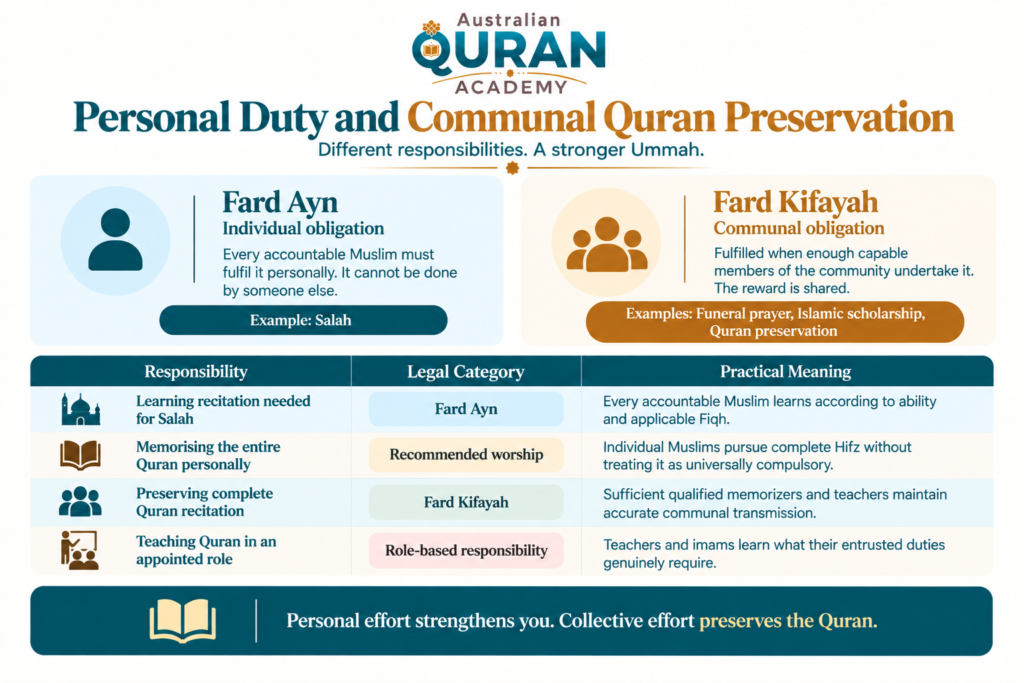
Fard Ayn cannot be completed by another person on someone’s behalf. Salah is a personal duty, so each Muslim must learn the beliefs, words, and actions necessary to perform that worship correctly.
Fard Kifayah is fulfilled when enough capable members of the community undertake it. Funeral prayer, specialised scholarship, and preservation of essential religious knowledge are familiar examples of this shared legal category.
Scholars commonly place complete Quran preservation through qualified memorizers within Fard Kifayah. Written Mushafs preserve the script, while living reciters preserve pronunciation, transmission, correction, and the practical recitation received through generations.
| Responsibility | Legal Category | Practical Meaning |
| Learning recitation needed for Salah | Fard Ayn | Every accountable Muslim learns according to ability and applicable Fiqh |
| Memorising the entire Quran personally | Recommended worship | Individual Muslims pursue complete Hifz without treating it as universally compulsory |
| Preserving complete Quran recitation | Fard Kifayah | Sufficient qualified memorizers and teachers maintain accurate communal transmission |
| Teaching Quran in an appointed role | Role-based responsibility | Teachers and imams learn what their entrusted duties genuinely require |
Read also: 7 Best Quran Memorization Websites
Quran Required for a Valid Salah
A Muslim must learn the Quranic recitation required for valid Salah according to personal ability and the Fiqh followed. For most learners, Surah Al-Fatihah is therefore the first essential memorisation priority.
The majority of Sunni jurists regard Al-Fatihah as required in every rakah for the person responsible for reciting it. Hanafi jurisprudence treats Quran recitation as obligatory while classifying Al-Fatihah through a different legal analysis.
Recitation behind an imam also contains recognised differences among the schools. A short internet answer cannot determine every congregational case, so learners should follow reliable instruction rather than combining isolated rulings independently.
The Prophet’s statement establishes the central evidence used by the majority regarding Al-Fatihah in Salah:
لَا صَلَاةَ لِمَنْ لَمْ يَقْرَأْ بِفَاتِحَةِ الْكِتَابِ
(La salata liman lam yaqra bi Fatihati al-Kitab)
(“Whoever does not recite Al-Fatiha in his prayer, his prayer is invalid.”)
Sahih Bukhari 756
This evidence establishes the importance of Al-Fatihah without proving that every Muslim must memorise the complete Mushaf. The personal duty remains connected to valid worship, ability, and relevant juristic detail.
Australian Quran Academy offers Quran Memorization Course in Australia with guided memorisation, correction, and revision suited to students pursuing structured Hifz beyond the prayer minimum.
Begin Quran memorisation with a free trial
Full Hifz as Voluntary Individual Worship
Complete Hifz remains voluntary for an ordinary Muslim who has learned what personal worship requires. Voluntary does not mean insignificant; it means Allah rewards the deed without imposing it universally upon every individual.
A Hafiz carries a remarkable blessing and a serious responsibility. Memorisation requires regular revision, accurate recitation, sincere intention, and conduct shaped by the Quran rather than public recognition or an impressive completion date.
Muslims have different capacities, responsibilities, and opportunities. One learner may complete the Quran, another may retain several Juz, while someone facing illness or disability may concentrate carefully on Al-Fatihah and selected short Surahs.
Religious commitment cannot be measured solely by memorised pages. Salah, honest dealings, family responsibilities, repentance, lawful earnings, and applying revealed guidance remain essential parts of obedience that Hifz does not replace.
See Us in Action!
Curious about what our online classrooms look like? Watch the short clips below to see how our interactive, one-on-one sessions bring learning to life with real-time feedback and engaging teaching methods.
Start Your Quranic Journey in Australia
Join our leading online academy and learn with expert tutors through a structured, personalized curriculum.
Book Your Free TrialQualified Huffaz Preserve Quran Transmission
Qualified Huffaz preserve more than the ability to repeat words without looking. They maintain accurate letter articulation, recitation rules, stopping points, textual order, and correction received directly from reliable Quran teachers.
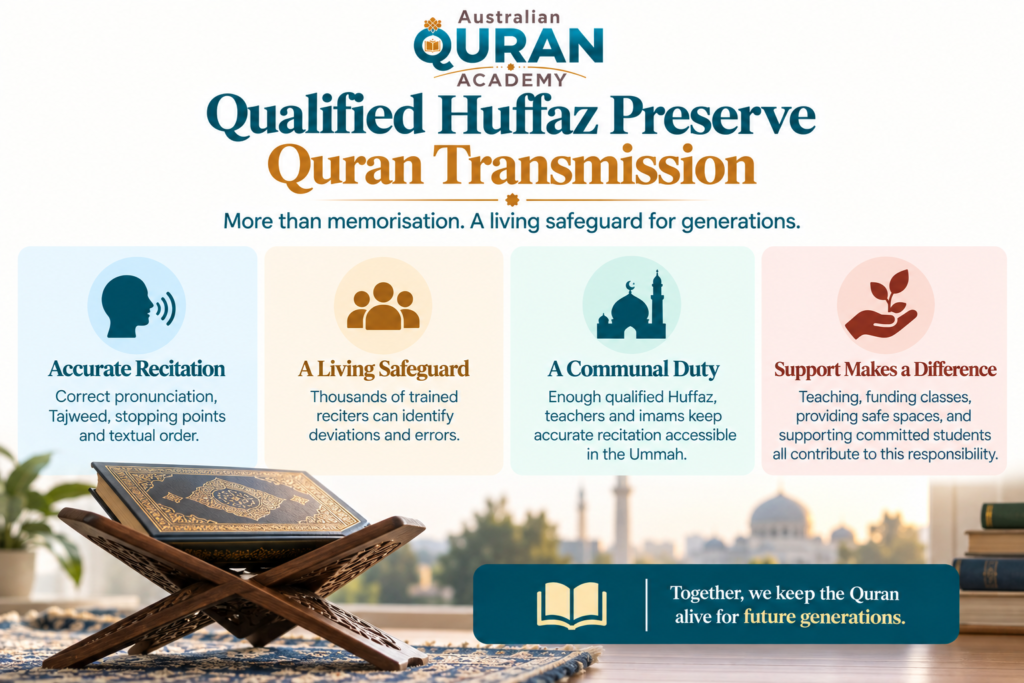
Mass memorisation also provides a living safeguard across places and generations. A written error, printing problem, or individual mistake can be identified because thousands of trained reciters know the same text and recognise deviations.
Communal preservation does not require every Muslim in every household to complete Hifz. It requires enough capable students, teachers, imams, and specialists to keep accurate recitation accessible within the wider Muslim community.
Supporting this responsibility includes teaching, funding classes, providing safe learning spaces, and helping committed students continue. Parents who facilitate sound Quran education contribute even when they have not personally memorised the entire Quran.
Adult Hifz Support Across Australia
Adult Muslims in Australia can pursue Hifz without treating one timetable as compulsory for everyone. Employment, university, parenting, health, and travel time all affect how much new material a learner can retain.
A realistic adult plan begins with an accurate assessment of current recitation. Learners who repeatedly memorise pronunciation mistakes create additional work because every weak sound must later be identified, corrected, and relearned.
Daily targets should reflect available revision time rather than enthusiasm alone. Memorising three careful lines with dependable review is more sustainable than adding one page daily while older portions disappear from memory.
Australian schedules may require early morning, evening, weekend, or online lessons. Consistency matters more than copying a timetable developed for a full-time student in a completely different family and working environment.
Australian Quran Academy offers Hifz Classes for Adults in Australia covering daily targets, systematic revision, mistake analysis, and retention methods for working adults.
Plan sustainable adult Hifz through a free trial
New Muslims and Learners With Limited Ability
New Muslims must continue praying while learning the required recitation. Genuine inability is not treated like deliberate neglect, and Islamic responsibility remains connected to what a person can reasonably learn and perform.
A beginner should seek prompt instruction rather than waiting for perfect Arabic. A qualified teacher or scholar can explain temporary recitation options according to the learner’s ability, circumstances, and recognised school of Fiqh.
Physical disability, cognitive disability, memory impairment, speech difficulty, and advanced age can affect learning.
These situations require individual guidance, patient teaching, and reasonable adaptation rather than shame or automatic accusations of negligence.
Progress should be measured against sincere effort and actual capacity. Accurate mastery of a smaller essential portion may represent greater dedication than rapid memorisation completed without correction, comprehension, or dependable long-term retention.
Tajweed Accuracy Before Expanding Hifz
Accurate pronunciation should be established before a learner rapidly expands Hifz. Tajweed means the rules governing correct Quran recitation, while Makharij identifies where Arabic letter sounds are produced.
Memorisation fixes sound patterns into memory through repetition. When the original pattern contains serious pronunciation errors, repetition strengthens the mistake and makes later correction slower, more frustrating, and less reliable.
A teacher should listen for substituted letters, missing elongation, weak Ghunnah, incorrect vowels, and unsuitable stopping points. Audio recordings support practice, but recordings cannot hear the learner or explain why a sound is inaccurate.
Beginners do not need to master every advanced rule before memorising short passages. They do need reliable correction, especially when an error changes a letter, grammatical form, or meaning within the recited text.
Australian Quran Academy offers Online Tajweed Classes in Australia that strengthen Makharij, pronunciation, elongation, and practical rule application before students expand their memorisation targets.

Check Quran pronunciation in a free trial
Revision Duties After Memorising Quran
Regular revision is necessary for preserving memorised Quran, even though ordinary forgetting can occur through human weakness. Illness, ageing, stress, trauma, and major responsibilities can all affect recall without proving deliberate disrespect.
A learner should distinguish gradual memory loss from careless abandonment. The appropriate response to weakened recall is renewed revision, sincere repentance when neglect occurred, and a manageable plan that restores passages without despair.
New memorisation should pause when older portions become unstable. Continuing to add pages may create an impressive record of completed lessons while leaving the student unable to recite earlier Surahs accurately without repeated prompting.
| Revision Level | Material Reviewed | Recommended Response |
| Daily review | Newly memorised lines and recent pages | Correct hesitation before adding another portion |
| Weekly review | Recent Surahs or one developing section | Recite to a teacher or dependable study partner |
| Monthly review | Older memorisation across several sections | Record mistakes and rebuild weak connections |
| Recovery review | Passages largely forgotten | Reduce new work and restore one section systematically |
Inside Our Virtual Classrooms
We believe in full transparency and proven quality. Take a look at these actual snippets from our live classes to experience our modern learning platform, patient instructors, and interactive student participation.
Start Your Quranic Journey in Australia
Join our leading online academy and learn with expert tutors through a structured, personalized curriculum.
Book Your Free TrialChildren’s Quran Memorisation in Australia
Children in Australia are not required to complete Hifz merely because parents prefer that achievement. Religious accountability, personal capacity, wellbeing, and readiness must guide expectations rather than comparison with another child’s progress.
Young learners often benefit from short repetition, regular listening, visual familiarity, and frequent correction.
Sessions should suit the child’s age and concentration instead of reproducing an adult schedule with longer portions and extended sitting.
Parents should monitor teaching quality, child safety, communication boundaries, and emotional responses. Firm standards can coexist with patience, but ridicule, threats, or public comparison may damage both confidence and attachment to Quran learning.
School terms, homework, sport, family commitments, and sleep require practical planning. A smaller target maintained throughout the year generally produces stronger retention than intense holiday memorisation followed by months without structured revision.
Australian Quran Academy offers Quran Memorization for Kids in Australia with age-appropriate Hifz stages, Tajweed correction, Makharij practice, and systematic retention under qualified teachers.
Assess a child’s Hifz level through a free trial
Quranic Meaning Strengthens Memorisation
Memorisation preserves the Quran’s revealed Arabic wording, while understanding helps a learner respond to its commands, warnings, promises, stories, and moral guidance. Neither purpose should be used to dismiss the other.
An English translation explains interpreted meaning but does not become the Arabic Quran itself. Translation study supports reflection, yet it cannot replace the Arabic recitation required within Salah or constitute Quran memorisation in Arabic.
Learners can connect each new passage with a reliable translation and concise Tafsir. Knowing the subject, repeated ideas, and verse sequence improves recall because the memorised words become an ordered message rather than isolated sounds.
Practice completes the relationship. A student memorising verses about truthful speech, patience, prayer, or family responsibility should identify how those teachings affect decisions rather than treating successful recall as the final objective.
Quran Memorisation Goals for Learners in Australia
Suitable memorisation goals differ according to religious need, recitation level, available time, and retention. A clear goal protects learners from pursuing complete Hifz before establishing the foundation necessary to preserve it.
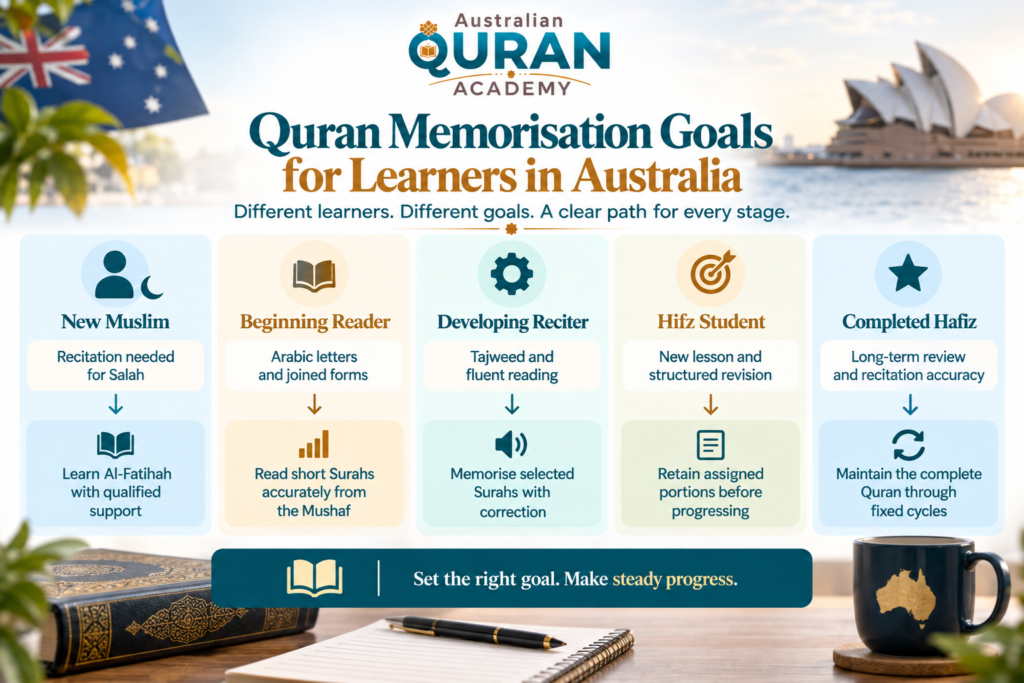
Several common learner profiles require different priorities. The most suitable starting point can be identified by comparing immediate need, current ability, and the next measurable outcome rather than assigning everyone one program.
| Learner | Immediate Priority | Suitable Next Goal |
| New Muslim | Recitation needed for Salah | Learn Al-Fatihah with qualified support |
| Beginning reader | Arabic letters and joined forms | Read short Surahs accurately from the Mushaf |
| Developing reciter | Tajweed and fluent reading | Memorise selected Surahs with correction |
| Hifz student | New lesson and structured revision | Retain assigned portions before progressing |
| Completed Hafiz | Long-term review and recitation accuracy | Maintain the complete Quran through fixed cycles |
Goals should be reviewed when circumstances change. A new job, examination period, illness, newborn child, or improved fluency may require reducing, pausing, or increasing the memorisation target without abandoning Quran learning entirely.
Read also: How To Start Memorizing Quran In Australia In 10 Steps
Sustainable Hifz Without Religious Guilt
Sustainable Hifz begins by separating genuine obligation from voluntary ambition. A learner first secures what Salah requires, then chooses additional memorisation that can be learned accurately and maintained through dependable revision.
Guilt becomes harmful when it treats missed voluntary targets as proof of spiritual failure. Constructive accountability identifies the exact problem, such as weak scheduling, insufficient correction, excessive new material, or inconsistent review.
A practical routine can divide study into three parts: older revision, recent revision, and a small new portion.
New memorisation should receive the least time once the learner has accumulated substantial material requiring preservation.
Motivation will rise and fall, so the schedule must survive ordinary low-energy days. Ten focused minutes maintained throughout a difficult month often protects more Quran than occasional long sessions driven by temporary enthusiasm.
Quran Teachers Serving Learners Across Australia
Qualified Quran teachers across Australia should combine sound recitation with the ability to diagnose individual mistakes. Knowledge alone does not guarantee effective teaching if correction is unclear, inconsistent, rushed, or humiliating.
Students should ask about teacher training, recitation credentials, lesson structure, revision expectations, and experience with the relevant age group.
Parents also need clear safeguarding practices and appropriate oversight for every child’s online lessons.
Online instruction can reduce travel between suburbs and widen access to suitable teachers. It still requires punctual lessons, stable communication, active recitation, direct feedback, and written goals that both teacher and student can evaluate.
Course choice should follow the learner’s actual level. Someone unable to read connected Arabic needs foundational reading support, while a fluent reciter with unstable memorisation requires a Hifz program built around revision and accountability.
Begin Hifz With Australian Quran Academy Teachers
Australian Quran Academy provides online instruction for beginners, adults, children, and developing Hifz students. Lessons can combine live correction, Tajweed application, personal targets, and scheduled revision according to each learner’s present level.
What sets Australian Quran Academy apart:
- Qualified instructors who listen to recitation and correct individual errors.
- Separate course pathways for children, adults, sisters, Tajweed, and complete Hifz.
- Online scheduling suited to Australian families balancing study, work, and home responsibilities.
Our Quran Courses
- Online Quran Classes for Kids
- Quran Classes for Adults
- Quran Classes for Female/Sisters
- Quran Memorization for Kids in Australia
- Online Tajweed Classes in Australia
- Hifz Classes for Adults in Australia
- Quran Memorization Course in Australia
Conclusion
Memorising the complete Quran is not an individual duty for every Muslim. The personal obligation is learning the Quranic recitation needed for valid Salah according to ability and the recognised Fiqh governing each situation.
Complete preservation remains a communal responsibility fulfilled through qualified memorizers, teachers, written Mushafs, and reliable transmission. Pursuing full Hifz is therefore deeply virtuous without becoming a universal condition for sincere Muslim practice.
Learners should prioritise Al-Fatihah, accurate pronunciation, realistic targets, and continuous revision.
A smaller portion retained carefully and practised consistently is more valuable than rapid progress that disappears through weak foundations and neglected review.
FAQs
Do you have to memorize the Quran completely?
No, you do not have to memorise the entire Quran as an individual duty. You must learn the recitation required for Salah according to your ability, while complete Hifz remains highly rewarded voluntary worship.
Is becoming a Hafiz compulsory in Islam?
No, becoming a Hafiz is not compulsory for every Muslim. Scholars commonly treat preservation of the entire Quran through sufficient qualified memorizers as a communal obligation rather than a personal duty imposed upon each believer.
Must every Muslim memorise Surah Al-Fatihah?
Most Muslims should prioritise memorising Al-Fatihah because the majority of Sunni jurists require it within Salah. Recognised differences apply to specific cases, including followers behind an imam and people genuinely unable to learn it.
Is memorising several short Surahs compulsory?
No fixed universal number of short Surahs is compulsory for every Muslim. Learning additional Surahs supports Sunnah recitation and variety in Salah, but the legal minimum depends on applicable Fiqh and individual ability.
Is forgetting memorised Quran always sinful?
No, ordinary forgetting caused by human weakness is not automatically sinful. Deliberate neglect remains blameworthy, while illness, ageing, stress, and disability require compassion, renewed revision, and individual scholarly guidance rather than automatic condemnation.
Can adults begin complete Hifz later in life?
Yes, adults can begin complete Hifz at any age when health and capacity allow. Success usually requires smaller daily portions, accurate teacher correction, substantial revision, and a schedule compatible with employment and family responsibilities.





Leave a Reply