 Quran
| Key Takeaways |
| Begin with a reading and recall assessment, then set a target the child can repeat accurately without prompting. |
| Keep new Hifz small and protect it with daily Sabaqi and Manzil rather than chasing rapid page totals. |
| Schedule short sessions around Australian school hours, prayer times, state time zones, and daylight-saving changes. |
| Use one Mushaf, one reciter, immediate correction, and weekly testing so errors do not become permanent. |
Parents learning how to help kids Memorise Quran In Australia usually face a practical problem rather than a lack of good intentions. School, homework, sport, changing prayer times, and family commitments can leave memorisation dependent on whatever time remains.
Children make steadier progress when adults replace vague goals with a small daily system. The system must separate new memorisation from recent and older revision, define acceptable accuracy, and respond calmly when a lesson is missed or a passage remains weak.
The ten steps below show how to make your child memorise Quran through actions that can be measured at home. Follow them in order, because the assessment determines the target, the target determines the routine, and the routine determines how much revision the child needs.
1. Assess Quran Reading Before Setting a Hifz Target
Begin with a short baseline test instead of assigning a surah immediately. Ask the child to read an unfamiliar five-line passage, repeat one familiar ayah after audio, and recite a previously memorised surah without prompts.
Record the number of decoding errors, pronunciation errors, prompts, and hesitations. This distinguishes a memory problem from a reading problem; increasing repetition will not repair letters or vowel signs that the child is reading incorrectly.
Use the result to choose the starting point. A child who still guesses words should pause new Hifz for focused reading work, while a fluent reader with weak recall can begin a small memorisation target alongside structured revision.
| Assessment Result | Starting Decision | First Two-Week Target |
| Frequent decoding errors | Strengthen reading first | Five accurate lines read daily |
| Accurate reading, weak pronunciation | Correct sounds before memorising | One or two corrected ayahs |
| Accurate reading, weak recall | Train repetition and retrieval | Two or three short ayahs |
| Accurate reading and recall | Begin a balanced Hifz plan | Three to five lines daily |
Australian Quran Academy offers Online Noorani Qaida Classes for Kids for children who need to secure letter recognition, joining, vowels, and accurate word reading before expanding their Hifz target.

Book a free reading assessment for your child
2. Choose One Suitable Passage and Measurable Goal
Select a passage the child can read correctly and understand at an age-appropriate level. Short surahs often suit beginners, but familiarity alone is not enough; first check every word with a reliable teacher or accurate model recitation.
Define the target as a passage, a quality standard, and a deadline. “Memorise more Quran” cannot be measured, whereas “recite three lines with no word substitutions and no more than one prompt by Thursday” gives everyone a clear result.
Set a two-week trial target and adjust it from evidence. If the child retains at least 80 to 90 per cent during delayed recall, maintain or slightly increase the portion; if not, reduce new work before adding repetitions.
Quick exercise: Mark a starting point and ending point on a printed plan, not inside the Quran. Ask the child to recite the target after ten minutes, later that day, and the next morning without looking.
3. Match Hifz Methods to Each Child’s Age
Children need different session lengths, instructions, and levels of independence as they grow. Age does not determine ability by itself, but it helps parents avoid expecting a preschooler to work like a teenager or supervising an older learner too closely.
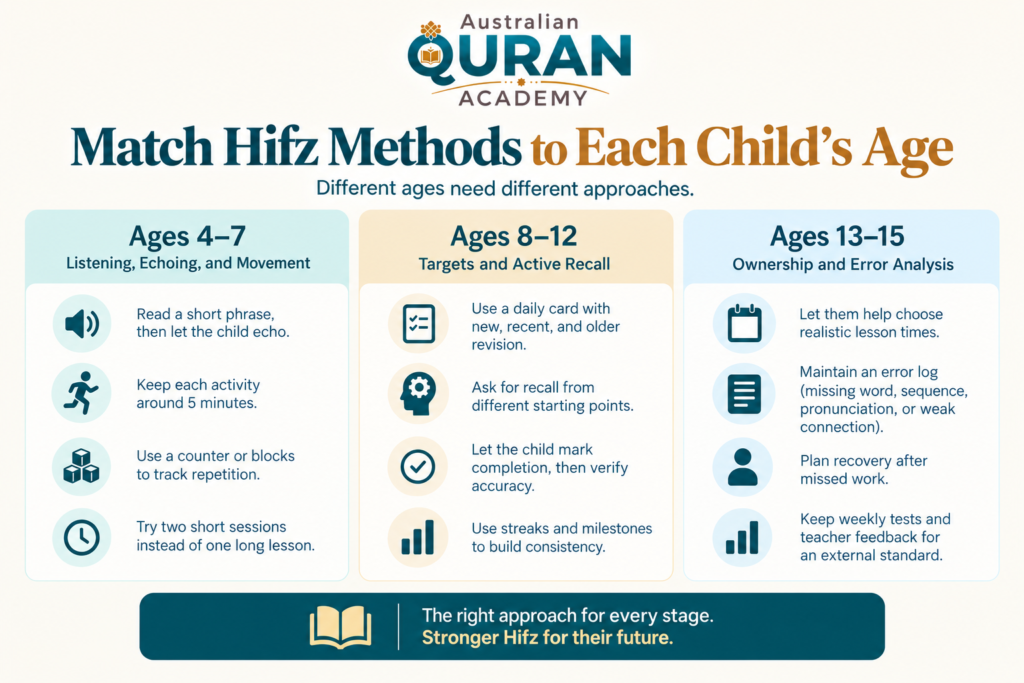
Ages 4–7 Use Listening, Echoing, and Movement
Keep one activity to about five minutes, then change the mode. The parent or teacher reads one short phrase, the child echoes it, and both join the phrases before the child recites alone.
Use a counter, blocks, or finger taps to make repetition visible without turning Quran recitation into background noise. End while attention remains available, and use two short sessions rather than one tiring lesson.
Ages 8–12 in Australia Add Targets and Active Recall
Give the child a simple daily card showing new lines, recent revision, and older revision. After guided repetition, close the Mushaf and ask for recall from different starting points instead of always beginning at the first ayah.
Invite the child to mark completion independently, but let an adult verify accuracy. This age group often responds well to streaks and milestones when rewards recognise consistency and correction rather than speed or comparison with siblings.
Ages 13–15 Build Ownership and Error Analysis
Teenagers can help select realistic lesson times, maintain an error log, and plan recovery after missed work. Ask them to label each mistake as a missing word, sequence error, pronunciation issue, or weak connection between ayahs.
Ownership does not mean removing supervision. A weekly recitation test and teacher feedback still provide an external standard, while the teenager gains responsibility for daily preparation and honest reporting.
See Us in Action!
Curious about what our online classrooms look like? Watch the short clips below to see how our interactive, one-on-one sessions bring learning to life with real-time feedback and engaging teaching methods.
Start Your Quranic Journey in Australia
Join our leading online academy and learn with expert tutors through a structured, personalized curriculum.
Book Your Free Trial4. Build a Short Daily Hifz Session in Australia
Place Hifz beside events that already happen every day, such as Fajr, breakfast, arriving home, or bedtime. For most children, a protected 15-to-30-minute session is more repeatable than an open-ended hour that competes with homework.
Families in Sydney, Melbourne, Canberra, Hobart, and Adelaide should review online lesson times when daylight saving starts or ends. Queensland, Western Australia, and the Northern Territory keep different clock arrangements, so always confirm the child’s local time.
Choose the freshest part of the day for new memorisation and a lower-energy period for familiar revision. During long summer days, do not insist that every child wait until after a late Isha if tiredness is already damaging accuracy.
| Daily Window | Task | Suggested Time |
| After Fajr or breakfast | New passage | 10–15 minutes |
| After school and a short break | Recent revision | 10 minutes |
| After Maghrib or before bed | Older revision | 10–15 minutes |
Australian Quran Academy offers Online Hifz Classes for Kids for families seeking live instruction that can be scheduled around school, family commitments, and the child’s Australian time zone.
Try a child-focused Hifz lesson
5. Teach Each Passage With One Repeatable Cycle
Use the same learning sequence until the child can perform it without reminders. A stable process reduces negotiation and shows exactly where the passage breaks down, which is more useful than simply ordering twenty repetitions.
Start with one phrase, not the full page. Let the child listen while tracking the words, repeat while looking, recite without looking, check the result, and then connect the phrase to the one before it.
Follow this six-part cycle for every small portion:
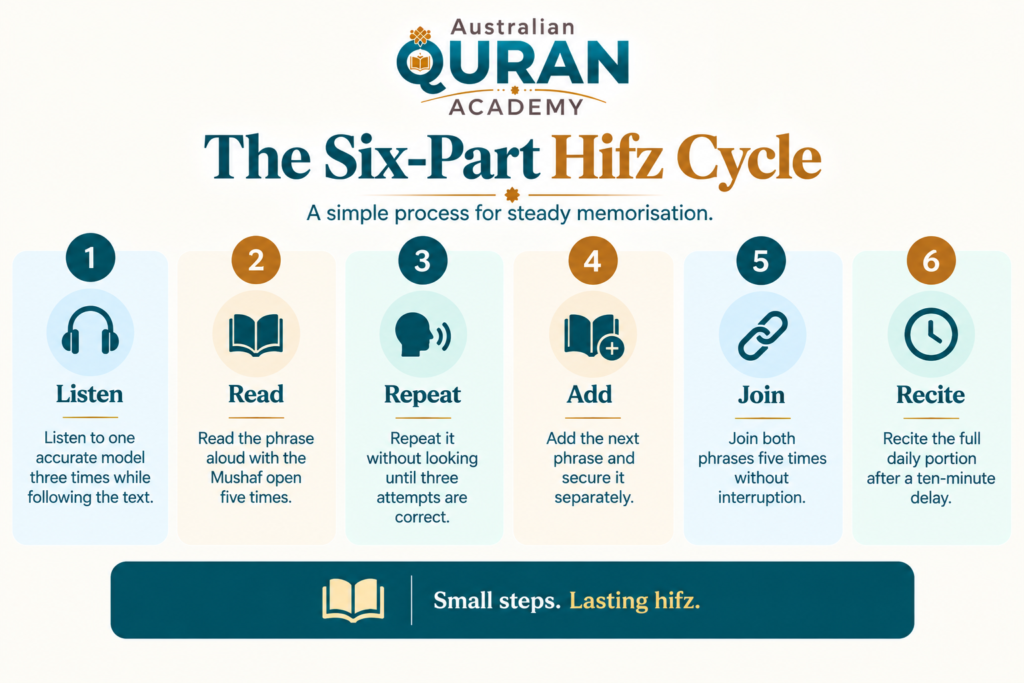
- Listen to one accurate model three times while following the text.
- Read the phrase aloud with the Mushaf open five times.
- Repeat it without looking until three attempts are correct.
- Add the next phrase and secure it separately.
- Join both phrases five times without interruption.
- Recite the full daily portion after a ten-minute delay.
Do not count a repetition containing an uncorrected mistake as successful practice. Stop, isolate the difficult word, hear it accurately, say it slowly, rebuild the phrase, and then return to the complete ayah.
Read also: How To Learn Quran Recitation In Australia?
6. Correct Tajweed Before Errors Become Memorised
Correct the child during the learning stage, not several weeks later. Hifz stores sound sequences, so a wrong letter, missing Shaddah, shortened Madd, or unsuitable stop becomes harder to remove after hundreds of repetitions.
Limit correction to the mistakes that affect the assigned passage. A beginner does not need a lecture on every Tajweed category; the child needs to hear the correct sound, compare it with the error, and produce three accurate attempts.
Use an error log with four fields so feedback remains specific:
| Date | Word or Location | Error Type | Correct on Next Test? |
| Monday | Line 2 | Letter sound | Yes or no |
| Tuesday | End of ayah | Missing Madd | Yes or no |
| Wednesday | Ayah connection | Word omitted | Yes or no |
Australian Quran Academy offers Online Tajweed Classes for Kids to help children hear and apply pronunciation rules during live recitation rather than relying only on a recording or an adult’s uncertain correction.

Let a teacher check your child’s Tajweed
7. Protect New Hifz With Layered Daily Revision
Divide revision into three layers. Sabaq means the new daily portion, Sabaqi means recently memorised passages that are still settling, and Manzil means older memorisation requiring continuous rotation.
Give revision more time than new work. A useful starting ratio is two units of revision for every one unit of new memorisation, then increase the older review whenever delayed recall falls below the agreed accuracy standard.
Use three review points for each new passage: later on the same day, the following morning, and at the end of the week. These delayed attempts reveal retention more honestly than repeated recitation completed in one sitting.
| Hifz Layer | What the Child Recites | Correction Rule |
| Sabaq | Today’s new lines | Stop and repair every error |
| Sabaqi | Recent lessons | Repeat weak connections three times |
| Manzil | Older surahs or pages | Log patterns and retest within 48 hours |
Pause new memorisation when old material is collapsing. A smaller secure portion is genuine progress; a growing total that cannot be recited without repeated prompts is only an unfinished workload.
Read also: Quran Memorization Certificate In Australia
8. Test Recall Without Giving Immediate Prompts
Test the child under conditions different from the learning session. Ask for the passage after a delay, begin from the middle, name an ayah ending, or request the next ayah after a selected cue.
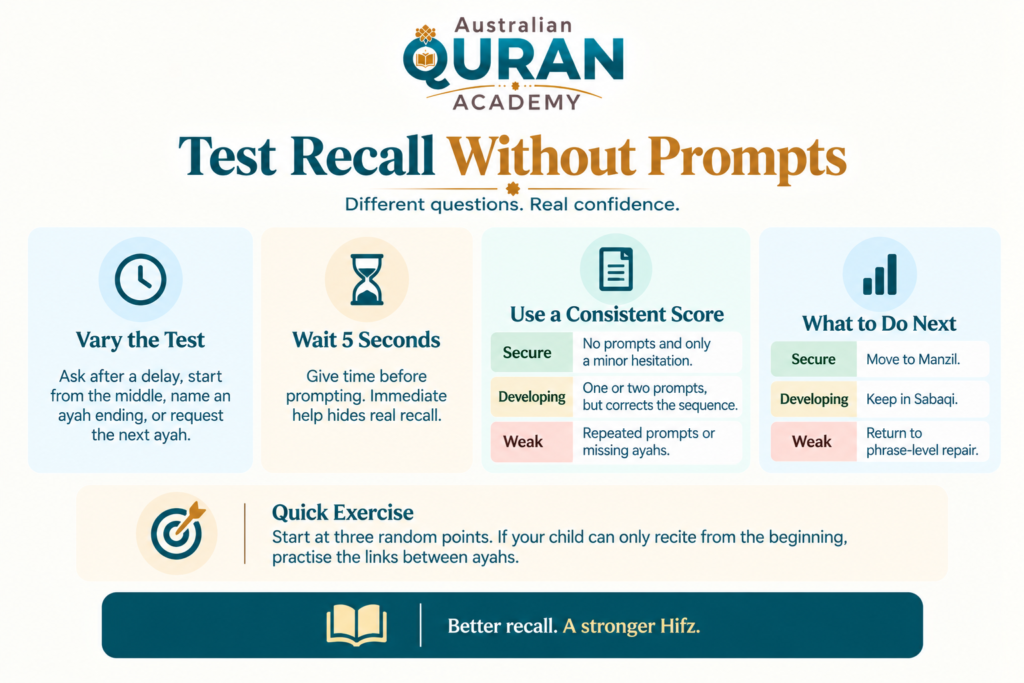
Wait five seconds before prompting. Immediate help can create the appearance of fluency while hiding dependence on the adult’s first word, facial expression, or rhythm.
Score the weekly test consistently:
- Secure: No prompts and only a minor self-corrected hesitation.
- Developing: One or two prompts, but the child restores the sequence.
- Weak: Repeated prompts, missing ayahs, or persistent pronunciation errors.
Move secure passages into the Manzil rotation. Keep developing passages in Sabaqi, and return weak passages to phrase-level repair without presenting the decision as punishment.
Quick exercise: Start at three random points in the assigned passage. If the child succeeds only from the beginning, practise links between ayahs before increasing the next target.
9. Recover From Missed Sessions Without Doubling Work
Do not combine yesterday’s entire missed target with today’s new target. Doubling the load creates rushed recitation and can make one disrupted day spread into a week of avoidance.
Use a recovery rule that protects retention first. Complete the normal revision, recover half of the missed new portion, and postpone the remaining half until the child meets the usual accuracy standard.
When illness, school assessments, travel, or family events interrupt several days, run a short audit before restarting. Sort assigned material into secure, developing, and weak groups, then repair the weak group before adding new lines.
| Interruption | Response | New Hifz Decision |
| One missed day | Keep revision and recover half | Reduce the next portion |
| Two or three missed days | Test recent passages first | Resume only if recall is stable |
| One week or more | Audit all current Sabaqi | Pause until weak sections improve |
This approach also suits interstate or overseas travel. Keep lesson times written in the child’s local time, especially when a teacher or family member is working from another time zone.
Inside Our Virtual Classrooms
We believe in full transparency and proven quality. Take a look at these actual snippets from our live classes to experience our modern learning platform, patient instructors, and interactive student participation.
Start Your Quranic Journey in Australia
Join our leading online academy and learn with expert tutors through a structured, personalized curriculum.
Book Your Free Trial10. Review Progress Monthly and Adjust One Variable
At the end of four weeks, compare results with the original baseline. Measure accurate lines retained, number of prompts, repeated error types, independent session completion, and how much older material the child can recite confidently.
Change only one variable for the next cycle. Reduce the new portion, increase Sabaqi, move the session time, shorten individual blocks, or request extra pronunciation support; changing everything at once hides which adjustment helped.
Ask the child two concrete questions: “Which part of the routine helps you remember?” and “Where do you usually get stuck?” Use the answers alongside recitation evidence, not as a replacement for testing.
Australian Quran Academy offers Online Quran Classes for Kids for children who need a broader pathway combining correct reading, guided recitation, Tajweed support, and progress suited to their present level.

Find the right Quran pathway for your child
Help Your Child Build Hifz With Australian Quran Academy
Australian Quran Academy provides live online support for children at different reading and memorisation levels.
A teacher can assess current accuracy, set manageable portions, correct recitation in real time, and monitor whether new work remains secure through revision.
What Sets Australian Quran Academy Apart:
- Child-focused online lessons arranged around the learner’s level and availability.
- Direct teacher correction for reading, Tajweed, memorisation, and revision errors.
- Course options that support beginners, developing readers, and active Hifz students.
Our Quran Courses
- Online Quran Classes for Kids
- Quran Classes for Adults
- Quran Classes for Female/Sisters
- Online Tajweed Classes for Kids
- Online Hifz Classes for Kids
- Online Noorani Qaida Classes for Kids
Book your child’s FREE trial lesson
Conclusion
The most reliable way to help kids with Quran Hifz in Australia is to build a system that makes accuracy visible. Assess first, assign a small target, teach it through one repeatable cycle, and test it after meaningful delays.
Progress depends on revision as much as new memorisation. Daily Sabaq, Sabaqi, and Manzil prevent recently learned passages from displacing older ones, while prompt counts and error logs show whether a child is genuinely ready to advance.
Families do not need a perfect uninterrupted schedule. They need a routine that fits Australian school life, adjusts to prayer times and clock changes, recovers calmly after disruption, and keeps qualified correction close to the child’s daily practice.
Frequently Asked Questions About Quran Hifz for Kids
How Can Kids Memorise Quran More Effectively?
Kids memorise Quran more effectively by learning a small correct portion, recalling it without looking, connecting it to earlier lines, and reviewing it later that day. Daily recent and older revision must remain larger than the amount of new memorisation.
How Can Parents Make a Child Memorise Quran?
Parents can make memorisation manageable by setting a measurable target, protecting a fixed daily time, listening without giving instant prompts, and recording errors. Pressure cannot produce secure Hifz; consistent instruction, correction, retrieval, and encouragement create the necessary conditions.
How Can Kids Memorise Quran Fast Without Weak Recall?
Kids should not increase speed until they retain at least 80 to 90 per cent of assigned material during delayed tests. The fastest sustainable method uses short portions, accurate audio, phrase linking, daily revision, and immediate correction instead of repeatedly adding pages.
How Much Quran Should a Child Memorise Each Day?
A beginner may start with one to three short ayahs or three to five lines, depending on reading accuracy and recall. Keep the portion unchanged for two weeks, then adjust it according to independent recitation rather than age, enthusiasm, or comparison.
When Should New Hifz Stop for Extra Revision?
New Hifz should pause when the child needs repeated prompts, confuses ayah order, reproduces persistent pronunciation errors, or retains less than the agreed standard. Resume after weak passages are repaired and older material can be recited reliably again.
Can Online Hifz Classes Fit Australian School Hours?
Yes, online Hifz classes can fit Australian school hours when families choose a consistent local-time slot and confirm daylight-saving changes. The best time is when the child is alert enough to learn new material and can still complete short daily revision.







Leave a Reply