 Quran
How to learn to read Quran online for kids in Australia is mainly a question of sequence. Children need engaging instruction that builds accurate sounds before fluency, while parents need visible progress rather than disconnected activities.
A child can learn to read Quran online for kids when lessons combine a qualified teacher, suitable technology, age-based practice, and steady parental support. The following ten steps lead towards confident, independent recitation.
1. Learn to Read Quran Online for Kids in Australia
Begin with a short assessment of the child’s listening, letter recognition, blending, and reading accuracy. Starting at the correct level prevents boredom for capable readers and confusion for children who still need phonics.
Ask the teacher to test recognition separately from production. A child may point to ب correctly yet pronounce it like an English letter, or read isolated forms while struggling to recognise it within words.
Use a simple baseline rather than a pass-or-fail test. Record what the child can do independently, what requires a prompt, and what remains unfamiliar, then review the same tasks after four weeks.
The starting level should match observable skills, as shown below.
| Starting level | Child can already do | Appropriate first target |
| Pre-reader | Listen, repeat, and match pictures | Distinguish Arabic letter sounds |
| Letter learner | Name some isolated letters | Recognise initial, medial, and final forms |
| Early blender | Read letters with basic vowels | Join two-letter and three-letter patterns |
| Emerging reader | Decode short Quranic words | Improve accuracy, rhythm, and stopping |
| Developing reciter | Read connected lines slowly | Apply foundational Tajweed consistently |
Do not place a child in Hifz merely because memorisation sounds more advanced. Memorising by imitation can hide weak decoding, leaving the learner unable to read an unfamiliar line without hearing it first.
2. Choose a Qualified Online Quran Teacher for Children
Choose a teacher who can demonstrate accurate recitation and explain sounds in child-friendly language. Credentials matter, but teaching skill becomes visible through correction quality, pacing, patience, and the child’s response.
During a trial lesson, observe whether the tutor identifies one precise error and shows the child how to fix it. Repeating “again” without explaining tongue position, airflow, or vowel length is not effective correction.
Good online teachers also check comprehension through action. They ask learners to identify, sort, read, compare, or teach a rule back, rather than filling the lesson with uninterrupted explanation and passive repetition.
Parents can use these criteria while observing the class:
- Recitation is accurate and the teacher corrects significant errors immediately.
- Instructions are brief enough for the child to follow without parental translation.
- Praise names the successful behaviour, such as clear blending or careful Madd.
- Lesson activities change before attention falls sharply.
- Homework is specific, measurable, and suitable for the learner’s level.
Australian Quran Academy offers Online Quran Classes for Kids in Australia with live guidance that allows children to practise, receive immediate correction, and progress from foundational reading towards confident recitation.
3. Build Arabic Letter Recognition Before Word Reading
Teach the sound and changing shape of each Arabic letter before expecting fluent word reading. Quranic script becomes manageable when children recognise letters automatically in isolated, initial, medial, and final positions.
Avoid relying only on the English alphabet or fixed transliteration. English spellings cannot represent several Arabic sounds accurately, and continued dependence encourages children to read the transliteration instead of decoding Arabic script.
Introduce visually similar letters in small groups, then contrast them deliberately.
ب, ت, and ث share a basic shape, so children must attend to dot number and position while preserving each letter’s distinct sound.
a. Use Multi-Sensory Letter Practice for Younger Children
Multi-sensory practice connects sight, sound, speech, and movement. Let the child hear one sound, trace its shape, find the matching card, and say it aloud clearly before introducing another letter.
Keep every activity tied to recognition rather than decoration. Colouring is useful only when the child must locate a target letter, distinguish its dots, or connect the written form with the sound being practised.
b. Contrast Similar Letters to Prevent Guessing
Contrast drills stop children from treating similar letters as interchangeable. Display two forms, pronounce one, and ask the learner to point, explain the visual difference, then produce both sounds without prompting.
Quick exercise: Place six letter cards on screen, including two similar pairs. Say one sound, let the child select it, then reverse roles so the learner tests the parent or teacher.
Read also: How To Memorize The Holy Quran By Skype In Australia
4. Set an Australian Schedule Children Can Sustain
Build the timetable around the child’s alert hours, not merely the first available teacher slot. For most school-aged learners, consistency improves when Quran lessons happen before fatigue, hunger, or evening activities reduce concentration.
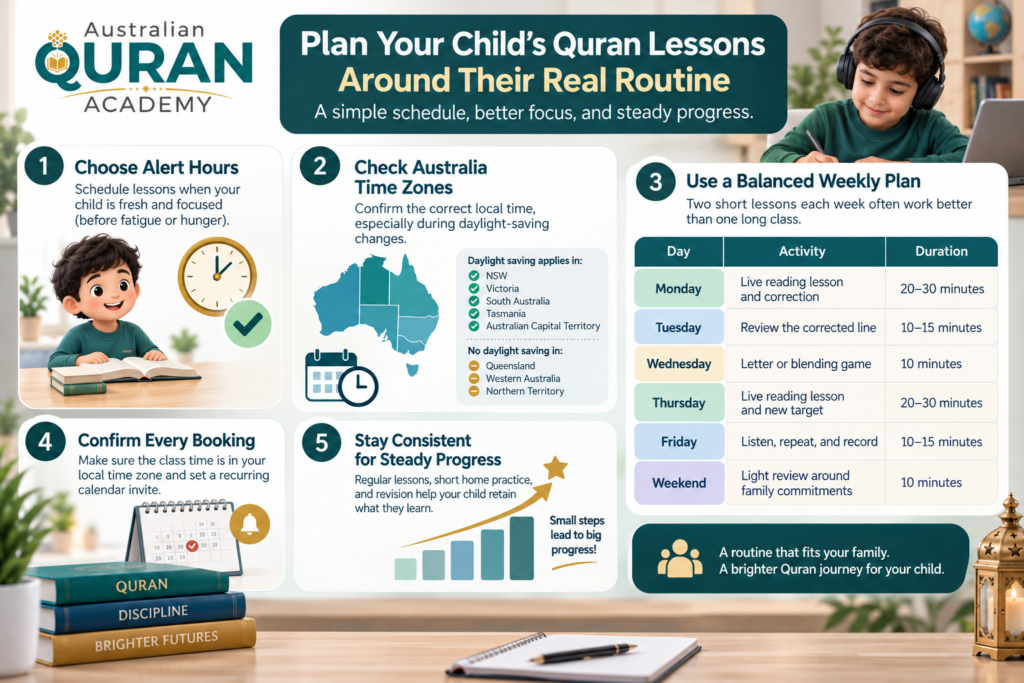
Australia’s time zones require deliberate checking, particularly when daylight-saving changes affect New South Wales, Victoria, South Australia, Tasmania, and the Australian Capital Territory but not Queensland, Western Australia, or the Northern Territory.
Confirm every booking in the family’s local time and ask how seasonal clock changes are handled. A recurring calendar invitation should display the correct zone rather than an ambiguous label such as “Australian evening”.
A practical weekly pattern balances live teaching with short home reviews.
| Day | Activity | Suggested duration |
| Monday | Live reading lesson and correction | 20 to 30 minutes |
| Tuesday | Review the corrected line | 10 to 15 minutes |
| Wednesday | Letter or blending game | 10 minutes |
| Thursday | Live reading lesson and new target | 20 to 30 minutes |
| Friday | Listen, repeat, and record | 10 to 15 minutes |
| Weekend | Light review around family commitments | 10 minutes |
Two brief lessons often suit beginners better than one long weekly class. The spacing allows correction, home practice, and retrieval, while reducing the risk that each session becomes a complete restart.
See Us in Action!
Curious about what our online classrooms look like? Watch the short clips below to see how our interactive, one-on-one sessions bring learning to life with real-time feedback and engaging teaching methods.
Start Your Quranic Journey in Australia
Join our leading online academy and learn with expert tutors through a structured, personalized curriculum.
Book Your Free Trial5. Teach Harakaat and Blending in a Fixed Sequence
Teach Harakaat, the vowel marks that guide pronunciation, before asking children to decode complete Quranic lines. Learners need to see how one letter changes with Fathah, Kasrah, Dammah, Sukoon, and Tanween.
Move from single sounds to two-letter combinations, then three-letter patterns, short words, and connected text. Skipping directly from alphabet names to Mushaf pages forces the child to guess instead of blending securely.
Use the same reading routine on every new pattern. The child points to the letter, identifies the mark, produces the combined sound, joins the next sound, then rereads the whole unit smoothly.
The progression should remain visible and cumulative.
| Reading element | Child’s task | Readiness check |
| Short vowels | Read one consonant with each Harakah | Produces the sound without naming the mark first |
| Sukoon | Close the sound without adding a vowel | Avoids an extra “uh” sound |
| Tanween | Read the doubled vowel ending | Preserves the final nasal sound |
| Shaddah | Hold and release the doubled consonant | Does not treat it as one light letter |
| Blending | Join sounds without long pauses | Reads familiar patterns as one unit |
Australian Quran Academy offers a Noorani Qaida Course for Kids in Australia that organises letters, Harakaat, joining, and foundational pronunciation into a progressive reading pathway.
Start Noorani Qaida with a free trial
6. Use Interactive Quran Reading Activities Purposefully
Use interaction to increase accurate responses, not simply to make the screen colourful. A useful game asks the child to listen, decide, read, compare, or correct while practising the exact skill taught that day.
Interactive ways to teach Quran reading for kids in Australia should remain simple enough that the learning goal stays visible. Complicated scoring, animations, or competitive pressure can distract from careful listening and pronunciation.
Choose one activity for recognition, one for production, and one for retrieval. Rotating the cognitive task keeps lessons lively without presenting unrelated content or changing the underlying rule before it becomes stable.
Effective activities match a clear reading purpose.
| Activity | Reading purpose | Online method |
| Sound hunt | Identify a target sound | Child circles letters on a shared page |
| Missing mark | Read Harakaat accurately | Teacher hides one mark and offers choices |
| Blend race | Join familiar units smoothly | Child reads five cards against a personal time |
| Error detective | Develop self-correction | Teacher makes one planned reading error |
| Echo reading | Improve rhythm and articulation | Child repeats a short model immediately |
| Sort the cards | Distinguish similar rules | Child drags examples into labelled groups |
Avoid rewarding speed when the child is still inaccurate. Timed play should compare the learner with a previous personal result only after correct decoding has become reliable, never encourage rushed recitation or swallowed sounds.
7. Match Quran Practice to Children’s Ages in Australia
Match practice length, language, and independence to developmental readiness. A five-year-old and a thirteen-year-old may study the same letter, but they should not receive the same explanation, activity, or homework load.
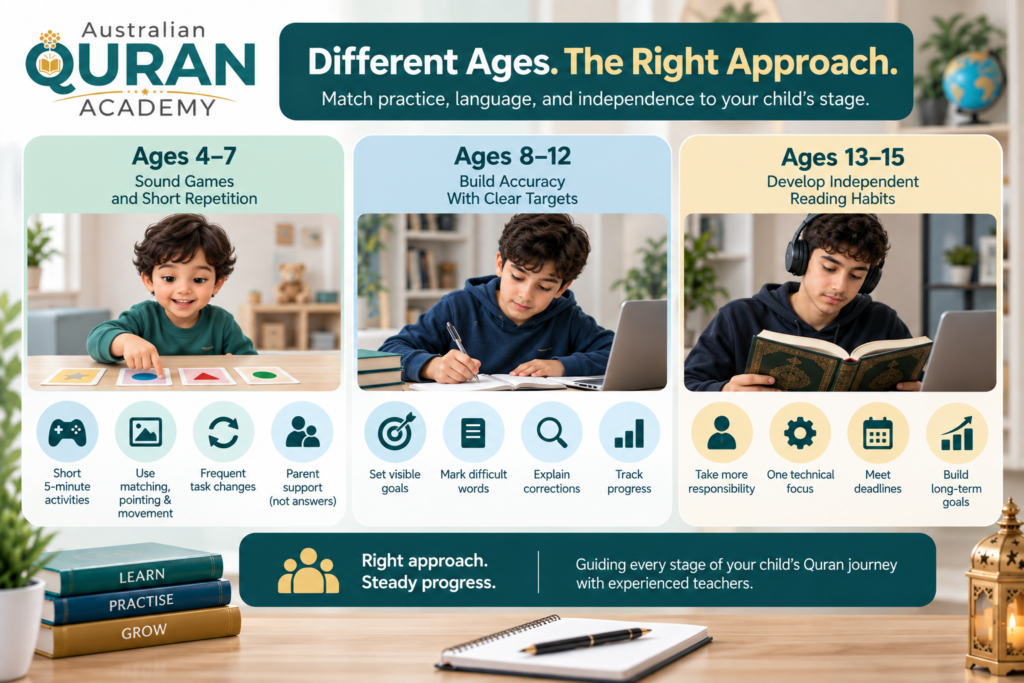
Younger learners need immediate feedback and frequent task changes. Older children can analyse recurring errors, maintain a practice log, and accept delayed goals, provided expectations remain clear and progress is genuinely measurable.
a. Ages 4 to 7 Use Sound Games and Short Repetition
Children aged four to seven learn best through five-minute activity cycles. Use matching, pointing, echo reading, and movement, then finish while attention remains positive rather than extending practice until resistance appears.
Parents should remain nearby for technology and encouragement without answering every prompt. A child needs enough wait time to retrieve the sound independently, because instant parental help can create dependence and hide uncertainty.
b. Ages 8 to 12 Build Accuracy Through Visible Targets
Children aged eight to twelve can follow a structured target such as reading five lines with fewer than three prompts. Visible goals make progress concrete and reduce arguments about whether practice was “good enough”.
Ask learners to mark difficult words and explain the correction afterwards. This age group responds well to personal bests, error-detective tasks, controlled choice, and short recordings that show improvement across several weeks.
c. Ages 13 to 15 Develop Independent Reading Habits
Teenagers should take increasing responsibility for preparation, attendance, and review. Give them a defined passage, one technical focus, and a deadline, while allowing some choice over lesson times and preferred reciters.
Respect matters more than childish entertainment at this stage. Use adult-quality feedback, private correction, and meaningful goals such as leading family revision, improving Salah recitation, or preparing for a future Tajweed pathway.
Read also: Is It Possible To Memorize The Quran In Australia?
8. Introduce Tajweed After Basic Decoding Becomes Stable
Introduce Tajweed as applied sound correction once the child can decode basic words. Tajweed means giving Quranic letters their correct articulation and qualities while observing rules that govern sounds in connected recitation.
Do not delay all pronunciation work until reading becomes fluent. Makharij al-Huruf, the articulation points of Arabic letters, belongs from the beginning, while detailed rule names can follow once decoding demands less mental effort.
Start with rules the child meets frequently and can hear clearly. Teach one rule, model it, locate several examples, practise them in isolation, then return to a short passage where the learner applies it naturally.
The first Tajweed targets should remain limited and observable:
- Correct articulation of commonly confused Arabic letters.
- Madd, the measured extension of a vowel sound.
- Ghunnah, the nasal resonance associated with specific letters and rules.
- Qalqalah, the controlled echo on designated letters carrying Sukoon.
- Safe stopping that does not break a word or distort meaning.
Australian Quran Academy offers a Tajweed Course for Kids in Australia where children apply pronunciation rules during live recitation instead of memorising terminology without reliable sound correction.
9. Use Recording and Feedback to Correct Recitation
Use short recordings to reveal repeated errors and confirm genuine progress. Recording does not replace a teacher, but it gives the teacher evidence and helps children hear differences that disappear during active reading.
Record the same passage before practice and after three focused attempts. Label each file with the date and target, then compare articulation, pauses, prompts, and fluency rather than judging improvement from memory.
Ask the teacher to prioritise corrections that change or obscure a letter before minor stylistic refinements. Children become discouraged when every imperfection receives equal attention, especially while decoding still requires considerable concentration.
A compact correction log keeps the next action clear.
| Passage | Repeated error | Teacher correction | Next review |
| Al-Fatihah line | ح sounds too light | Use lower-throat placement | Tomorrow |
| Short surah | Madd becomes shortened | Hold the assigned count | In three days |
| Practice phrase | Ghunnah disappears | Maintain nasal resonance | At next lesson |
| New line | Pause breaks the word | Continue to a safe stop | This weekend |
Limit each home practice to one or two priority corrections. Successful repetition builds a reliable motor pattern, whereas attempting ten corrections at once usually creates tension and leaves none of them secure.
10. Build Independent Mushaf Reading Through Review
Build independence by combining new reading with systematic review of previously corrected material. A child is progressing when familiar skills transfer to unseen words, not merely when one practised page sounds polished.
Use a three-part session: easy review, current instruction, and a short independent challenge. Beginning with success prepares attention, focused teaching develops one skill, and unseen text checks whether the child can transfer it.
Parents should monitor the process without becoming a second teacher. Confirm that practice happened, praise careful effort, note difficulties for the tutor, and avoid inventing pronunciation corrections when the correct sound is uncertain.
Track evidence monthly rather than evaluating every lesson emotionally. Useful measures include unfamiliar words decoded, teacher prompts needed, repeated errors corrected, lines read accurately, and willingness to begin practice without conflict.
Inside Our Virtual Classrooms
We believe in full transparency and proven quality. Take a look at these actual snippets from our live classes to experience our modern learning platform, patient instructors, and interactive student participation.
Start Your Quranic Journey in Australia
Join our leading online academy and learn with expert tutors through a structured, personalized curriculum.
Book Your Free TrialHelp Your Child Read Quran with Australian Quran Academy
Australian Quran Academy supports children through live instruction, level-based progression, immediate pronunciation correction, and scheduling suited to Australian family routines. Parents can use the trial lesson to assess teaching style, level placement, and child engagement.
What sets Australian Quran Academy apart:
- Live teacher feedback rather than passive video-only learning.
- Progressive instruction from Arabic letters to connected Quran reading.
- Child-appropriate lesson pacing with individual correction priorities.
- Flexible online access for families across Australian time zones.
Our Quran Courses:
- Online Quran Classes for Kids in Australia
- Noorani Qaida Course for Kids in Australia
- Tajweed Course for Kids in Australia
- Online Quran Reading Course in Australia
- Hifz Course for Kids in Australia
- Arabic Course for Kids in Australia
Conclusion
Learning to read the Quran online works when children follow a clear progression from sound recognition and letter forms to blending, Tajweed, guided practice, and independent reading. Each stage should be secure before difficulty increases.
For Australian parents, teacher quality and timetable fit are equally important. Short, regular lessons supported by focused home review usually produce stronger habits than long sessions that compete with school, sport, and family commitments.
The most reliable starting point is a genuine assessment followed by one measurable target. With consistent correction and purposeful practice, children can read unfamiliar Quranic text more accurately, confidently, and independently over time.
FAQs
What age should children start learning Quran online?
Children can begin guided listening and letter activities at four or five, but readiness matters more than age. The learner should follow short instructions, attend for several minutes, imitate sounds, and accept gentle correction.
How long should an online Quran lesson be for a child?
Most beginners manage 20 to 30 minutes effectively, while very young learners may need shorter sessions. Lesson length should reflect concentration, reading level, and activity design, with brief home practice used to reinforce corrections.
Can children learn Quran reading without knowing Arabic?
Yes, children can learn Quran reading without conversational Arabic because decoding and language comprehension are different skills. However, basic Quranic vocabulary and meaning should gradually accompany recitation so reading does not remain entirely mechanical.
How often should children practise Quran reading?
Children should practise for 10 to 15 minutes on most days, alongside one or two live lessons weekly. Frequent short retrieval strengthens letter recognition, blending, and corrected pronunciation more reliably than one long weekend session.
Are online Quran classes effective for young children?
Yes, online Quran classes can be effective when teaching is live, interactive, level-appropriate, and supported by a consistent routine. Effectiveness falls when children only watch videos, receive vague correction, or practise irregularly without clear targets.
What equipment does a child need for online Quran lessons?
A child needs stable internet, a laptop or tablet, clear audio, a quiet position, and the assigned Qaida or Mushaf. Headphones may improve listening, but younger children should remain appropriately supervised during online sessions.





Leave a Reply