 Quran
Quran
Thousands of Muslims around the world are memorizing the Quran right now — without speaking a word of Arabic. If you are one of them, or you want to be, the question is not whether it is possible. It is: what is the right structure to make it work?
How to memorize the Quran for non-Arabic speakers is genuinely different from the approach a native Arabic speaker would take. The language barrier is real. The unfamiliar sounds, the script, and 6,236 ayat can feel overwhelming at the start. But the obstacle is structural, not intellectual — and structure is something that can be learned and followed.
This guide gives you the exact 10-step framework used by successful Hifz students who started with no Arabic background.
1. Build Phonetically Accurate Arabic Pronunciation Before You Memorize Anything
The single most damaging mistake a beginner makes is memorizing before they can pronounce correctly. When you lock mispronounced sounds into long-term memory, those errors become harder to remove the longer you leave them — not easier.
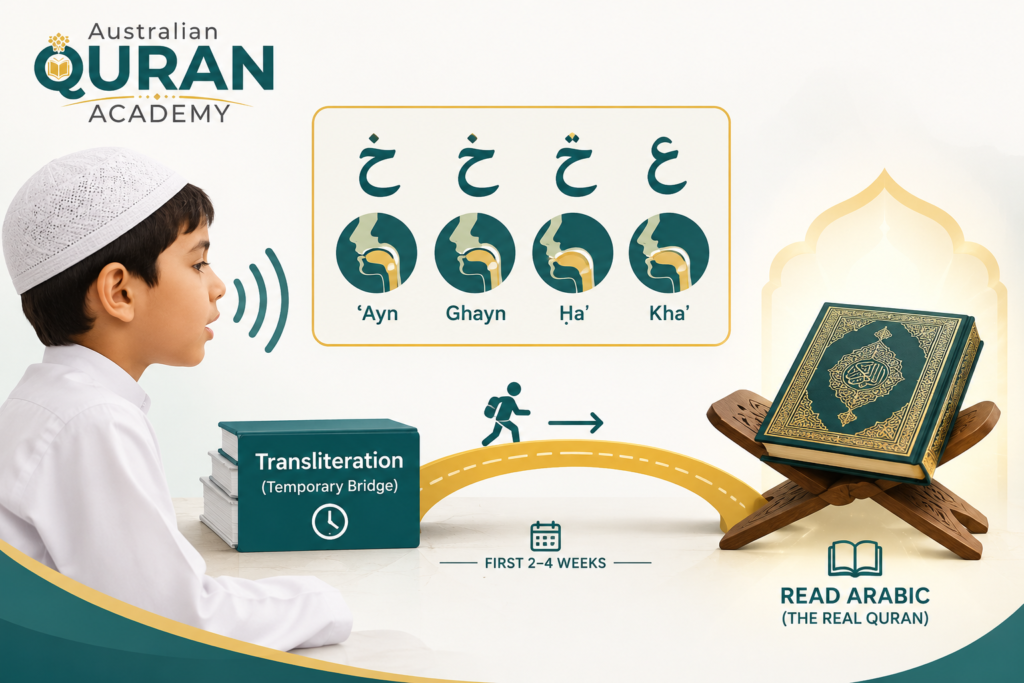
Arabic has sounds that simply do not exist in English. Letters like ع (ʿayn), غ (ghayn), ح (ḥa’), and خ (kha’) require targeted practice at the articulatory level. Students who skip this foundation consistently spend double the time correcting ingrained errors months into their Hifz.
Should You Use Transliteration at the Beginning?
Transliteration is a temporary bridge, not a memorization tool. Use it during your first two to four weeks only — while your ears and eyes adjust to Arabic sounds and script. Transition to reading Arabic as quickly as possible.
Memorizing from transliteration produces fragmented retention because your visual memory anchor does not match the Quranic text you will eventually read and recite. It also reinforces approximated pronunciations that teachers will need to spend time correcting later.
2. Learn Noorani Qaida and Core Tajweed Rules Before Beginning Any Surah
Tajweed is not an advanced topic for later. It is a prerequisite for correct Hifz. The Prophet ﷺ said: “The one who is proficient in reciting the Quran will be with the noble, righteous scribes” (Sahih Muslim 798). Proficiency, here, implies accurate recitation — and that requires Tajweed.
For complete beginners, Noorani Qaida is the most direct route from zero Arabic literacy to functional Quran reading. It introduces the alphabet, vowel sounds (harakaat), sukoon, shaddah, and basic elongation rules in a structured sequence before any Quranic text is introduced.
| Tajweed Rule | Why It Matters for Hifz |
| Noon Sakinah & Tanween | Appears on nearly every page |
| Meem Sakinah | Changes word sounds significantly |
| Madd (elongation) | Wrong length changes meaning |
| Ghunnah | Must be consistent to avoid false memory |
| Waqf (stopping rules) | Incorrect stops distort meaning |
These five categories are the minimum foundation any Hifz student needs before beginning to memorize. Australian Quran Academy’s Quran Reading Classes cover precisely this foundation — taking students from the alphabet through functional Tajweed before any surah is introduced.
Join Quran Reading Classes in Australia and Start with a FREE Trial Class

3. Choose One Sheikh and Listen to Each Portion 20–30 Times Before Memorizing It
Auditory imprinting is one of the most effective memorization tools available specifically to non-Arabic speakers. Before attempting to memorize any new portion, listen to a single reciter reciting those exact ayat a minimum of twenty to thirty times. This is not an exaggeration — it is a proven methodology used by Hifz schools worldwide.
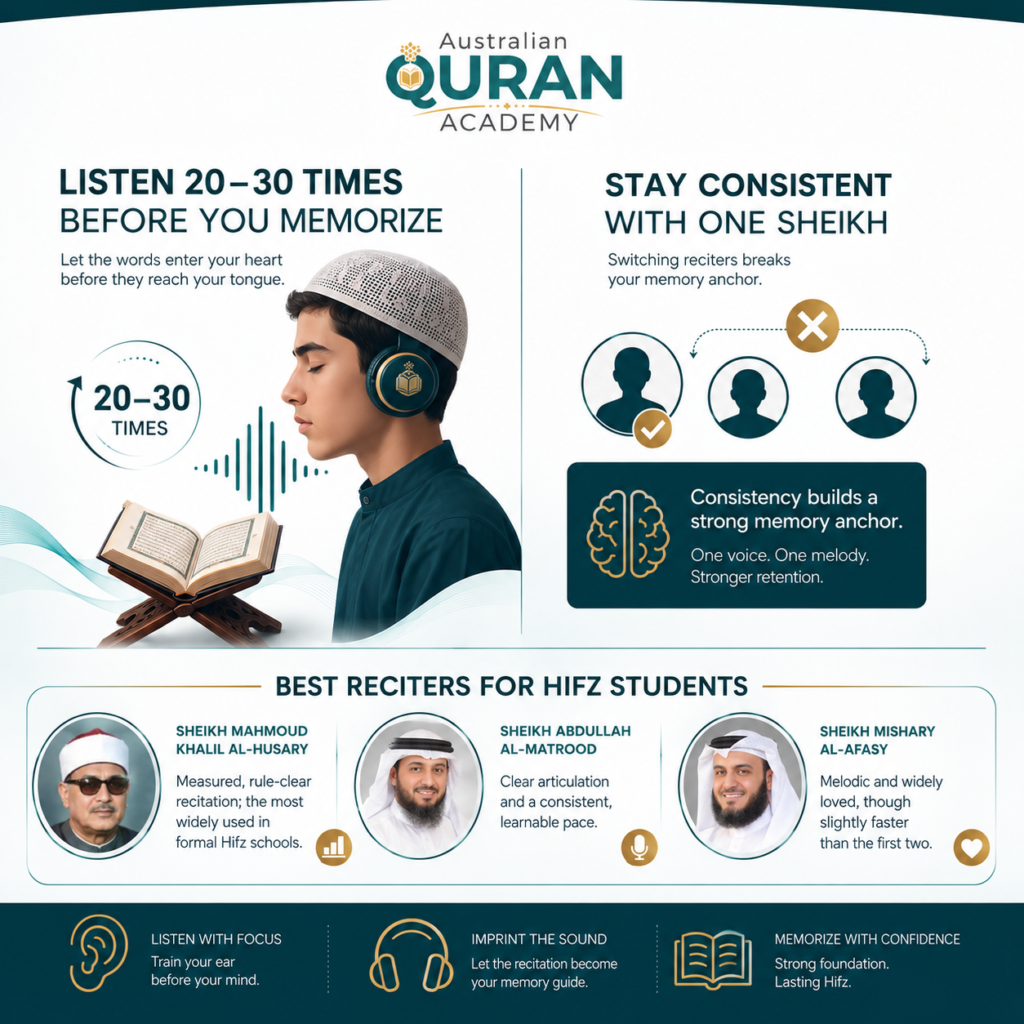
The mechanism behind this is straightforward. Non-Arabic speakers cannot rely on word meaning to anchor memorization the way a native speaker can. Instead, the melody, rhythm, and sound pattern of the recitation become the primary memory anchor. When you have heard an ayah twenty times, your mouth begins forming the sounds before your brain consciously processes them.
Which Reciters Are Best for Hifz Students?
Choose a reciter with a clear, measured pace and clean Tajweed articulation. Three widely recommended options for Hifz students are:
- Sheikh Mahmoud Khalil Al-Husary — Measured, rule-clear recitation; the most widely used in formal Hifz schools
- Sheikh Abdullah Al-Matrood — Clear articulation and a consistent, learnable pace
- Sheikh Mishary Al-Afasy — Melodic and widely loved, though slightly faster than the first two
Critically: choose one reciter and remain consistent throughout your entire Hifz. Switching reciters mid-journey creates auditory confusion because your memory has anchored to specific melodic patterns. Changing that anchor mid-way forces partial re-memorization.
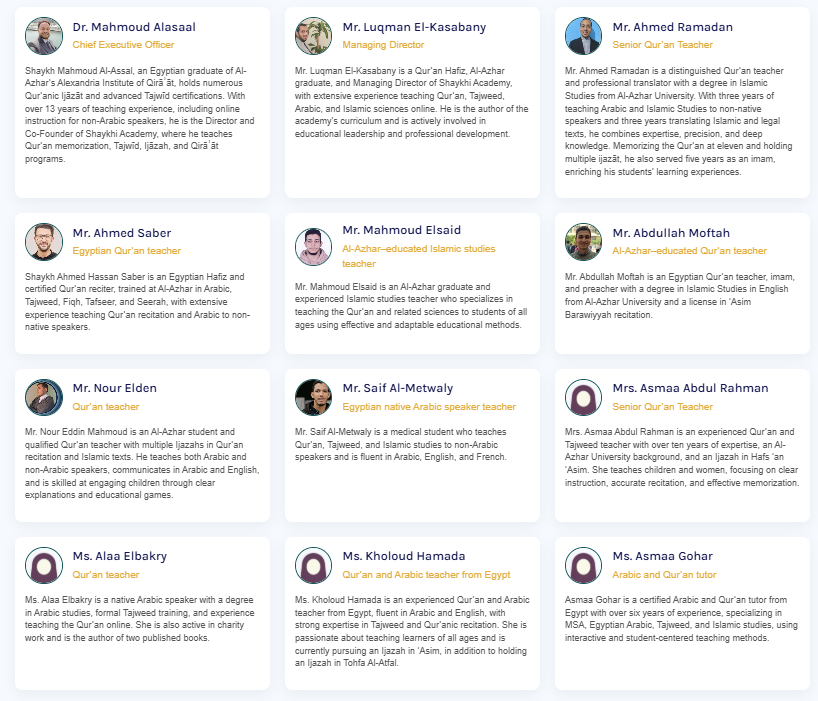
Meet our Arabic and Quran teachers.
4. Start with Juz Amma and Work Backwards — Not from Al-Baqarah
This is one of the most consequential strategic decisions a beginner makes — and one of the most commonly misunderstood.
For non-Arabic speakers asking how to memorize the Quran for non-Arabic speakers, the correct starting point is Juz 30 (Juz Amma), not Surah Al-Baqarah. Juz Amma contains the shortest surahs, most of which are already familiar from daily prayer. That familiarity dramatically reduces the cognitive load at the point in your journey when your memorization habits are weakest and need the most support.
Starting from Juz 30 and working backwards — Juz 29, then 28, and so on — means you are always moving toward longer, more complex material as your skills grow stronger. Beginning with Al-Baqarah (the longest surah in the Quran) before you have developed consistent memorization habits is a strategic error that causes many students to stall in the early months.
How Many Ayat Should a Non-Arabic Speaker Memorize Each Day?
For non-Arabic speakers, the right daily memorization target depends mainly on Arabic reading ability, Tajweed level, and the amount of time available for consistent review:
| Student Profile | Recommended Daily New Memorization |
| Complete beginner (no Arabic background) | 1–2 ayat per day |
| Basic Arabic reader | 3–5 ayat per day |
| Fluent Arabic reader with Tajweed | 5–10 ayat per day |
| Full-time Hifz student | Half to one page per day |
Consistency matters far more than daily volume. A student memorizing two ayat every single day outperforms a student memorizing ten ayat three days a week — both in retention and in total progress over a year.
Read also: How to Memorize the Quran in Australia?
5. Apply the New Lesson Plus Rolling Review Method Every Single Day
The most common reason students fail to complete Hifz is not an inability to memorize new material. It is forgetting what they previously memorized. Revision is the architecture that holds your entire Hifz together — not an optional addition to it.
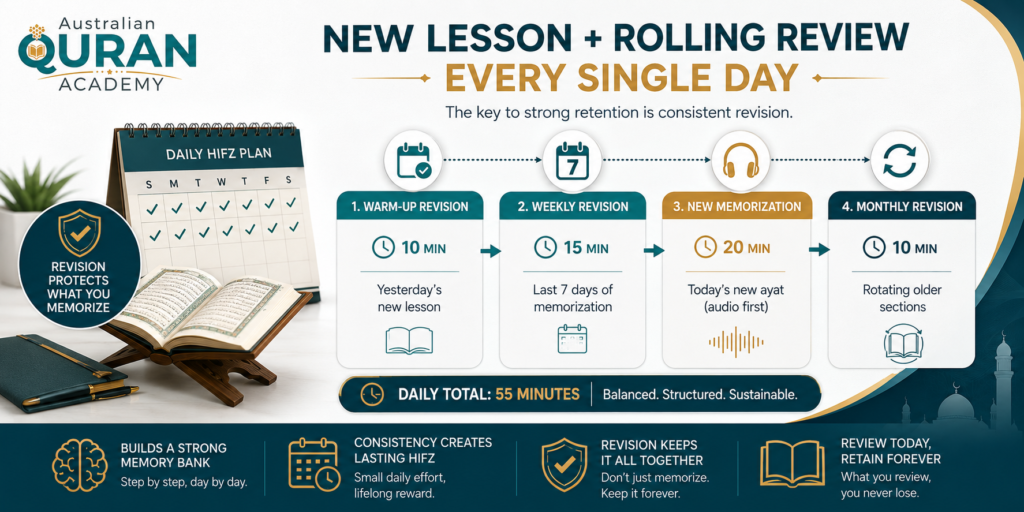
The New Lesson Plus Rolling Review method works by combining new material with systematic revision of older portions in every single session. As your memorized bank grows, revision time increases proportionally. This is why planning your revision structure early — before you have a large bank to review — is essential.
A Practical Daily Revision Structure for Non-Arabic Speakers
For non-Arabic speakers, an effective daily Hifz routine should balance new memorization with short, structured revision sessions, so older ayat remain strong as new ones are added:
| Session Component | Time | Content |
| Warm-up revision | 10 minutes | Yesterday’s new lesson |
| Weekly revision | 15 minutes | Last 7 days of memorization |
| New memorization | 20 minutes | Today’s new ayat (audio first) |
| Monthly revision | 10 minutes | Rotating older sections |
This 55-minute structure is realistic for working adults and parents. The key is treating it as a fixed appointment — not a task to complete “when there’s time.” Students who sustain multi-year Hifz journeys share one consistent habit: their memorization session is protected time that does not move.
See Us in Action!
Curious about what our online classrooms look like? Watch the short clips below to see how our interactive, one-on-one sessions bring learning to life with real-time feedback and engaging teaching methods.
Start Your Quranic Journey in Australia
Join our leading online academy and learn with expert tutors through a structured, personalized curriculum.
Book Your Free Trial6. Memorize at Your Strongest Mental Hour — Then Guard That Time
Cognitive retention quality is not uniform across the day. For most people, retention peaks in two windows: the early morning after Fajr, and again in the early evening. The Prophet ﷺ said: “Make use of five things before five others: your youth before old age, your health before sickness…” (Shu’ab al-Iman, Al-Bayhaqi). Using time intentionally is a Quranic and prophetic principle — and it directly applies to Hifz scheduling.
For non-Arabic speakers in Australian time zones, scheduling challenges are real — work shifts, family commitments, and time differences for online classes all create pressure on that protected session. The practical solution is a makeup protocol: a specific plan for what you do on days when your primary memorization window is missed. Without a protocol, missed sessions become habits of avoidance.
7. Work with a Qualified Teacher Who Corrects You in Real Time
Self-directed Hifz without a teacher produces one nearly universal outcome: incorrect memorization that can take years to unlearn. A qualified Hifz teacher provides three things no app or audio recording can replace: real-time error correction, accountability structure, and personalized pacing.
For non-Arabic speakers specifically, a teacher’s role is amplified. You cannot always hear your own pronunciation errors — particularly makharij distinctions like ص vs.
س, or ط vs.
ت — because these distinctions do not exist in English phonology. A teacher experienced with non-Arabic speaking students knows exactly where your mother tongue is likely to interfere with Arabic sound production.
Australian Quran Academy’s Al-Azhar Certified Program pairs students with Al-Azhar-trained instructors holding Ijazah certification in Hafs ʿan ʿAsim — the chain of authentic recitation transmission that guarantees every correction given is rooted in unbroken scholarly authority. This matters because correct Hifz is not just an academic goal; it is a trust passed from teacher to student across generations.
Start Your Al-Azhar Quran Course in Australia with a FREE Trial Class

8. Use the 3-3-3 Repetition Method to Anchor Ayat in Long-Term Memory
Memorization is a physical skill as much as a mental one. The mouth, tongue, and breath learn to produce Quranic sounds through repetition — not through comprehension.
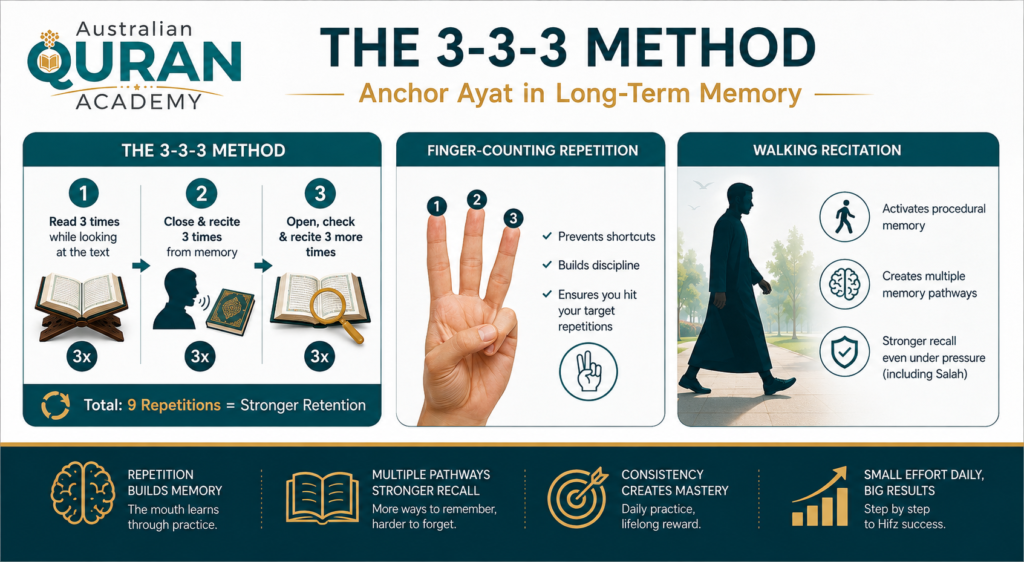
Non-Arabic speakers benefit from specific techniques that work through this physical learning channel:
The 3-3-3 Method:
Read the ayah three times while looking at the text. Close the mushaf and recite three times from memory. Open and check for errors, then recite three more times with corrections applied. This nine-repetition cycle embeds the ayah in short-term memory within a single session — without relying on word meaning to do the work.
Finger-counting repetition:
Physically counting repetitions on your fingers prevents unconscious shortcuts — a common problem when students feel they have repeated enough without completing the actual target count.
Walking recitation:
Reciting while walking during the review phase activates procedural memory alongside verbal memory. This creates multiple retrieval pathways for each ayah — making recall more resilient under pressure, including during Salah.
Read also: Psychological Barriers in Memorization – Why Your Brain Blocks Quran Hifz and How to Break Through?
9. Recite Your Memorization in Every Salah, Every Day
The five daily prayers are the most powerful revision tool a Muslim already has. Every memorized surah recited in Salah receives the spiritual reward of prayer and the neurological benefit of active recall under mild, natural pressure — one of the most effective memory consolidation conditions available.
Non-Arabic speakers frequently underuse this tool by reciting only Al-Fatiha and two or three familiar surahs in every prayer. Instead, rotate your most recently memorized surahs through your prayers deliberately. This distributes revision across five natural checkpoints in the day without adding any additional time to your schedule.
وَرَتِّلِ ٱلْقُرْءَانَ تَرْتِيلًا
“And recite the Quran with measured recitation.” (Al-Muzzammil 73:4)
This command applies most naturally and immediately in Salah — making the prayer itself the daily exam your Hifz is being tested against.
10. Track Progress in a Written Hifz Log and Mark Every Milestone
Long-term Hifz — spanning three to eight years for most non-Arabic speakers — requires visible progress markers to sustain motivation through the middle stretch, which is where most students struggle most. A written Hifz log serves both a practical and psychological function: it shows where you are and how far you have already come.
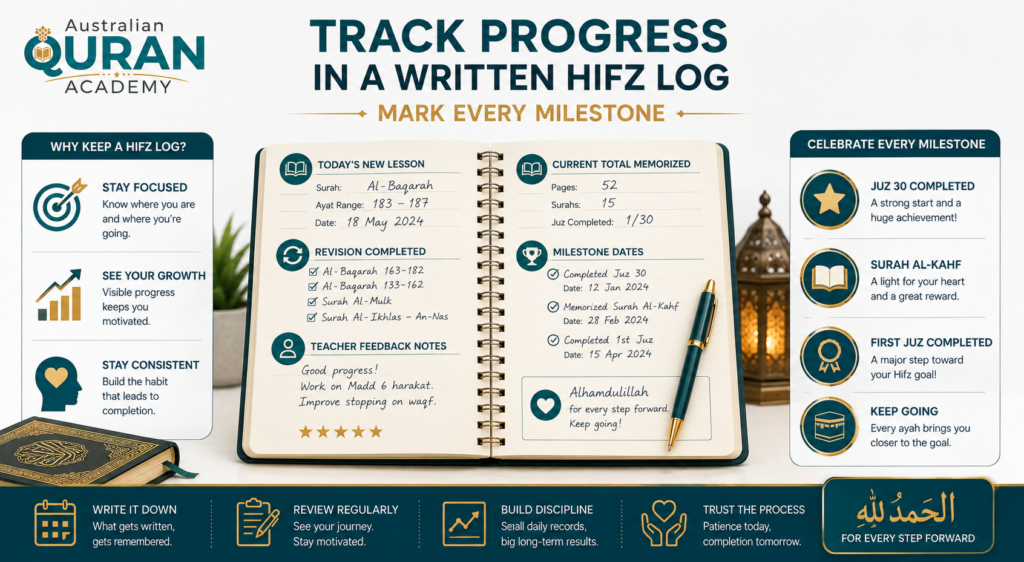
A simple log should record:
- Today’s new lesson (surah and ayat range)
- Revision completed (which sections reviewed)
- Teacher feedback notes
- Current total memorized (pages and surahs)
- Milestone dates (Juz completed, major surahs finished)
Milestones deserve acknowledgment. Completing Juz 30, memorizing Surah Al-Kahf, finishing your first full Juz — these are significant spiritual achievements. Alhamdulillah for every step forward.
Inside Our Virtual Classrooms
We believe in full transparency and proven quality. Take a look at these actual snippets from our live classes to experience our modern learning platform, patient instructors, and interactive student participation.
Begin Your Hifz Journey with Australian Quran Academy’s Expert Instructors
If you are serious about how to memorize the Quran for non-Arabic speakers, the structure above works — but structure without expert guidance moves slowly and risks compounding errors that cost you later.
Australian Quran Academy’s Intensive Quran Program provides everything a non-Arabic speaking student needs to begin and sustain Hifz:
- Al-Azhar-trained instructors with Ijazah certification
- Personalized 1-on-1 sessions adapted to your level and schedule
- Real-time Tajweed correction from the very first lesson
- Flexible scheduling across Australian time zones
- A structured curriculum that goes from phonetics through full Hifz
Book your free trial lesson today and take the first real step toward becoming a Hafiz or Hafizah, Insha’Allah.
Our Quran Courses
- Quran Online Academy
- Quran Recitation Classes
- Quran Reading Classes
- Online Quran Classes for Kids
- Quran Classes for Adults
- Quran Classes for Female/Sisters
- Learn Quran Course for Beginners
- Quran Memorization (Hifz) Course
- Hifz Classes for Adults
- Quran Memorization and Hifz Course for Kids
- Quran Hifz Course for Ladies
- Quran Ijazah Program
- Quran Qirat Learning Course
- Quran Tafsir Course
- Noorani Qaida Course
- Noorani Qaida Course for Kids
- Weekend Quran Classes
- Intensive Quran Course
- Al-Azhar Quran Course
- Online Tajweed Classes
- Tajweed Course for Kids
- Tajweed Course for Adults
- Tajweed Course for Ladies
Start Your Quranic Journey in Australia
Join our leading online academy and learn with expert tutors through a structured, personalized curriculum.
Book Your Free Trial
Conclusion
How to memorize the Quran for non-Arabic speakers is a question with a clear, structured answer — and that structure is what this guide has laid out. The ten steps above are not motivational advice. They are a proven instructional framework: phonetic accuracy before memorization, Tajweed as a prerequisite, auditory imprinting as your primary memory anchor, Juz Amma as your starting point, and revision as the daily habit that holds everything together.
The linguistic barrier is real, but it is structural — and structure can be learned. What no guide can provide for you is consistency and sincerity. Those belong entirely to you.
May Allah ﷻ make the Quran easy for your tongue, your heart, and your memory. Ameen.
Read also: What Is the Best Way to Memorize the Quran in Australia?
Frequently Asked Questions About How to Memorize the Quran for Non-Arabic Speakers
Can a non-Arabic speaker memorize the entire Quran?
Yes — thousands of non-Arabic speaking Muslims complete full Quran memorization every year. The process requires more structured phonetic preparation than it does for native speakers, but the memorization capacity is equal. With consistent daily practice and qualified teacher guidance, full Hifz is achievable for non-Arabic speakers of any age.
How long does it take a non-Arabic speaker to memorize the full Quran?
Memorizing the full Quran typically takes non-Arabic speakers between three and eight years, depending on daily time invested, prior Arabic reading ability, and the consistency of revision. Students memorizing three to five ayat daily with proper review often complete the Quran in five to seven years. Full-time Hifz study can shorten that timeline significantly.
Is it necessary to understand Arabic to memorize the Quran?
Understanding Arabic is not a prerequisite for Hifz, but it strengthens long-term retention considerably. When you understand — even partially — what you are memorizing, semantic memory anchors support phonetic memory. Learning basic Quranic Arabic vocabulary alongside Hifz, even at a foundational level, is strongly recommended.
What is the best surah to start memorizing as a complete beginner?
Begin with the short surahs of Juz 30 — specifically Surah Al-Ikhlas, Al-Falaq, and An-Nas, which most Muslims already know from prayer. Familiarity reduces the initial cognitive load significantly. After these, continue through Juz Amma in reverse order before progressing to earlier Juz.
Why should non-Arabic speakers not start with Surah Al-Baqarah?
Al-Baqarah is the longest surah in the Quran. Starting there before developing consistent memorization habits is a structural mismatch — the difficulty level is highest at the point when your skills are weakest. Beginning with Juz Amma builds memorization discipline on short, familiar surahs, then scales difficulty as your capacity grows.
Does using a qualified teacher really make a difference for non-Arabic speakers?
Yes — and the difference is disproportionately large for non-Arabic speakers specifically. You cannot reliably hear your own makharij errors because the sounds that are wrong in Arabic do not exist in English phonology. A teacher experienced with non-Arabic speaking students knows exactly where English pronunciation habits interfere with Arabic sounds, and corrects them before they become locked into long-term memory.






Leave a Reply