 Quran
Quran
Hundreds of thousands of Muslim families across Australia — from Sydney’s western suburbs to Melbourne’s north, from Brisbane’s south side to Perth’s eastern corridors — share one aspiration: memorizing the Quran. Yet most who begin the journey of hifz slow down within weeks, not because they lack dedication, but because they lack a clear system.
Finding effective Quran memorization techniques in Australia means building a method that fits real Australian life — shift work, school schedules, long commutes, and the practical reality of living far from a traditional Quran institute. If you are wondering how to memorize the Quran consistently, the answer is not one shortcut but a combination of repetition, revision, listening, understanding, and qualified guidance.
The following 15 memorization techniques for Quran give beginners and progressing students a practical system they can adapt to their level and daily schedule.
1. Begin Your Hifz with a Clear and Sincere Intention
Sincerity is not a one-time decision. It is a daily renewal that makes the effort feel purposeful and the reward real. Before every session, remind yourself that this is an act of worship — not a personal achievement.
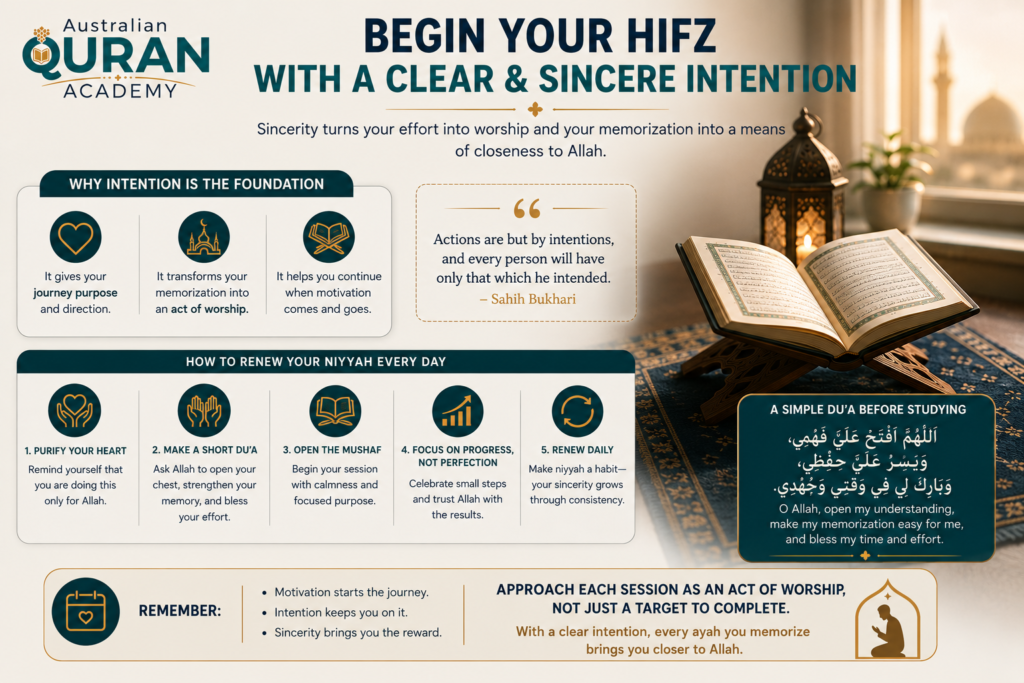
Among the most important tips for Hifz Quran is to avoid depending entirely on motivation. When a memorization session feels difficult or progress seems slower than expected, a clear intention gives you a reason to continue. Renew your niyyah before opening the Mushaf, make a short du’a asking Allah to place barakah in your effort, and approach each session as another small act of worship rather than a target you simply need to complete.
2. Choose a Consistent Daily Time for Quran Memorization
The most important factor in fast, lasting memorization is consistency at the right time of day. The brain retains new information most strongly in the hours immediately after sleep — which aligns exactly with the post-Fajr window.
Australia’s seasonal variation creates a genuine structural advantage for hifz students. Consider how Fajr time shifts across the year:
| City | Fajr in December (Summer) | Fajr in June (Winter) |
| Sydney | ~4:30 AM | ~6:00 AM |
| Melbourne | ~4:15 AM | ~6:10 AM |
| Brisbane | ~4:10 AM | ~5:30 AM |
| Perth | ~4:20 AM | ~6:00 AM |
The later winter Fajr gives working adults and school students a naturally wider, more manageable study window. Even 30–45 focused minutes after Fajr outperforms two unfocused afternoon hours.
For Australian students, online Hifz instruction removes much of the geographic barrier. Whether you are in rural Queensland, suburban Adelaide, or the Northern Territory, one-on-one guidance can be accessed remotely. For students pursuing formal certification, Australian Quran Academy’s Ijazah program provides a pathway toward authenticated Quranic recitation and transmission.
Earn Your Quran Ijazah in Australia with a FREE Trial Class

3. Stick to One Mushaf to Strengthen Visual Memory
The brain encodes the Quran visually as well as aurally. During recitation, experienced Huffaz often mentally “see” the page — the position of a line, where an ayah ends, or where a particular word sits near the margin. Switching between Quran editions can disrupt these visual anchors.
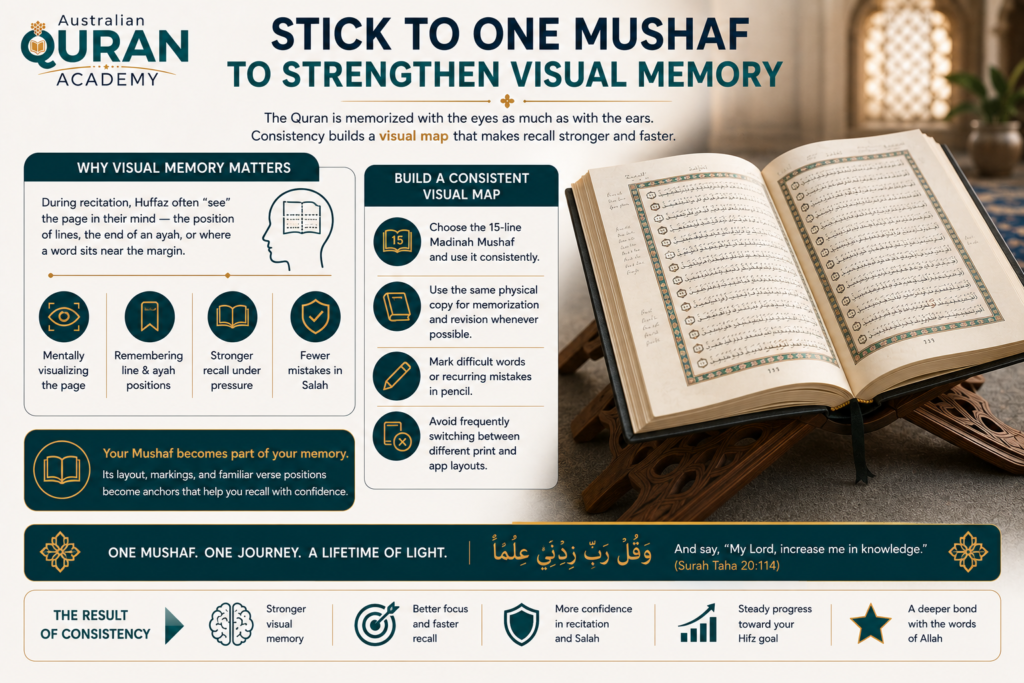
To build a consistent visual map:
- Choose the 15-line Madinah Mushaf and use it consistently.
- Use the same physical copy for memorization and revision whenever possible.
- Mark difficult words or recurring mistakes in pencil.
- Avoid frequently switching between different print and app layouts.
Over time, your Mushaf becomes more than the text you read from. Its page layout, markings, and familiar verse positions become part of the way you recall what you have memorized.
4. Build Confidence by Starting with Juz 30
A common mistake is opening Al-Baqarah on day one. Juz 30 contains shorter surahs with strong rhythm and natural repetition — Al-Ikhlas, Al-Falaq, An-Nas, and dozens more. Early wins in short surahs help establish the habit that students will later need for longer sections.
Start with Juz 30, then Juz 29, then Juz 28, before moving into longer portions of the Quran. This gradual progression allows you to build confidence, strengthen your memorization habits, and develop the revision discipline needed before tackling longer passages.
For someone learning how to memorize the whole Quran, the goal is not to begin with the largest possible portion. It is to develop the skills and consistency required to continue when the passages become longer and the amount of old material requiring revision increases.
Read also: What Is the Best Way to Memorize the Quran in Australia?
5. Memorize the Quran in Small, Manageable Sections
One of the most effective ways to memorize Quran is to reduce a large page into smaller, achievable sections. Looking at a full page and attempting to memorize it as one unit can overwhelm working memory. Instead, divide the page into sections of approximately 3–4 lines and memorize each section completely before moving to the next.
This section-by-section approach makes several parts of Hifz easier:
- Errors can be caught before they spread across an entire page.
- Difficult words and Tajweed points are easier to isolate.
- Transitions between ayat can be practised deliberately.
- Each small section provides a clear, achievable target.
Once every section is stable individually, recite the full page aloud from beginning to end. This final step is essential because your goal is not to remember several isolated blocks — it is to connect them into one continuous sequence.
6. Spread Your Memorization Across the Day with the 6446 Method
For students searching for a structured Quran memorization technique, the 6446 method distributes memorization across the day rather than asking you to complete everything in one long session. This creates repeated exposure to the Quran and makes a larger daily target feel more manageable.
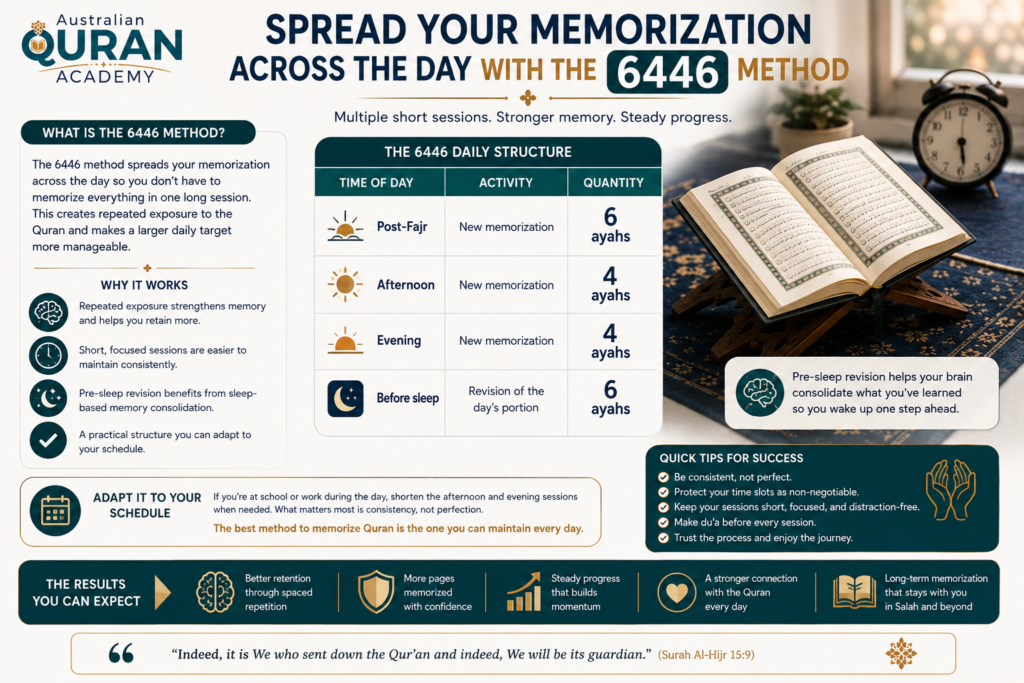
A typical 6446 structure looks like this:
| Time of Day | Activity | Quantity |
| Post-Fajr | New memorization | 6 ayahs |
| Afternoon | New memorization | 4 ayahs |
| Evening | New memorization | 4 ayahs |
| Before sleep | Revision of the day’s portion | 6 ayahs |
Each exposure reinforces the previous one, and the pre-sleep revision takes advantage of sleep-based memory consolidation — the process by which the brain transfers new learning into stable long-term storage during the night.
For Australian students who are at school or work during the day, the afternoon and evening slots can be shortened when necessary without losing the core principle. The best method to memorize Quran is ultimately one that can be maintained consistently, so adjust the quantity to your current ability instead of abandoning the structure when the target feels too large.
7. Strengthen Each Ayah with the 3×3 Repetition Method
For each individual ayah, use structured rounds of reading and recall before moving on. Read the ayah three times from the Mushaf, then look away and recite it three times from memory. Return to the Mushaf for another three repetitions, then test yourself again without looking.
The value of this cycle is that it alternates between exposure and active recall. Instead of repeatedly reading until the ayah simply feels familiar, you continually test whether you can actually retrieve it without visual support.
This is especially useful for ayahs containing similar-sounding phrases, unfamiliar vocabulary, or long compound words. If you continue hesitating after the cycle, do not rush to the next ayah. Repeat the process until the current one is stable.
See Us in Action!
Curious about what our online classrooms look like? Watch the short clips below to see how our interactive, one-on-one sessions bring learning to life with real-time feedback and engaging teaching methods.
Start Your Quranic Journey in Australia
Join our leading online academy and learn with expert tutors through a structured, personalized curriculum.
Book Your Free Trial8. Use the Mirror Method for Difficult Ayahs
Some ayahs resist normal repetition because of their length, unusual word order, or similarity to an adjacent verse. The mirror method handles these: recite the ayah backward — from the last word to the first — then forward again.
This forces the brain to process each individual word rather than relying on rhythmic momentum, which is exactly how errors hide in familiar passages. After one backward-forward pass, forward recitation almost always becomes noticeably more stable.
If you are new to Quran study or returning after a long break, Australian Quran Academy’s beginner Quran classes provide a structured foundation — covering Noorani Qaida, basic tajweed, and confident reading before hifz begins.
Begin Your Quran Learning Journey in Australia with Expert Guidance and a FREE Trial Class

Read also: Psychological Barriers in Memorization – Why Your Brain Blocks Quran Hifz and How to Break Through?
9. Give New Memorization Extra Revision in the First 21 Days
Learning new ayat is only part of understanding how to memorize and retain Quran. Recently memorized material needs frequent revision before it can become part of your longer-term Muraja’ah rotation.
The 21-day protection rule requires the following:
- Recite every newly memorized portion every single day for 21 consecutive days
- Do not skip a single day during this window — even one missed day weakens the trace measurably
- If you are memorizing multiple portions simultaneously, track each one separately against its own 21-day calendar
- After 21 days, the portion moves into the regular Muraja’ah cycle (Step 10)
10. Balance New Hifz and Old Revision with Sabaq-Muraja’ah
The Sabaq-Muraja’ah system divides every memorization session into two distinct, non-negotiable activities. A practical daily structure looks like this:
| Session Component | Content | Minimum Duration |
| Sabaqi Review | Last 7 days’ portions recited from memory | 15–20 minutes |
| New Sabaq | Today’s new memorization using 6446 or 3×3 | 20–30 minutes |
| Old Muraja’ah | Older portions reviewed at a separate time of day | 4–5 pages minimum |
Students who run this system daily find that large portions of the Quran stay sharp even after extended time away from a specific surah. The Muraja’ah component is not a bonus activity — it is the entire retention mechanism.
11. Close the Mushaf and Test Your Real Recall
One of the most common problems in self-directed Hifz is confusing recognition with recall. Reading from the Mushaf repeatedly feels productive because every word becomes familiar, but familiarity does not necessarily mean you can retrieve the passage independently.
After every memorization session, close the Mushaf completely and recite the new portion from beginning to end. Do not immediately reopen the page when you hesitate. Give yourself a moment to retrieve the next word.
Every hesitation, substitution, or missing phrase identifies a specific weakness. Reopen the Mushaf, correct those points, repeat them, and then test the complete passage again with the Mushaf closed.
This is the type of recall you eventually need in Salah, so it should be trained from the beginning.
12. Reinforce Memorization by Listening to One Qari
Another of the practical ways to memorize Quran is to surround your formal Hifz sessions with focused listening. Hearing the same passage repeatedly gives you additional exposure without requiring another full study session.
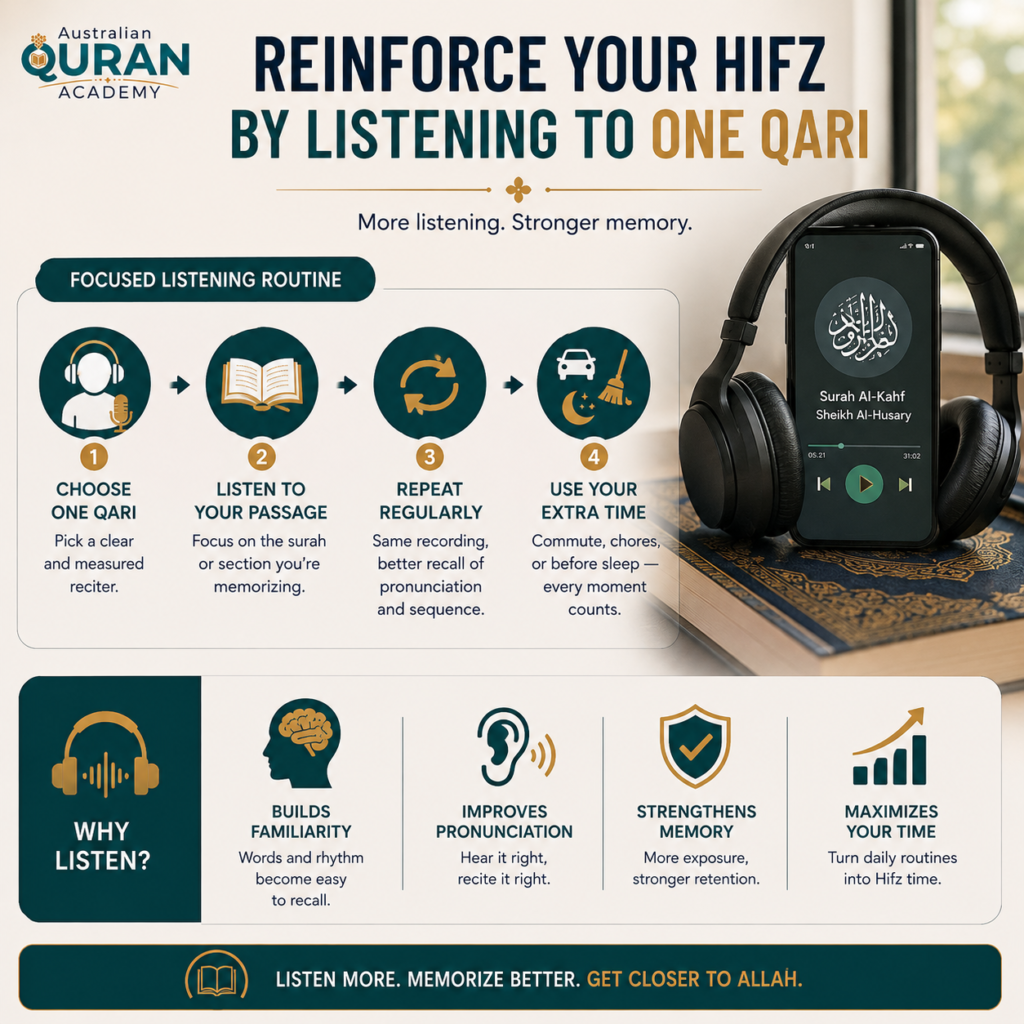
For a focused listening routine:
- Choose one Qari, such as Sheikh Al-Husary, whose recitation is clear and measured.
- Listen specifically to the surah or passage you are currently memorizing.
- Repeat the same recording so pronunciation and verse sequence become familiar.
- Use your commute, household tasks, or time before sleep for additional listening.
In Australia, where long drives are common — particularly in outer suburban Sydney, Melbourne, Brisbane, and Perth — commuting time can become a valuable Hifz resource. A 40-minute journey each way creates up to 80 minutes of additional Quran exposure without adding another block to your schedule.
Listening alone will not replace active memorization, but it can make the words, rhythm, and sequence far more familiar before your next session.
13. Understand the Meaning Before Memorizing New Ayahs
The brain remembers connected information more easily than a sequence that feels disconnected. Reading the meaning of a passage before memorizing it gives you a semantic structure: you understand what is being discussed and how one ayah leads into the next.
This does not require a long Tafseer session before every Hifz block. Spend two or three minutes reading a reliable translation, identify the main theme of the passage, and notice the relationship between consecutive ayat.
Then return to the Arabic and begin memorizing. When you know what the passage is saying, the order of the ayat becomes easier to understand rather than existing only as a sequence of sounds.
Australian Quran Academy’s Hifz program integrates meaning alongside memorization — so students understand what they are learning, not just how to recite it. This distinction separates fast, lasting hifz from brittle word-by-word repetition.
Build Your Quran Memorization Step by Step in Australia with a FREE Trial Class

14. Recite New Memorization in Your Daily Prayers
Salah gives you a natural opportunity to test whether memorization remains stable when the Mushaf is no longer in front of you. A passage that feels completely secure during practice may suddenly reveal a weak transition or forgotten word when you attempt to recite it in prayer.
Use your daily prayers deliberately as part of the revision process:
- Recite stable, recently memorized portions in your prayers.
- Notice the exact ayah or phrase where you hesitate.
- Return to the Mushaf after Salah and check the mistake.
- Re-drill that specific point instead of repeating only the easy sections.
- Rotate different memorized portions across your prayers.
Salah should complement your formal Muraja’ah rather than replace it. Together, they give you scheduled revision and repeated real-world recall.
Read also: How to Memorize the Quran for Non-Arabic Speakers?
15. Track Your Progress and Learn with a Qualified Teacher
Visible progress tracking helps turn a large goal into smaller achievements. Instead of thinking only in terms of completing the entire Quran, establish checkpoints you can reach, test, and record throughout the year.
For example:
| Milestone Level | Example Achievement | Action |
| Weekly | Complete your planned weekly portion | Log and review |
| Monthly | Complete a target surah or section | Recite to teacher |
| Quarterly | Reach a larger memorization milestone | Formal revision test |
| Annual | Review overall Hifz progress | Adjust the next year’s target |
Your actual targets should reflect your level and schedule. A beginner balancing Hifz with full-time work should not use the same milestones as a full-time memorization student.
Tracking tells you how much you have covered; a qualified teacher tells you how well you actually know it. Regular recitation to a teacher allows Tajweed errors, weak transitions, and hidden memorization mistakes to be identified before they become established habits.
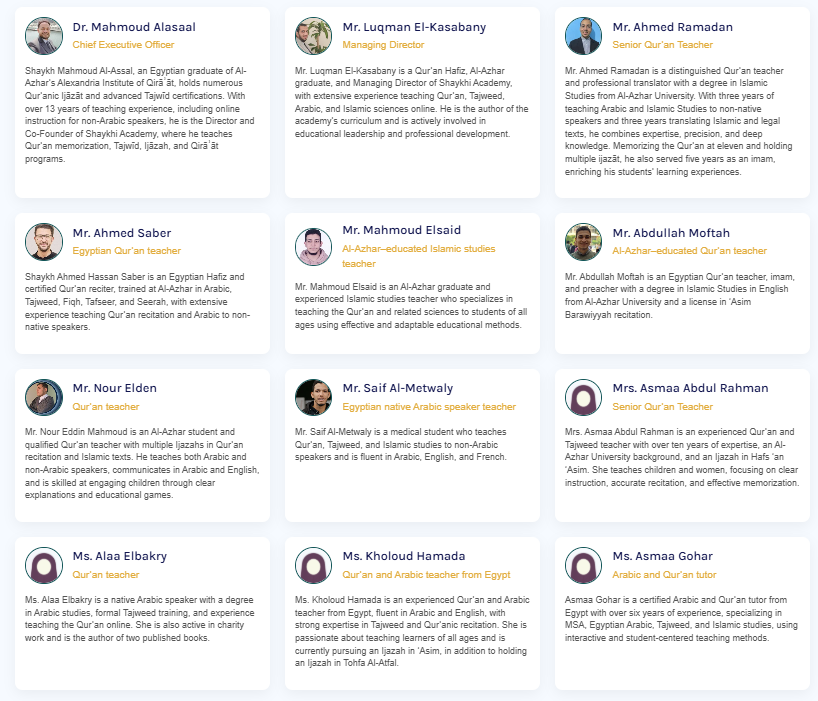
Meet our Arabic and Quran teachers.
Inside Our Virtual Classrooms
We believe in full transparency and proven quality. Take a look at these actual snippets from our live classes to experience our modern learning platform, patient instructors, and interactive student participation.
Take the Next Step in Your Quran Memorization Journey
Memorizing the Quran becomes more manageable when you have a qualified teacher correcting your recitation, guiding your daily memorization, and making sure revision remains part of your routine. With the right support, you can progress at a pace that fits your current level without sacrificing accuracy.
Australian Quran Academy offers live, one-on-one online Quran lessons with qualified teachers, allowing students across Australia to learn from home and build a structured Hifz routine around school, work, and family commitments.
Start your Hifz journey with expert guidance — book your free trial lesson today.
Our Quran Courses
- Quran Online Academy
- Quran Recitation Classes
- Quran Reading Classes
- Online Quran Classes for Kids
- Quran Classes for Adults
- Quran Classes for Female/Sisters
- Learn Quran Course for Beginners
- Quran Memorization (Hifz) Course
- Hifz Classes for Adults
- Quran Memorization and Hifz Course for Kids
- Quran Hifz Course for Ladies
- Quran Ijazah Program
- Quran Qirat Learning Course
- Quran Tafsir Course
- Noorani Qaida Course
- Noorani Qaida Course for Kids
- Weekend Quran Classes
- Intensive Quran Course
- Al-Azhar Quran Course
- Online Tajweed Classes
- Tajweed Course for Kids
- Tajweed Course for Adults
- Tajweed Course for Ladies
Start Your Quranic Journey in Australia
Join our leading online academy and learn with expert tutors through a structured, personalized curriculum.
Book Your Free Trial
Conclusion
Memorizing the Quran in Australia is achievable — for students at any age, at any pace, from any location in the country. The 15 steps above form a complete system: a strong foundation, a daily memorization technique, a revision framework that prevents forgetting, and the accelerators that build speed without sacrificing accuracy.
The most important thing is not to start perfectly. It is to start with a system. Fix your intention, secure your post-Fajr slot, choose your mushaf, and begin from Juz 30. Run Sabaq-Muraja’ah every day. Protect the 21-day window. Close the mushaf and test real recall. Recite in prayer.
Knowing how to memorize the Quran in Australia is not what most students lack — it is a consistent, structured approach applied day after day. Begin today, build the habit in the first week, and the rest follows.
Frequently Asked Questions
How long does it take to memorize the Quran in Australia?
The time varies by daily commitment. Students memorizing one page per day typically complete the full Quran in approximately three years. Those memorizing half a page daily with consistent revision complete it in five to six years. With a qualified teacher and a structured schedule, motivated students with higher daily targets can complete it in one to two years.
Can I memorize the Quran online while living in Australia?
Yes. Online hifz instruction is fully effective and increasingly the preferred option for Australian Muslims. One-on-one online classes eliminate the geographic barrier, allow flexible scheduling across Australian time zones, and give students access to qualified teachers regardless of their state or suburb.
What is the best time to memorize the Quran each day?
The strongest memorization happens immediately after Fajr prayer, when the mind is clear and free from the day’s distractions. In Australia, Fajr shifts between roughly 4:30 AM and 6:30 AM across seasons — the later winter Fajr makes the daily commitment more manageable for working adults and school students.
What is the Muraja’ah method and why does it matter?
Muraja’ah is structured daily revision of previously memorized portions. In practice, it means reviewing the last 7 days’ memorization before each new session and revisiting older portions at a separate time of day. Without muraja’ah, even well-memorized portions fade within weeks. It is not optional — it is the entire retention mechanism.
Do I need a teacher to memorize the Quran?
A teacher is not strictly required, but significantly increases both speed and accuracy. A qualified teacher catches tajweed errors before they solidify into habits, provides the accountability that self-study lacks, and adjusts your pace when you are either pushing too fast or losing retention without realizing it.
What is an Ijazah in Quran memorization?
An Ijazah is a formal certification of Quran memorization, granted by a qualified scholar after verifying that the student’s recitation meets the precise standard of tajweed and accuracy. It carries an unbroken chain of transmission that traces back to the Prophet ﷺ — making it the highest credential available in Quranic studies and the recognized standard for those who wish to teach the Quran authoritatively.








Leave a Reply