 Quran
Quran
| Key Takeaways |
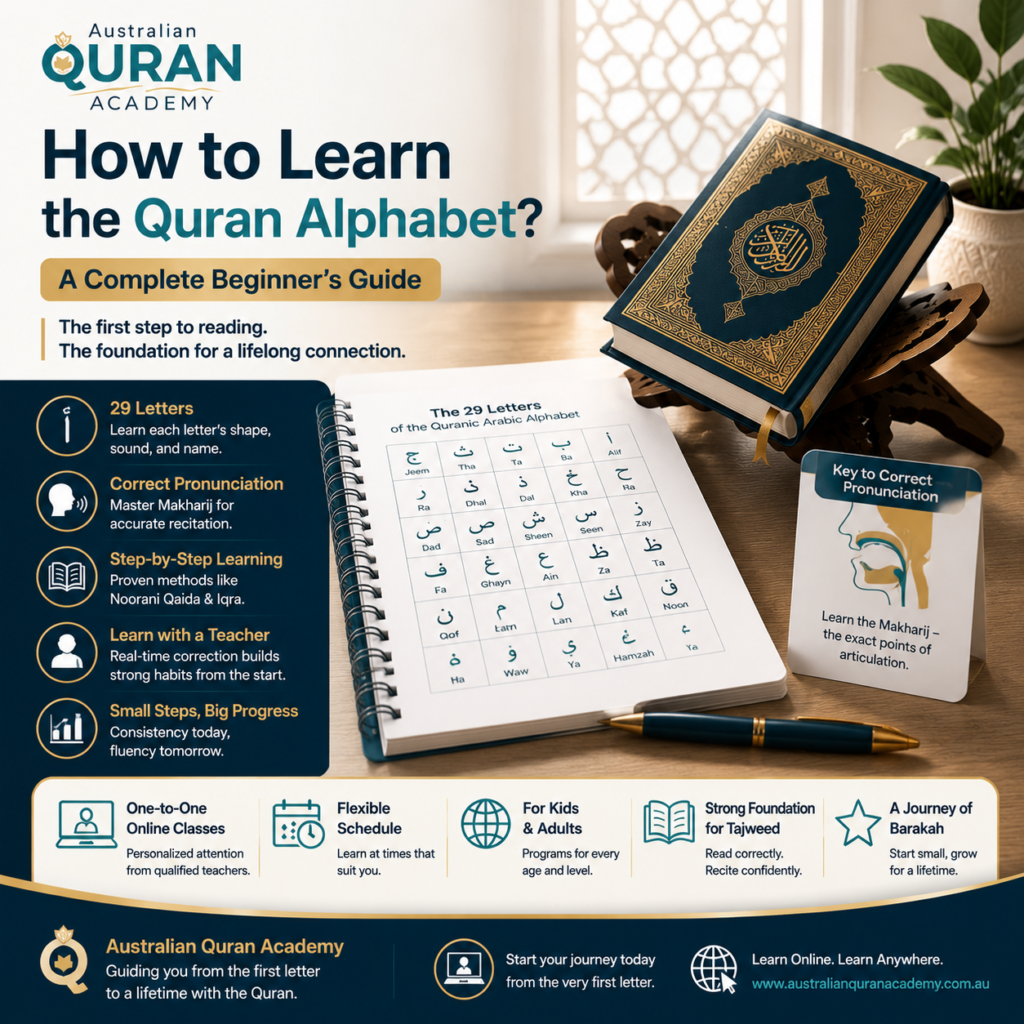
| The Quran alphabet has 29 letters, each with a distinct sound, name, and up to four writing forms. |
| Correct pronunciation depends on the Makharij — the exact articulation points — not on approximating sounds from English. |
| Most structured programs, including in Australia, use the Noorani Qaida or Iqra method to teach the alphabet in a fixed sequence. |
| The biggest beginner mistake is mispronouncing “close enough” letters rather than unfamiliar ones — this habit is harder to correct later. |
| A live teacher who corrects pronunciation in real time, whether in-person or online, is the fastest way to learn the Quran alphabet in Australia correctly. |
Every Quran journey starts in the same place: the Arabic alphabet. Before you can recite a single ayah with confidence, you need to know how to learn the Quran alphabet in Australia in a way that fits your schedule, your city, and your learning pace.
Whether you’re a parent looking for classes for your child or an adult beginner starting from scratch, this guide walks you through the letters, the common mistakes, and the best ways to get started locally or online.
Learning the Quran alphabet is not just about memorizing 29 shapes. It’s the first step toward correct recitation, proper Tajweed, and a real understanding of the Quran’s meaning.
This article covers what the alphabet includes, how it’s taught, and how you can learn the Quran alphabet in Australia through structured, guided classes.
Why Learning The Quran Alphabet Matters For Every Muslim?
The Quran alphabet is the foundation everything else is built on. You cannot read a word of the Quran, let alone recite it with Tajweed, until you know each letter’s shape, sound, and place of articulation.
This isn’t a technicality. A single mispronounced letter, or a short vowel read incorrectly, can change the meaning of a word entirely. That’s why every structured Quran program — including at Australian Quran Academy — starts new students at the alphabet stage before moving to words, verses, and full Surahs.
The Quran was revealed in Arabic, and reciting it as it was revealed is part of how Muslims connect with its message. Reading translations gives you the general meaning, but it strips away the exact wording, rhythm, and structure of the original text.
Once you can read the Arabic script directly, prayer and recitation stop being mechanical repetition.
Understanding what the letters form, word by word, is what allows a Muslim to move from reciting the Quran to genuinely reflecting on it.
The Link Between Arabic Letters And Correct Recitation
Correct recitation, known as Tajweed, depends entirely on knowing the Makharij — the exact points in the mouth and throat where each letter is produced. Letters like ح, خ, ع, and ق have no equivalent sound in English, which is exactly why guesswork leads to recurring mistakes.
A student who learns the alphabet properly the first time avoids having to unlearn bad habits later.
This is one of the clearest reasons people search for how to learn Quran alphabet in Australia rather than trying to self-teach from apps or videos alone — pronunciation needs a teacher who can hear and correct you in real time.
Many students who want to build this connection also start with Learn Quran for Beginners in Australia, which structures the alphabet stage as the first unit of a full beginner’s course rather than an isolated lesson.
Read Also: best country to learn quran
How to Learn the Quran Alphabet?
Australia has genuine options for this stage of learning, whether you want in-person instruction or the flexibility of studying from home.
What matters most isn’t the format — it’s whether the teacher corrects your pronunciation letter by letter, rather than moving you forward before you’re ready.
Face-to-face classes in cities like Sydney and Melbourne suit families who want a classroom routine and direct supervision.
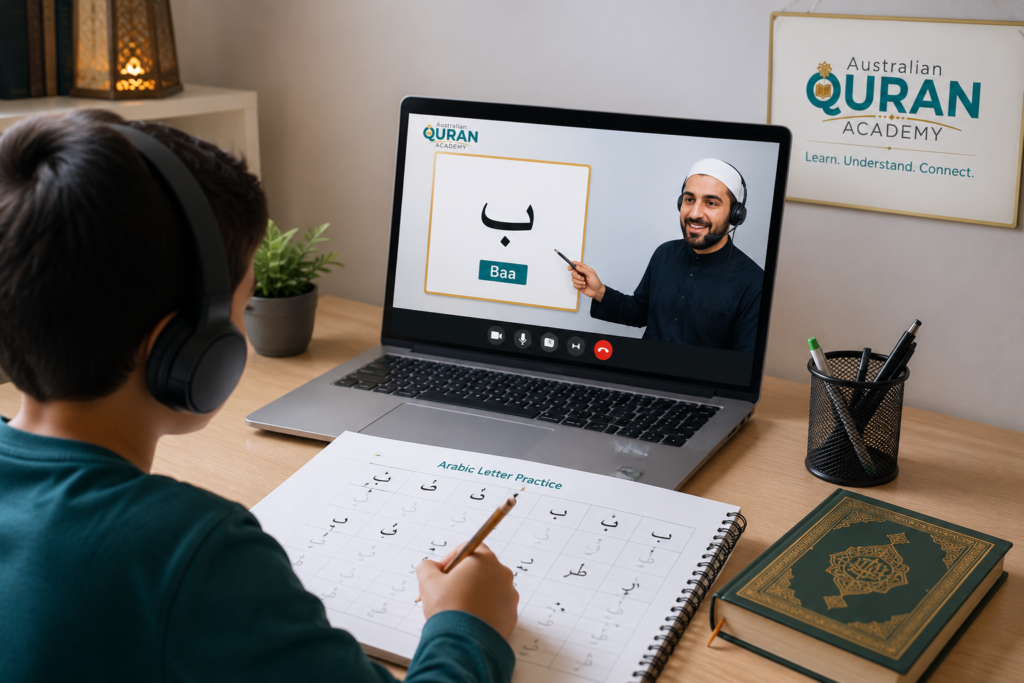
Online classes suit anyone balancing work, study, or a location outside a major city, since a live tutor can still hear and correct your pronunciation over video in real time — the same way they would in person.
If you’re teaching a young child, a dedicated program built around shorter attention spans and repetition works better than a general adult curriculum. Arabic Lessons for Kindergarten in Australia is built specifically for this early stage.
For adults starting with no prior Arabic background, Learning Arabic for Non-Arabic Speakers in Australia covers the alphabet as the entry point into reading, not just speaking, Arabic.
See Us in Action!
Curious about what our online classrooms look like? Watch the short clips below to see how our interactive, one-on-one sessions bring learning to life with real-time feedback and engaging teaching methods.
Start Your Quranic Journey in Australia
Join our leading online academy and learn with expert tutors through a structured, personalized curriculum.
Book Your Free TrialThe Noorani Qaida And Iqra Method
Most structured programs in Australia and internationally use the Noorani Qaida or Iqra curriculum as the foundation for teaching the alphabet. These methods introduce letters individually, then in combinations, then with short vowels — building recitation skill in a fixed, tested sequence rather than an ad-hoc order.
The reason this method has stayed standard for decades is simple: it isolates one pronunciation challenge at a time instead of overwhelming a beginner with vowels, letter joins, and Tajweed rules all at once.
At Australian Quran Academy, this staged approach is exactly how new students begin, with a qualified teacher correcting pronunciation live rather than leaving it to self-study.
The 29 Letters of the Quranic Arabic Alphabet
The Quranic Arabic alphabet consists of 29 letters, with Hamzah (ء) usually taught as a separate unit because of its distinct pronunciation and writing rules.
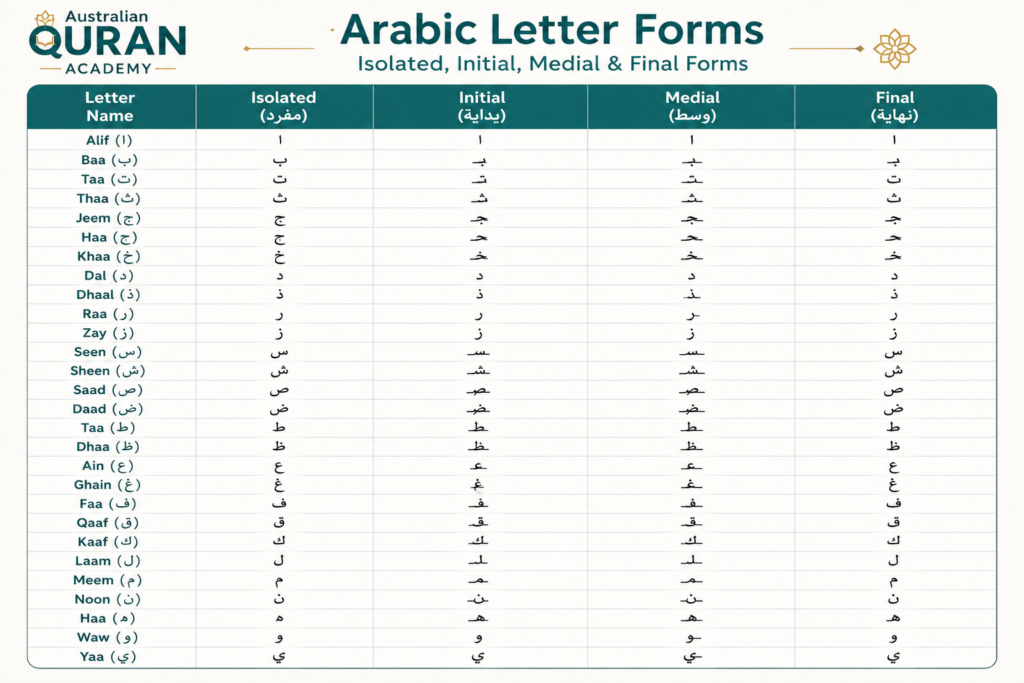
Each letter has a name, a sound, and up to four different written forms depending on its position in a word — isolated, initial, middle, or final.
Below is the full alphabet with simplified pronunciation guidance for beginners.
| Letter | Name | Approximate Sound | Writing Forms |
| ء | Hamzah | Glottal stop (like the break in “uh-oh”) | ء |
| ا | Alif | “aa” as in father | ا → ا → ـا → ـا |
| ب | Baa | b as in book | ب → بـ → ـبـ → ـب |
| ت | Taa | t as in table | ت → تـ → ـتـ → ـت |
| ث | Thaa | th as in think | ث → ثـ → ـثـ → ـث |
| ج | Jeem | j as in jump | ج → جـ → ـجـ → ـج |
| ح | Haa | Deep breathy h (no English equivalent) | ح → حـ → ـحـ → ـح |
| خ | Khaa | Throat sound, like Scottish “loch” | خ → خـ → ـخـ → ـخ |
| د | Daal | d as in door | د → د → ـد → ـد |
| ذ | Dhaal | th as in this | ذ → ذ → ـذ → ـذ |
| ر | Raa | Rolled r | ر → ر → ـر → ـر |
| ز | Zay | z as in zoo | ز → ز → ـز → ـز |
| س | Seen | s as in sun | س → سـ → ـسـ → ـس |
| ش | Sheen | sh as in ship | ش → شـ → ـشـ → ـش |
| ص | Saad | Heavy s (no exact English sound) | ص → صـ → ـصـ → ـص |
| ض | Daad | Heavy d (no exact English sound) | ض → ضـ → ـضـ → ـض |
| ط | Taa | Heavy t (no exact English sound) | ط → طـ → ـطـ → ـط |
| ظ | Zaa | Heavy dh/z (no exact English sound) | ظ → ظـ → ـظـ → ـظ |
| ع | Ain | Deep throat sound | ع → عـ → ـعـ → ـع |
| غ | Ghayn | Voiced throat sound | غ → غـ → ـغـ → ـغ |
| ف | Faa | f as in fish | ف → فـ → ـفـ → ـف |
| ق | Qaaf | Deep q (no exact English sound) | ق → قـ → ـقـ → ـق |
| ك | Kaaf | k as in kite | ك → كـ → ـكـ → ـك |
| ل | Laam | l as in lamp | ل → لـ → ـلـ → ـل |
| م | Meem | m as in moon | م → مـ → ـمـ → ـم |
| ن | Noon | n as in nose | ن → نـ → ـنـ → ـن |
| هـ | Haa | h as in house | هـ → هـ → ـهـ → ـه |
| و | Waaw | w, or long “oo” | و → و → ـو → ـو |
| ي | Yaa | y, or long “ee” | ي → يـ → ـيـ → ـي |
Common Mistakes Beginners Make And How To Avoid Them
Most beginners run into the same handful of problems, and knowing them in advance saves months of correction later.
- Confusing similar-looking letters, especially ب، ت، ث.
- Replacing throat and heavy letters (ح، خ، ع، ق، ص، ض) with the closest English sound instead of the correct Makhraj.
- Rushing through the alphabet before the shapes and sounds are automatic.
- Skipping daily revision, which causes letters to blur together again within weeks.
A practitioner note worth remembering: the letters that cause the most long-term recitation errors aren’t the unfamiliar-looking ones — they’re the letters that sound “close enough” to an English sound.
Students get comfortable with an approximate pronunciation early on, and that habit is far harder to correct once it’s set than learning an unfamiliar letter from scratch.
Read Also: how to learn the quran in Australia
Tips to Master the Quran Alphabet Quickly
Progress at this stage depends far more on consistency than on natural talent. A few habits make the biggest difference.
1. Practice Makharij Daily, Not Just Weekly
Articulation points are muscle memory. Ten minutes of daily letter practice, said aloud, builds accuracy faster than a single long session once a week — the mouth and throat need repeated use to produce heavy and throat letters correctly.
2. Learn Letters In Small Groups
Trying to master all 29 letters at once is a common beginner mistake. Learning them in small groups of three or four, with full mastery before moving on, reduces the mixing-up of similar letters like ب، ت، ث.
3. Get Corrected By A Qualified Teacher
Self-study tools can teach recognition, but they can’t hear your pronunciation. A teacher who listens to every letter you say and corrects it immediately is the single biggest factor in whether a beginner develops accurate habits or has to unlearn mistakes later.
This is the core reason structured programs remain the most reliable way to learn the Quran alphabet in Australia, rather than relying on apps alone.
Adult learners who want to combine the alphabet with a full grounding in Islamic knowledge often move on to Islamic Studies Courses for Adults in Australia once the alphabet and basic recitation are in place.
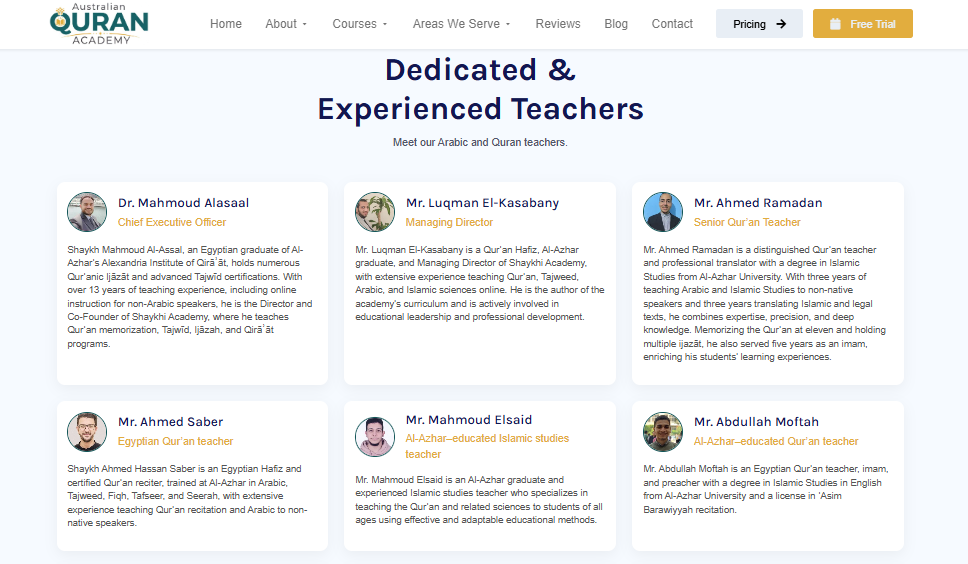
Inside Our Virtual Classrooms
We believe in full transparency and proven quality. Take a look at these actual snippets from our live classes to experience our modern learning platform, patient instructors, and interactive student participation.
Start Your Quranic Journey in Australia
Join our leading online academy and learn with expert tutors through a structured, personalized curriculum.
Book Your Free TrialStart Learning The Quran Alphabet With A Qualified Teacher Today
Getting the alphabet right the first time saves you months of correcting bad habits later. Australian Quran Academy offers structured, one-on-one classes that take you from your first letter through to confident recitation, with a qualified teacher listening and correcting you at every step.

Every course is built around live pronunciation correction, not pre-recorded lessons, so mistakes get fixed before they turn into habits.
Our Quran Courses:
- Quran Recitation Classes
- Quran Reading Classes
- Online Quran Classes for Kids
- Quran Classes for Adults
- Quran Classes for Female/Sisters
- Learn Quran for Beginners
- Quran Memorization (Hifz) Course
- Hifz Classes for Adults
- Quran Memorization and Hifz for Kids
- Quran Hifz for Ladies
- Quran Ijazah Program
- Quran Qirat Learning Course
- Quran Tafsir Course
- Noorani Qaida Course
- Noorani Qaida Course for Kids
Start Your Quranic Journey in Australia
Join our leading online academy and learn with expert tutors through a structured, personalized curriculum.
Book Your Free TrialConclusion
Learning the Quran alphabet is the first and most important step toward reading, reciting, and eventually memorizing the Quran with confidence.
The 29 letters, their correct pronunciation, and their writing forms form the base that every other skill — Tajweed, fluency, and understanding — is built on. Getting this stage right, with proper guidance rather than guesswork, is what determines how smoothly the rest of the journey goes.
For anyone in Australia looking for a clear, guided path, Quran Classes in Australia at Australian Quran Academy start exactly where every learner should: at the alphabet, with a qualified teacher correcting your pronunciation from lesson one.
If you’re ready to learn the Quran alphabet in Australia properly, structured one-on-one guidance is the fastest way to build a foundation that lasts.
Frequently Asked Questions
The following questions cover what beginners and parents most often ask before starting Quran alphabet lessons in Australia.
1. How long does it take to learn the Quran alphabet?
Most beginners learn to recognize and pronounce all 29 letters within four to eight weeks of consistent practice. The exact pace depends on how often you practice and whether you’re learning individually or as part of a class with fixed lesson time.
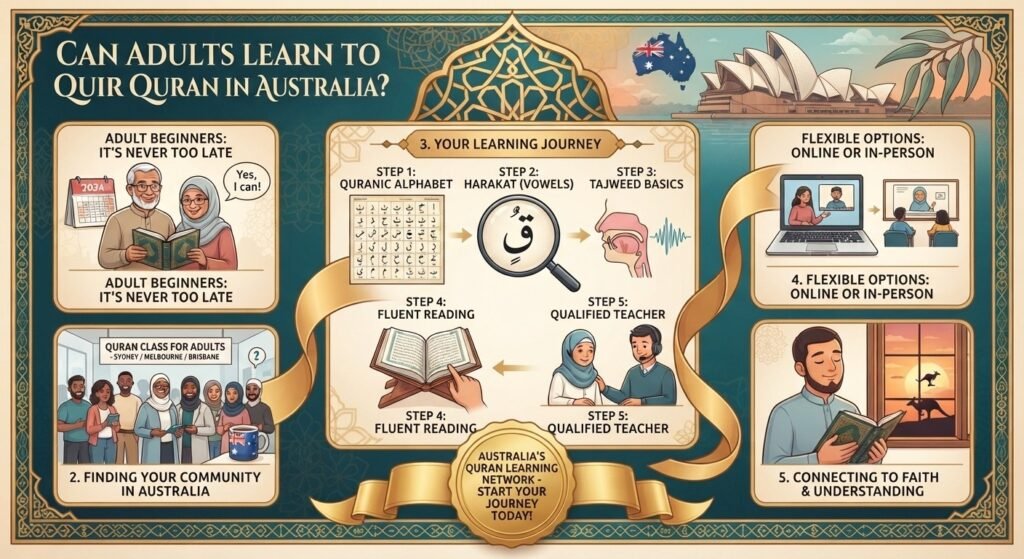
2. Can adults learn the Quran alphabet, or is it only for children?
Adults can learn the Quran alphabet at any age, and many programs are designed specifically for adult beginners with no prior Arabic background. Age has no bearing on the ability to learn correct pronunciation with consistent practice.
3. Do I need to learn Arabic grammar before the alphabet?
No, the alphabet always comes first. Grammar and vocabulary are built on top of alphabet knowledge, not the other way around, since you need to recognize and pronounce letters before you can read words or sentences.
4. Is online learning as effective as in-person classes for the alphabet?
Online learning is as effective as in-person classes when the lessons are one-on-one and live, since a tutor can still hear your pronunciation and correct you in real time over video. The key factor is direct teacher correction, not the physical setting.
5. What curriculum is used to teach the Quran alphabet?
Most structured programs use the Noorani Qaida or Iqra curriculum, which introduces letters individually before combining them with vowels and letter joins. This staged method is what most Quran alphabet courses in Australia and internationally are built on.

Leave a Reply